
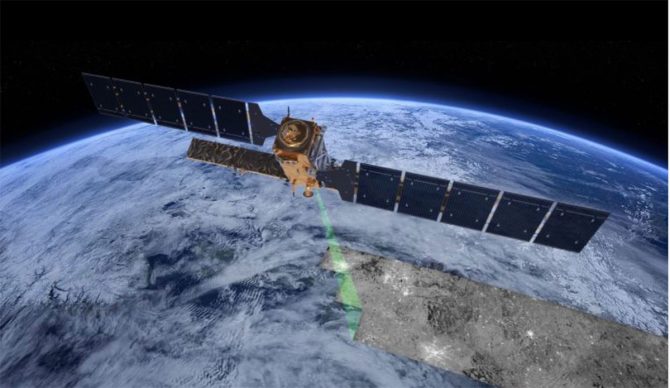
Nearly 100,000 seamounts have been mapped using the SWOT satellite. Photo: Seabed 2030//Instagram

Researchers recently devised a way to get a new higher resolution map of the ocean floor, and it shed a lot of light on what’s down there. Nearly 100,000 mountains that were previously unknown to us were revealed in the SWOT mission, and the details of that mission were recently published in the journal Science.
SWOT, an acronym for Surface Water and Ocean Topography, is a NASA-led mission that brings together U.S. and French oceanographers and hydrologists to try and get a better understanding of a place we know next to nothing about. According to NOAA, as of June 2024, 26.1 percent of the global seafloor had been mapped. To do so, high resolution sonar systems that are generally mounted to ships scan the murky depths. It’s a slog, though, because the ocean covers around 70 percent of the planet. But using the SWOT system, things are getting a little bit easier.
Using satellites, SWOT researchers are attempting to make the first-ever global survey of the surface water and the finer details of the bottom of the ocean as well.
“Satellites like SWOT cover about 90 percent of the Earth every 21 days,” Earth.com explained. “They don’t match the detail of sonar, but they make up for it with speed, scale, and frequency of observation.”
Even though we don’t spend much time down there, figuring out what the seafloor looks like is important work.
“Seafloor mapping is key in both established and emerging economic opportunities, including rare-mineral seabed mining, optimizing shipping routes, hazard detection, and seabed warfare operations,” said Nadya Vinogradova Shiffer in a NASA statement.
One hundred thousand mountains, though, is a lot of new information. Known as seamounts, they’re simply mountains that rise up from the seafloor but not quite high enough to break the surface. It’s tough to find them if they’re less about 3,000 feet tall.
But using the SWOT satellite, seamounts in the 1,500 range are visible.
“By zeroing in on tiny gravitational ‘bumps’ on the water’s surface, the data predict the position of these newly discovered peaks,” NASA wrote, “boosting known seamount counts from 44,000 to nearly 100,000.”
Interestingly, those bumps are caused by gravity. Seamounts have more mass than the plain old seafloor, so they pull gently on the ocean above them. Those deviations are found using satellites and allow researchers to mark where the mountains under them are.
“That tug creates tiny rises in the water’s surface, sometimes only a few centimeters high,” NASA researchers said. “The SWOT satellite detects those subtle changes and translates them into detailed maps that outline what’s below.”
Even with the best technology, complete sonar-based coverage of Earth’s ocean will still take time. However, satellite missions like SWOT will speed up progress and ensure more sections of the ocean floor are understood.

