
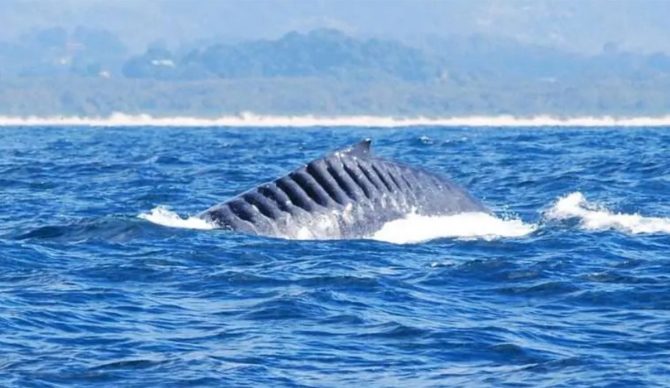
Despite her injuries, Bladerunner has survived. Photo: Peta Beeman//Creative Commons (CC0 1.0)

In 2001, a humpback whale was swimming off the coast of Sydney, Australia when she was hit by a boat. The propellor ripped into her back and tail fluke, leaving gaping wounds. Somehow, despite her enormous wounds, she survived. Because of her deep scars, she was given the name “Bladerunner.”
In the years since, Bladerunner has been spotted multiple times. Twelve years after she was torn apart, in 2013, she was seen swimming alongside a newborn calf, and has since become a symbol of resilience in the animal kingdom.
Her scars are a reminder of something that sadly happens all too often. An estimated 20,000 boat strikes happen every year, but that number is likely low, since many go unnoticed or unreported.
View this post on Instagram
“That could really spell potential extinction for some of these species,” said Chloe Robinson, director of whales for Ocean Wise, a Canadian organization that provided data for the paper published in the peer-reviewed journal Science.
Although severely injured, Bladerunner has continued to migrate along the Australian coastline. She was spotted most recently in 2023, off the coast of Eden, New South Wales.
Her story has served as a constant reminder of the need for marine conservation rules and enforcement, and researchers are continuing to track her movements in hopes that she can teach us how to better avoid boat strikes in the future.
“It’s bitter in the fact that it’s unfortunate the animal had to go through what it went through as a result of human activity,” NSW National Parks and Wildlife Service (NPWS) marine wildlife team leader Duane March told ABC News. “But sweet in the fact that it’s awesome the animal has healed and lived 20 years on and it’s still going about and doing its thing. It’s a real testament to the resilience of the animals.”

