
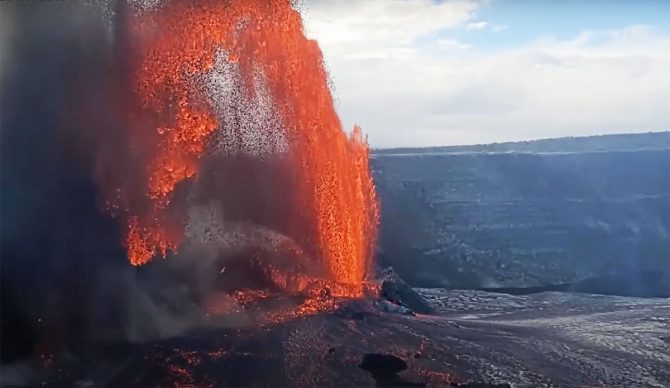
Fountains from the Kilauea Volcano exceeded 1,000 feet. Photo: YouTube//U.S. Geological Survey

Our planet is an extraordinary place full of extraordinary occurrences. Many of the most extraordinary can be devastating to our way of life, but that violence is part of what makes them so interesting. Things like landslides and tsunamis and volcanoes. The latter is what brings you here today.
The Big Island’s Kīlauea volcano is one of the world’s most active, and on December 23, 2024, the Halema‘uma‘u eruption began. On May 25, 2025, it spewed one of its most spectacular shows yet. For six hours, the volcano shot fountains of lava up to 1,000 feet in the air. This particular eruption is based in the summit caldera in the Halemaʻumaʻu crater, and it’s being compared to the Pu’u’ō’ō eruption that began in 1983 and didn’t stop until 2018. The earlier years of the Pu’u’ō’ō eruption were marked by huge lava fountains like the ones you see here, before slowing slightly as the pressure eased.
“The current eruption has been characterized by episodic fountaining not seen in any eruptions since the 1983-86 episodic fountains at the beginning of the Puʻuʻōʻō eruption,” the USGS wrote. “Fountains and lava flows have erupted from two vents within Halema’um’a’u crater that we refer to as the north vent and south vent. Each of the previous fountaining episodes lasted from a few hours to over a week and have been accompanied by strong deflation of the summit region. Pauses between the fountaining episodes have been marked by an immediate change from deflation to inflation as the magma chamber recharges and re-pressurizes.”
Since the start of the Halema‘uma‘u eruption, there have been 23 episodes. They are generally separated by pauses in activity, and while this current one has stopped for now, it is expected to start up again in early June.
There doesn’t appear to be much of a threat to life or structures at the moment — all the volcanic activity is in Hawaiʻi Volcanoes National Park — but nearby communities have been impacted by noxious gasses and Pele’s Hair, which is a volcanic glass fine enough to be blown around by the wind.

