
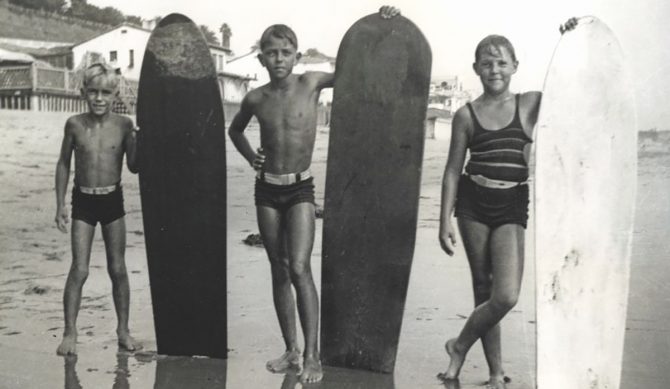
Joe Quigg, older brother Jack and buddy Anslie Moon. Photo: Quigg collection

Today, as I write this, 37-year-old father of two Jordy Smith is the top-ranked competitive surfer on the World Championship Tour. Besides Smith’s ascendence to pole position after 20 years on tour, the next biggest splash in contemporary professional surfing competition has been the return of 36-year-old, and father of three, Julian Wilson. Upon slipping back into his soggy jersey, he has been trouncing younger surfers in both the Challenger Series and World Championship events, just narrowly missing out on a win at the recent Gold Coast Pro. Oh, and there’s also the news that 53-year-old, and father of two, Kelly Slater has been given a wildcard berth in the upcoming CT event at Lower Trestles, site of his very first pro contest victory in 1990; Smith and Wilson were two years-old at the time, and besides Smith, none of today’s CT qualifiers — men or women — had even been born.
Now, judged by the disparity between the number of interested parties tuning into HBO’s 100 Foot Wave and those following the Championship Tour, it’s clear that competitive surfing and its fans are much too small a slice of the sport’s demographic by which to accurately gauge its current zeitgeist. Yet that anyone is surprised that dads are out there schooling the kids points to what I believe has been the most pervasive misconception our sport has ever labored under: that surfing is a youth sport.
This isn’t to imply that kids don’t surf. I’d bet that statistics would show that until very recently, most active surfers have tended to pick up the sport in their youth — between six years old and early teens. However, it’s pretty clear that somewhere along the surfing timeline, a false cultural narrative took shape: that surfing, in its essence, is a sport for the young. And to this I say, “Says who?”
As with virtually every other aspect of the study of history, it’s all about perception and presentation, and so far as surfing is concerned, history’s been pretty kind to grownup surfers. As prime example, let’s go back to the beginning. While no doubt Hawaiians George Freeth and Duke Kahanamoku, born in 1883 and 1890 respectively, learned to ride waves as children, by 1907, when first introduced to the world in renowned author Jack London’s magazine feature “A Royal Sport,” Freeth was 23 years-old; in 1915, Duke, already a world-famous Olympic swimmer, was 25 when popularizing surfing in California, and later introducing the sport to the U.S. East Coast and Australia. These two seminal figures, both prominently featured in some of the earliest visual depictions of this “royal sport,” personified its first archetype: highly-skilled, vastly experienced watermen. Emphasis on “men” deliberate: the average male lifespan in 1915 was 52, meaning that both George and Duke, when busy becoming our sport’s first surf stars, were already middle-aged.
Chronicling female surfing archetypes would be an entirely different story, these culturally courageous pioneers having been largely ignored for most of the 20th century — the sport’s Original Sin. That having been said, when perusing depictions of the first six decades of modern surfing history, you’re hard-pressed to find any photos or footage of anybody other than grown men riding waves. In fact, other than a photo of seven-year-old Joe Quigg, older brother Jack and buddy Anslie Moon, proudly posed with their wooden alaias on a Santa Monica Beach in 1932 (above), very few images or footage of serious grom-culture exists. For example, proto-filmmaker Bud Browne’s early 1950s surf movies (acknowledged as the sport’s very first) may have shown Island keikis playing around on paipo boards at “Walls” in Waikiki, but left no doubt that the real action was taking place out at spots like Makaha and along the North Shore, where the big guns were made of wood, and the men who rode them, of iron.
In 1958’s smash hit movie Gidget, the mainstream’s first, and perhaps most impactful exposure to California’s nascent surf culture, Gidget, at age 15, is the film’s only kid. Moondoggie, Gidget’s hotdoggin’ love interest, is at least a college junior, and “Kahoona,” the self-proclaimed “surf bum’, but in fact a slumming aerospace engineer, is practically ancient; the rest of the Malibu surf crew portrayed not as free-spirited gremmies, but a lazy pack of free-loading bindlestiffs. No youth vibe there.
Granted, those early wooden boards were heavy and hard to handle, making surfing back then quite literally a difficult sport for youngsters to pick up. Yet even when they did, they were never considered in the vanguard, but primarily as precocious puppies snapping at the heels of the big dogs. Sure, 15-year-old Linda Benson got a photo in 1960’s first issue of John Severson’s The Surfer, and in his 1963 film The Angry Sea, the 14-year-old phenom Jeff Hakman made appearances riding Haleiwa, Sunset and Waimea, but both mighty tykes highlighted more as anomalies among the period’s more relevant “veterans,” most typically in their mid-twenties.
This tone of presentation was borne out as the 1960s progressed. In a 1965 issue of SURFER magazine, for example, although including a brief feature covering a 12-and-under “menehune contest” (the open division won by young Margo Godfrey), there’s practically no products marketed to, nor endorsed by, anyone under the legal drinking age. International Surfing magazine’s coverage of 1967’s USSA competitive rankings, despite including junior and junior boy’s, focused almost entirely on the vaulted men’s division, open to surfers between 18 and 34 years old. Only one of the top-10 finishers was in his teens, with most in their mid-to late-twenties. And 1968’s SURFER magazine Readers Poll, again prominently featuring only the men’s result, included only a single teen in the top 10: 18-year-old Dru Harrison. By contrast, Skip Frye and Mike Doyle, finishing second and ninth respectively, were veritable silverbacks at age 27; even winner Corky Carroll was 21.
Keep in mind that a 21-year-old in 1968 was a lot older than a 21-year-old in 2025, an assertion backed up by available statistics. Sociological studies show that in 1968 over 60 percent of young people had, by age 18, already moved away from home — probably a much higher percentage if we’re talking about typical surfers. But in 2025, the average age for leaving the nest jumps up to age 24, a significant difference, in terms of emotional development. Put another way, this means that by the time 24-year-old Steve Bigler placed fifth in ‘68’s poll, he’d already been out in the world and making it on his own for six years. Practically all grown up.
This contrast was even more evident in the late-60s-early-70s. Consider characters presented as archetypes in 1972’s classic film Five Summer Stories, surfers like Gerry Lopez, Barry Kanaiaupuni, Terry Fitzgerald, all in their early-20s, were also professional board-builders with orders to fill and bills to pay. Now compare this sort of maturity to the brat pack presented two decades later in Taylor Steele’s Momentum, most of similar age to their predecessors, but more apt to be found playing on Benji Weatherley’s backyard trampoline post-session than, after ripping Sunset or Pipeline, heading off to clock in at the shaping room, before (in BK’s case, at least) having to go pick the kid up from daycare.
Small wonder that as late as the mid-1970s, with the exception of the proliferation of new urethane skateboard wheels, the existing surf media didn’t contain much content aimed specifically at a youth market, choosing rather to present the sport more as lifestyle than trend; more of a continuing journey toward eventual fulfillment (read: surfing perfect, empty waves). Put simply, in 1976, a surfer was a surfer.
All that changed with the meteoric growth of the surfwear industry in the early 1980s. Suddenly surfers weren’t just surfers, content with their choices of surfboards, wetsuits, trunks, t-shirts and wax sold to them in a manner unchanged for decades, but a collective who in its ranks existed a previously untapped market — younger surfers, naturally more susceptible to pandering by surfwear companies who realized that the surest way to create brand loyalty was to foster division within those ranks. Not that they were the bad guys, exactly — virtually every major surf brand was founded by a hardcore, lifelong surfer. But in the midst of a booming fashion market, selling “rebellious youth” has always been easy, and profit-wise certainly more expeditious than “stick with us, we’re with you for the whole ride.” They just lost the plot of the long game. So, for the very first time, surfers were being encouraged to rebel not against the establishment, but against surfers older than themselves — in some cases just a few years older — the best way of doing this being to align with a particular brand whose marketing efforts were aimed specifically at their particular age group.
Divide and conquer is an old story, but conquer they did, the Big Five surfwear brands. For quite a while, long enough to have firmly settled into surfing’s consciousness an erroneous perception that have many still insisting surfing is a youth sport. Oh yeah, it’s still here, all these years later, despite the many cultural indications to the otherwise. It’s why you read about renowned, middle-aged surfboard designers deriding their wildly popular mid-lengths, more vigorously promoting the “shortboards” they claim will allow their grownup customers to surf the way they did when they were 18. Why adult learners are often discouraged and even scorned by more experienced surfers, many who’ve apparently forgotten that they’re probably older than anyone else in the water. And it’s why in some circles – so-called “youth-oriented” surf sites mostly – surprise is expressed at the circumstance of Jordy, Julian and Kelly dominating a much younger competitive field, as if years of experience, exemplary fitness and emotional maturity should be no match for the fast-burning flame of youth.
Viewed in its most modern incarnation it should be plain to see that surfing is not now, nor has it ever been, exclusively a youth sport. If anything, it’s a life sport, with the excitement and wonder of those early years growing steadily, incrementally, swell by swell, season after season, wave after wave, into the satisfaction and fulfillment of the later years.
Don’t take my word for it. Let’s go back to the beginning…or at least the 1930s, when Tom Blake, our sport’s first lifestyle influencer, wrote of 40-year-old Duke Kahanamoku’s return to the surf after a prolonged layoff:
“I remember the day in 1930 when Duke caught the big swells at Kalahuewehe with is new long, hollow board. The first big swell he caught went to his head like wine. He yelled and shouted at the top of his voice as he rode in. He was happy. It put new life into him and ever since his attitude towards surf-riding has been as keen as when he was a boy. I believe Duke attained his greatest surfing satisfaction, and some of his greatest achievements as a rider, after his 40th year.”
Hear that, kids?

