
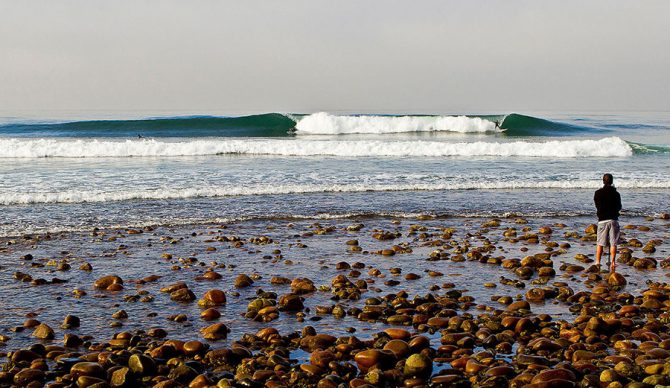
Sand is an issue at Southern California’s best performance wave. Photo: WSL

The longtime local battle to save Trestles has suddenly been thrust into international discourse following the announcement that the Southern California beach will host surfing at the Los Angeles 2028 Olympics. AFP, one of the big three newswires, delved into the topic, triggering calls for the International Olympic Committee (IOC) to step in and solve Trestles’ sand issues.
AFP’s story highlighted efforts by Save Our Beaches San Clemente (SOBSC) and the Surfrider Foundation to combat the ongoing loss of sand at Trestles. Suzie Whitelaw, president of SOBSC, told AFP that the beach at Trestles has shrunk by about 30 feet in width over the last 10 years due to inland human development, such as dams. San Clemente City Council director Andy Hall added that the Dana Point Harbor, just eight miles north, also plays a big factor in impeding the natural flow of sand.
The City of San Clemente has poured more than 190,000 cubic meters of sand to offset the loss of beaches, forecasting that another 2.3 million cubic meters will be needed over the next half century.
Kanoa Igarashi, the Tokyo 2020 Olympic silver medalist, currently ranked third on the WSL Championship Tour, also provided his thoughts on the matter, telling AFP that he’s noticed a slight change in the wave at Trestles due to erosion. He called on the IOC to leverage its resources to protect the Olympic venue.
“I trust the Olympics that they’re going to preserve it and not only just preserve it, but make it better,” said Igarashi.
SOBSC also sees the Olympics as a rallying point to bring about action. “The Olympics is a once in a lifetime thing,” said Julian Husbands, a group member. “So hopefully we can use that to compel more folks to understand ‘Okay, we’ve created this problem and we can fix it.'”
AFP’s story caused the leading Olympic media outlet, Inside the Games (ITG), to openly ponder if the IOC will take action.
“Targeting the IOC could help push LA28 organizers to take more responsibility and include sand replenishment in their sustainability strategy and legacy programs,” wrote ITG journalist Gretelle Jimenez. “However, according to AFP, for now, organizers are simply ensuring that the venue comes up to scratch, ruling out investment beyond that.”
Jimenez is referencing vague comments made by LA28 chairman Casey Wasserman, who told AFP that they are focused on ensuring the venue is serviceable for the Olympics, avoiding any further promises of support.
“There’s lots of talk about the shorelines, but Olympic surfing is going to be great at Trestles and that’s our job,” said Wasserman. “We want to make sure that we have the best competition for the greatest athletes and Trestles is going to provide that.”
SOBSC and Surfrider advocate for nature-based solutions to combat coastal erosion instead of rock and concrete structures that have widely been used to armor coastlines in the area. (Read The Inertia’s interview on erosion solutions with Surfrider CEO Chad Nelsen here.) Recently, the WSL and Surfrider partnered to remove non-native flora, like ice plant, to restore the natural ecosystem and reduce erosion.
Hall notes that solutions to coastal erosion are not so cut and dry, underlining that haphazardly adding sand at Trestles could alter the wave or adversely affect the coastal wetlands. SOBSC recommends adding more sand to San Clemente State Beach and North Beach, which lie north of Trestles.
Trestles has long been a focal point for campaigns opposing developments that threaten the region’s ecosystem and wave quality. Activists previously halted multiple attempts to build a toll road that, they argued, would have damaged the watershed feeding into Trestles.

