
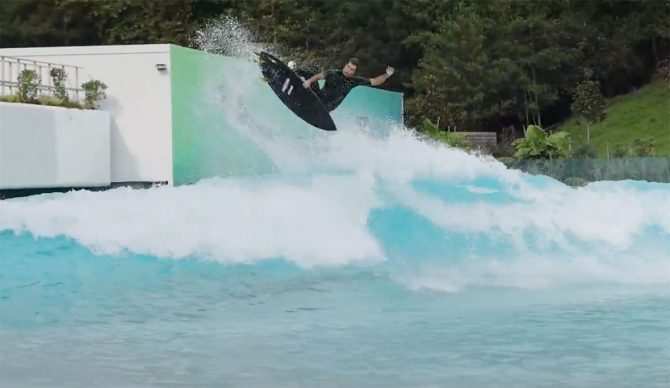
When you’re designing your own waves at a wave pool research facility, you think air only. Mateus Herdy at the Wavegarden lab. Photo: YouTube//Screenshot

Be honest: Have you ever done an aerial? Myself, I have not. Even though aerials have been on my radar, right from their genesis. Adjacent, you might say.
I was there at the 1981 Stubbies East Coast Trials, when eventual winner Matt Kechele pulled off the first legitimate “chop hop” in competition. Surfing Four-Mile, north of Santa Cruz, right around the same time, watching Kevin Reed lofting even higher versions…and on a four-fin, no less. Living in Santa Barbara in 1983, when along with the rest of the Channel Islands crew I watched goofy-phenom Davey Smith virtually give up conventional surfing in pursuit of the first documented above-the-lip air; working at SURFING magazine in San Clemente, mid-eighties, stopping on the way down to Lowers to see Potts and Archy freeing their fins over oncoming T-Street close-out sections, then out at Lowers lefts, witnessing Christian Fletcher’s very first integrated, mid-ride, above-the-lip airs. Looking back on surfing’s history of flight, those years were a wild time, giving one the impression that at the current state of progression, we’d all soon be taking to the air. And then…
Then…well, surfing pretty much went about its way, business as usual — for the most part, surfers of all skill levels simply kept their boards, and their minds, on the wave ahead of them. Look no further than the pervasive trends over the decades since: modern longboards, surf forecasting, surf resorts, women’s surfing, surf schools, not-so-modern longboards, WaveStorms, “alternative” designs and mid-lengths. But aerials? Outside of the rarified environs of professional competition and sponsored “freesurfing,” they never really took off; even today’s average good surfer willing to commit to mastering the move, could only hope to approximate the aerials Christian was boosting over 35 years ago. Hardly what I’d call progression.
This being the case, why does it seem that when virtually every week a new, prospective wave pool (surfing’s trendiest trend) drops its debut YouTube promo vid, so much of the marketing energy is geared toward touting the pool’s “greatest air section!”? It’s a curious sales pitch, when you consider that a multi-million-dollar, exotic surf charter/resort industry is currently thriving by offering clients merely the prospect of riding waves of a type absolutely guaranteed on a trip to the oft-derided Surf Ranch, which, for most folk, is still the embodiment of “the perfect wave.” Yet, when it comes to man-made waves, from the looks and tone of those many YouTube videos, all the excitement seems generated by the pool’s awesome air section.
But ask yourself, have you ever, throughout your entire surfing life, personally seen anyone do a “Stalefish flipper” backflip? Do you ever imagine yourself even attempting one? While watching all the promotional footage of these chlorinated trampoline parks, in your mind’s eye, how do you see yourself surfing should you find yourself on one of those tightly-compressed, big-finish shorebreak sections? Like Menehune Mason Ho? That’s a tall order, when you realize that pros like Mason and all those other high-flying aquatic acrobats aren’t paying for their allotment of waves, and can afford to squander the resource with experimentation.
This isn’t to say that there might not be plenty of surfers out there willing to commit a lot of time, money and public humiliation necessary to learn how to do an aerial — any sort of aerial, let alone achieving the mastery required to authoritatively debate the merits distinguishing a single from a double-grab — in a wave pool. Then, after spending, let’s say, at least a summer (and as much dinero on a trip to Salina Cruz) getting even the most modest air reasonably wired, return to their local ocean surf spot and commit a good portion of their precious surf time looking for that perfect close-out end section on which to display their new-found skill set.
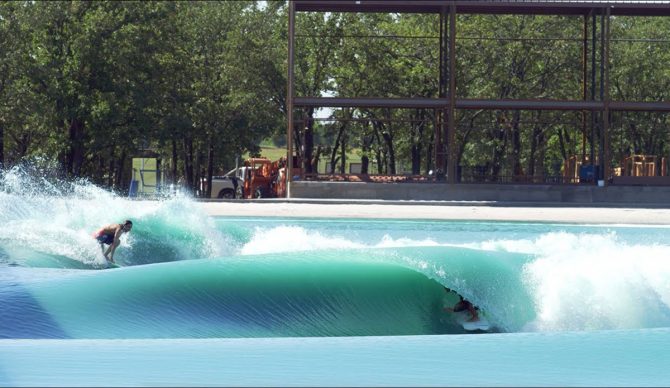
But what about the tube? Photo: Wavegarden
Sound like anyone you know? Because these are the customers so many of these new pool projects are banking on, or else why would their marketing lean so heavily on the “air section?” The baby-tube sections? Sure, if you’re under 5’5” and do a lot of yoga. The beginner and intermediate wave setting? Set the dial on crumble and you have a new wave version of Disney’s Typhoon Lagoon — hardly a sexy selling point. No, in terms of promotion and perception, not to mention irony, the rallying cry seems to be “Everybody out of the pool!”
Which is weird, when you think about it, considering how few surfers are obsessed with doing aerials — and make no mistake, repetitive practice in a pool setting (think competitive swimming and springboard diving) demands obsession. Not the sort of experience most surfers are looking for when paddling out “free range.” And then there’s the relationship side of things. An aerial quite literally separates the surfer from the wave, fostering a relationship where the wave doesn’t exist in its own form, but merely to serve the need of the surfer. This eliminates any element of the mystery that enlivens all good love affairs, replacing the ephemeral thrill of communion with a primal, altogether natural energy source — the very appeal that has made surfing unique among all other sports — with jumping off a ramp. Might as well be riding BMX.
Okay, now I’m proselytizing. Fact is, surfers have always loved tricks. Headstands, tandem rides, spinners, hang-tens, fin-firsts, 360s — there have always been plenty of fun ways to show off. But when was the last time you risked a good wave doing any of these? They’re still out there, still a fun way to show off. Then again, how much is showing off an integral element of your wave-riding repertoire? If it is, then maybe there really is one of these new wave pool memberships in your future. For the rest of us, however, it’s pretty clear that keeping our boards, and our minds, on the wave ahead will continue to be enough.

