
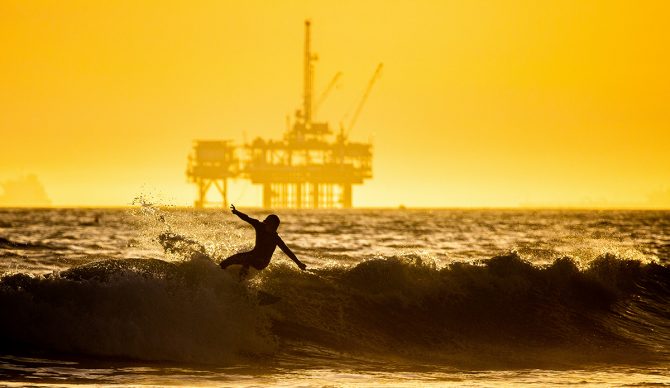
According to statistics, offshore drilling is in decline in regions like the Gulf of Mexico. So why do we need more? And in places like California (pictured) we’re still cleaning up from oil spills. Photo: Unsplash

Environmentalists have rung the alarm about ocean drilling provisions in the Trump administration’s “Big Beautiful Bill.” While public outrage and political interests led Republicans to scrap plans to sell off public lands, Congress quietly passed conditions to open millions of acres of ocean to oil drilling.
Pete Stauffer, the Ocean Protection Manager at Surfrider Foundation, told The Inertia that “every American should be outraged” by the risk these provisions pose to the ocean. He called it the “largest fossil fuel giveaway in U.S. history.”
The provisions that passed with the bill mandate at least 30 lease sales for oil drilling in the Gulf of Mexico over a 15-year period, each totaling at least 80 million acres. It also calls for six lease sales of at least one million acres each for drilling in Alaska’s Cook Inlet over a 10-year period.
Aside from the new drilling zones, Stauffer highlighted other provisions in the bill that weaken environmental protections, such as subsidies for offshore drilling, pay-to-play privileges for polluters, and funding cuts to climate, coastal resilience, endangered species, and the National Oceanic and Atmospheric Administration.
“Public lands and waters belong to all Americans,” said Stauffer. “When you have a bill that gives away public resources to an industry that has a terrible track record of oil spills, equipment failures, and harm to recreation and public health, everyone loses.”
According to Stauffer, the ocean provisions appear to have been drafted based on financial accounting with little understanding of offshore drilling, in a misguided attempt to offset the bill’s high costs. The 30 mandated leases in the Gulf would cover more area than the entire body of water – a contradiction that remains unexplained. Meanwhile, oil companies already own leases to large portions of the Gulf that they have left unexploited. Additionally, offshore drilling in the Gulf is already in decline: Only 10 rigs are currently operating, half the number from a year ago. Analysts attribute the drop-off to supply chain issues, rising costs, a shift toward more affordable onshore drilling, and industry consolidation.
Stauffer warns that more offshore drilling will result in more oil spills, more pollution, and more extreme weather disasters. He also underscores that once a lease is sold, it can be held in perpetuity before the owner decides to drill. The lasting effects of drilling in California serve as a cautionary tale.
“The last time new offshore oil leases were approved in California was the early 1980s, and we’re still having oil spills,” said Stauffer. “We’re still trying to stop new drilling through the pipeline that caused the oil spill off Santa Barbara years ago. There still isn’t a plan for decommissioning. Federal agencies aren’t compelling the oil companies to clean up their mess and get the infrastructure out of the water. Once a lease sale happens, the impact is generational.”
Due to the haphazard creation of these provisions, there are many unknowns as to how the drilling leases will play out. Stauffer acknowledges that, despite the drilling mandates, there is a chance market conditions dictate a shift to renewables and clean energy due to the relative costs of offshore production versus other sources of energy. However, he emphasizes the glaring issue that oil companies can sit on these leases indefinitely and drill when they see fit.
A further concern with the drilling lease mandates is they bypass existing law, which requires a public process including environmental impact studies and comment periods.
“The Department of Interior’s five-year plan process provides a framework for the government to evaluate trade-offs of the potential benefits and drawbacks of more offshore drilling as it relates to the environment and the economy,” Stauffer explained. “All that goes out the window.”
The Trump administration is concurrently mapping out its five-year plan proposal, in addition to the leases mandated in the “Big Beautiful Bill.” Stauffer expects that this plan will include more bad news with proposals to drill in areas that have long been off-limits, such as the Atlantic coast, the Pacific coast, and, ironically, the Gulf coast.
While Surfrider is gearing up to oppose future drilling through public engagement in the five-year planning process, combatting the mandates in the “Big Beautiful Bill” will be difficult given they have already been signed into law. However, Stauffer says Surfrider will act and influence where it can. Earlier this year, the organization took legal action against the Trump administration for an executive order that reversed drilling prohibitions established during the Biden administration.
“It’s about public resources, the health of our environment, and the health of our communities,” said Stauffer. “Every American should be outraged, whether or not you live on the Gulf Coast.”

