
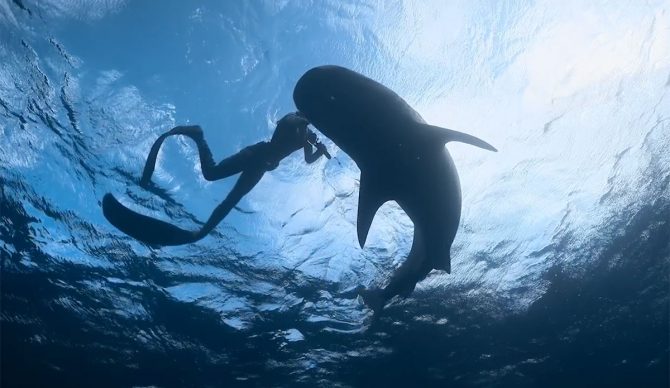
Netflix’s “Shark Whisperer” has attracted the ire of many, and the attention of more. Photo: Netflix//Screenshot

Time magazine has published an op-ed after the new Netflix documentary, Shark Whisperer, was released. Written by Kaniela Ing, a Maui-born former state legislator and National Director of the Green New Deal Network, “‘Shark Whisperer’ Villainizes Native Hawaiians Like Me” accuses the show of reducing Native Hawaiians — lawmakers, kūpuna (elders), and local researchers — to mere obstacles.
“I only found out about the new Netflix documentary Shark Whisperer because my social media notifications exploded,” Ing began. “I had been tagged in posts by people calling me anti-shark and anti-environment. I was confused, until I watched the film. There I was, portrayed as the antagonist.”
Shark Whisperer, which focuses on Ocean Ramsey’s compelling story of a lifetime dedicated to shark activism, aired on Netflix at the end of June. As is generally the case with anything shark-related, it faced harsh criticism from both sides. Ramsey’s approach to sharks — which I was lucky enough to see firsthand — is literally hands on, and critics worry that she may be putting herself, the sharks, and others at risk for the sake of attention. Attention, however, is part of Ramsey’s goal, so it’s a bit of a double-edged sword. But Shark Whisperer, according to Ing, creates a savior and a villain storyline that doesn’t help anything.
“We are either tokenized or vilified, while a single outsider (in this case, social media activist Ocean Ramsey) is framed as the story’s savior,” Ing continued. “This isn’t just a misrepresentation. It reflects a deeper pattern in the way mainstream documentaries often frame their stories: who is cast as the subject, and who is cast as the object. Whose knowledge is celebrated, and whose is pushed aside.”
Ing served as Chair of Hawaii’s House Committee on Ocean, Marine Resources and Hawaiian Affairs, which was featured in the documentary. In it, they held hearings on legislation that covered shark protection, and the members were cast in a dark light. Ing took issue with that.
“What the film doesn’t show is that I was one the earliest and strongest champions of the bill that banned shark fishing,” he wrote. “I called for a hearing when others hesitated. I moved the bill to a vote despite resistance from House leadership. I worked hard to secure the support needed to pass it.”
In Ing’s view, Shark Whisperer misses the mark. Instead of viewing sharks as something sacred, it views them as something we need to hold dominion over.
“Shark Whisperer claims to honor marine life, but it often confuses reverence with control,” he writes. “It reduces wild, sacred beings to characters in a human-centered story, mistaking closeness for connection.”
Ing grew up in the ocean off Maui, freediving and spearfishing. He routinely encountered sharks, and he sees them as aumākua, a family guardian.
“These weren’t adrenaline-fueled stunts,” he remembered. “They were sacred moments. In our tradition, the shark is not something to be humanized or monetized… We do not stalk them, name them, or treat them like pets. We show respect. We let the manō come to us. But in our culture, true respect often means keeping a sacred distance. Not everything powerful needs to be tamed. Every creature holds its own essence and role in the web of life, whether or not it reflects us. To honor them is to let go of the need to dominate or display, and simply let them be.”
Ing worries that Shark Whisperer, aired on a global platform like Netflix, will lead to a worse outcome overall for sharks. He doubts Ramsey’s methods, preferring to yield to the generational knowledge passed down through families of Native Hawaiians who have revered sharks.
“With an even larger platform, her example risks being imitated. And if others will mimic her tactics, our voices, the ones rooted in generations of lived experience and cultural knowledge, may be drowned out,” he wrote. “The truth is, Kānaka Maoli (Native Hawaiian) ocean protectors have been doing this work for generations. They’ve done it with fewer followers, without sponsorships or stunts, and without turning our aumākua into content or cash. Our true Kahu Manō (shark whisperers) may never get a documentary deal or millions of views, but they carry the knowledge that sustains life in our waters and our communities. They are who we turn to. They are who we trust.”

