
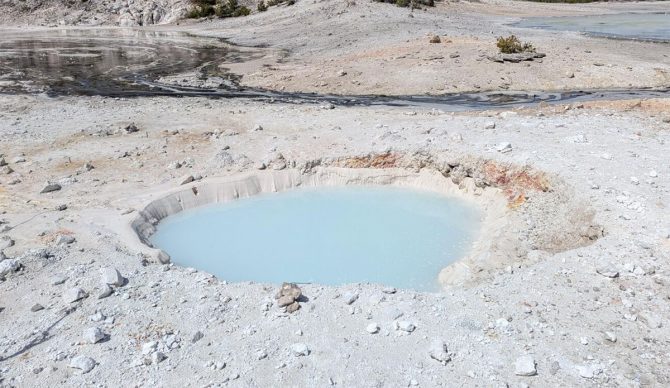
The new water feature at Yellowstone is hotter than a hot tub. Photo: USGS

In April, geologists from the USGS discovered something new in Yellowstone National Park: a massive new hole in the ground that’s filled with steaming hot water. Researchers believe that it was formed by a hydrothermal explosion.
Sitting in a subbasin of the Norris Geyser Basin, just west of a little patch of vegetation called Tree Island, the new hole is filled to the brim with chalky blue water that is hotter than most hot tubs. The temperature of it hovers around 109°F, while most hot tubs are between 100°F and 104°F. The rim of the hole is covered in rocks and dust, which scientists believe is evidence of the explosion that created it. The Norris Geyer Basin is a literal hotbed in terms of hydrothermal activity, so that’s not a huge revelation.
“That there might have been a hydrothermal explosion at Norris Geyser Basin is not surprising, given that the thermal basin has been the site of numerous such events,” the USGS wrote. “Some, like a crater in The Gap subbasin, probably occurred before people were documenting the area and have an unknown age. Others, like the 1989 explosion of Porkchop Geyser, were well observed. And thanks to a new monitoring station installed in September 2023, explosions can now be detected by geophysical data, including an explosion in the Porcelain Terrace area in April 15, 2024, that left a crater a few meters (several feet) across.”
These hydrothermal explosions are caused when hot water within a volcano’s hydrothermal system flashes to steam, breaking rocks and throwing them into the air.
The USGS used a variety of tools to figure out when, exactly, this hole opened up. With satellite imagery showing before and after snapshots, they were able to narrow it down to somewhere between late December and the beginning of January.
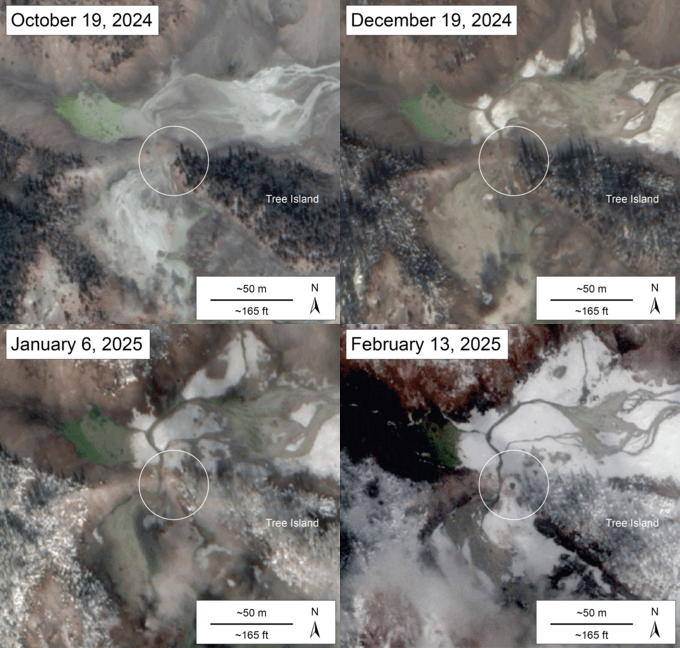
The new hole at Yellowstone was caused by a hydrothermal explosion. Image: USGS
By the middle of February, the hole was as big as it would get, and the hot water had filled it nearly to the brim. As it was forming, monitoring stations were picking up acoustic signals that indicated activity that is normal during hydrothermal explosions. When they put all the data together, they found that it is likely the new Yellowstone feature began to take shape on Christmas Day.
“The latest new thermal feature in Norris Geyser Basin—perhaps the most dynamic area in Yellowstone National Park—demonstrates the spectrum of ways in which hydrothermal features evolve,” scientists explained. “Some form during brief and violent episodes of change. Others may take shape far more gradually, like the new feature found near Tree Island that seems to have begun taking shape on Christmas 2024.”

