
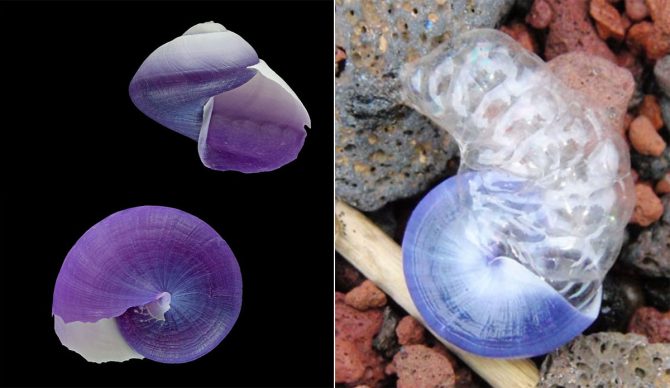
The Janthina sea snail is a pretty little thing that spends most of its time floating on the surface of the ocean. Photos: Wikimedia Commons

The ocean is a many splendored thing, and some of its rarer splendors recently washed up on the beaches of San Diego. The Janthina sea snail, a pretty purple little thing, is a rare species that’s known for its vibrant purple shell and an interesting evolutionary trait that allows them to float on the surface of the ocean.
The Janthina is generally found in warm, tropical waters, where it floats placidly along thanks to its ability to trap air bubbles at the surface of the ocean. They then secrete something called amphiphilic mucin, which helps to keep the air bubbles in place, essentially creating what’s often referred to as a “bubble raft.” Their shells are incredibly thin, so they’re able to float upside down as they drift around at the mercy of the currents and winds, feeding on by-the-wind sailors, also known as Velella velella, and the much-feared Portuguese man o’ war.
When scientists at San Diego’s Scripps Institution of Oceanography noticed that a pile of little purple sea snails were littering La Jolla Shores, they were excited.
“When I saw it on the beach, I instantly knew what it was, but I was in complete shock,” Anya Stajner, a fifth-year doctoral student at Scripps, told The LA Times. “I would never expect to see one washed up in San Diego. The odds of that are so slim.”
According to reports, this is the first time in 10 years that Janthina snails have been found on beaches in the area, and researchers have a theory about why they’re around: the warming waters.
“The day that I found my specimens, the water was notably warm,” Stajner said. “I remember when it washed up on my feet, I was like, ‘Whoa, this is hot’…. If these warm waters continue, we will want to see if we have any more of these violet snails washing ashore.”
Beachgoers who find any Janthina snails on Southern California beaches are being urged to take photos and send the pictures to Scripps. On certain beaches, however, taking a photo is all that’s allowed. Some of them are designated as “no take areas,” which means the public isn’t allowed to collect any pretty little purple sea shells.

