
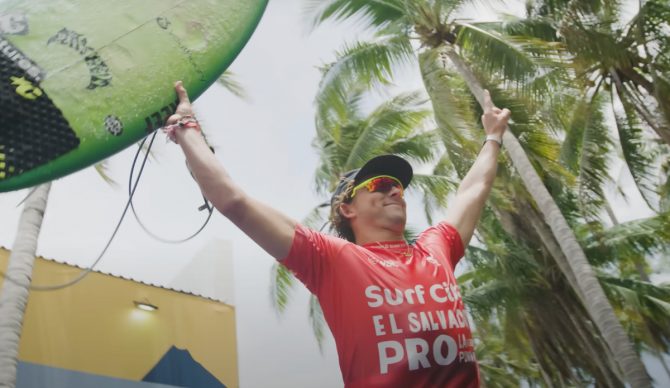
Griffin Colapinto, after his 2022 win at the Surf City El Salvador Pro. Photo: WSL

Nayib Bukele has a path to remain El Salvador’s president, barring any major shakeups, for decades to come. It’s a political move that could have a resounding impact on the global surfing landscape, not for what it could change, but for the status quo that it preserves. The Central American nation of six million has used an unprecedented level of investment to carve out an outsized role for itself in the sport.
On July 31, El Salvador’s congress passed a constitutional amendment that removed a cap on term limits and increased term length from five years to six. El Salvador had already changed its one-term presidential limit to two terms last year to allow Bukele to seek reelection.
Some politicians in El Salvador called it the end of democracy, while Bukele compared the move to other democracies that do not impose term limits on leaders, singling out Denmark, Spain, and the United Kingdom.
Under Bukele’s leadership, El Salvador has funneled public funds into surfing, using the sport to help rebrand the country from murder capital to surf destination. In 2023 alone, the government spent $23 million on surf events, coastal infrastructure, and tourism promotion. El Salvador has accomplished what no other Latin American nation has: securing a permanent stop on the World Surf League (WSL) Championship Tour. The country is also set to host the WSL Longboard Tour finals this year – its second consecutive year doing so. On top of that, it has hosted two Olympic qualifiers and signed a deal with the International Surfing Association (ISA) to host six “major events” through 2027.
As I’ve mentioned before, the relationship between El Salvador and surfing’s principal institutions is symbiotic. A reliable event host willing to sign checks without needing a title sponsor is a gold mine for the WSL and ISA.
In 2025, the ISA calendar shrank to two events, both in El Salvador: the longboard championships in April and the World Surfing Games in September. In 2023, the most recent year the ISA publicly released its financials, event licensing accounted for 66 percent of the organization’s revenue, nearly four times the next highest revenue source. Thus, the primary source of cash flow for surfing’s Olympic governing body is coming entirely from El Salvador this year.
El Salvador has once again secured a spot on the 2026 WSL Championship Tour – its fifth consecutive year on the schedule. While there’s no known long-term agreement with the WSL, all signs suggest that Punta Roca will continue to be a CT stop.
Setting aside human rights concerns, such as the imprisonment of foreign nationals without criminal conviction, from a purely surfing perspective, Bukele’s continued grip on power is likely seen as positive by the sport’s institutions, at least in the short to medium term. The WSL and ISA already expected his support through the end of his second term in 2029. However now, with no limit on reelections, El Salvador could funnel funding into surf events for decades to come.
As long as the country’s political climate remains relatively stable and its public safety continues to outpace the rest of the region, Bukele’s extended presidency means El Salvador is well-positioned to remain a major player on the global surfing stage.

