
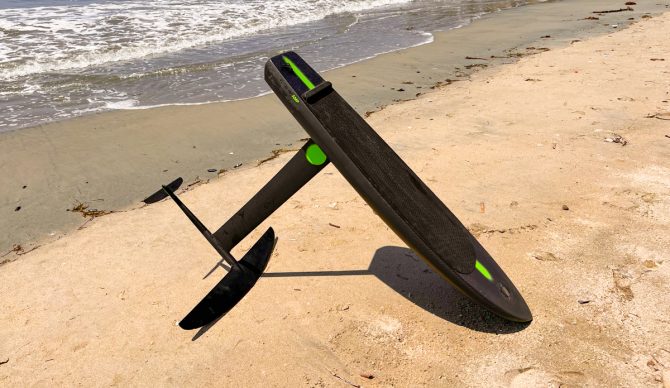
FLITELab* AMPJet 5’0”, 82cm UHM mast, and 1010 foil. Photo: Bowen Dwelle//The Inertia

We’ve all seen the videos of bucket-hat promoter and foil legend Adam “Mister” Bennetts carving endless turns on the prototypes (if you haven’t yet, feast your eyes on his Instagram), and now, after three solid years in development, testing, and refinement, FLITELab’s much-anticipated AMPJet is ready for release. The AMPJet is a whole new angle in the world of e-assist foiling, and so when the FLITE team invited me down to SoCal for a demo, I jumped on a plane, ready to ride.
Bottom Line: The FLITELab* AMPJet is a major upgrade compared to other e-assist foil systems in terms of engineering and elegance, and sets a new standard for prone foilers looking for a boost. That said, you still have to paddle, and you can’t motor up in the flats like you can with propeller-powered rigs, so it only makes sense for riders committed to prone foiling. The AMPJet is the brainchild of Flitelab founder and product architect Chris Reynolds, and part of the overall Fliteboard portfolio, which is itself part of Mercury Marine. The support of a major corporate backer shows in the quality and detail of the finished product.
See the AMPJet on MackiteRelated: Best E-Foils | Best Wetsuits | Best Surf Helmets
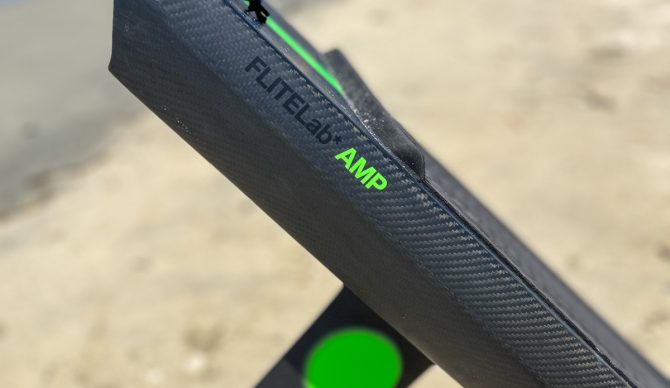
The Flitelab* AMP. Photo: Bowen Dwelle//The Inertia
Testing the AMPJet at Seal Beach, CA
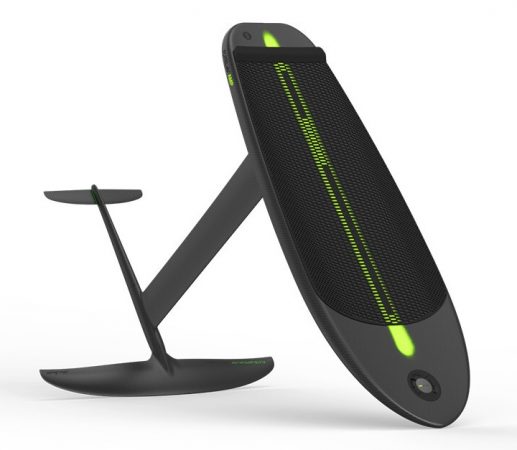
Sizes Tested: AMPJet w/ 5’0 x 18” 45L AMP board and 1010 FLUX foil
Price: $11,813 ($8,254 for the AMPJet board package + $3,559 for the 1010 foil set)
Weight: 8kg + mast + foil
Pros: Very well engineered, modular, low maintenance, easy to assemble
Cons: You still have to paddle!
First Impressions
Laying eyes on the AMPJet for the first time, what jumps out is how clean and refined everything is. Flite’s AMP lineup isn’t just an e-assist surf rig – it’s an entire foiling system, with boards, masts, and foils all engineered for high-performance foil surfing, downwinding, and even winging, all of which can be used with or without the AMPJet power system. The design and engineering are next level – this is more of an iPhone-level product in terms of fit, finish, and elegance. Everything is integrated, modular, and very clean, with very few connectors and no cables or latches. The boards, foils, and the mast all look amazing, and the Flitelab crew is pushing the distinctive “green dot” branding big time.
Of course, aside from all that black carbon, I was there to check out the e-assist power of the AMPJet itself. Getting on the water is a breeze – just bolt up a foil on the standard track mount, shove the power cartridge into the board, and you’re good to go. The controller is a little puck that sits embedded in the nose of the board. AMP founder and designer Chris Reynolds explained how to use the whole thing in about fifteen seconds, which is about as simple as “paddle assist button on the left, boost on the right.”
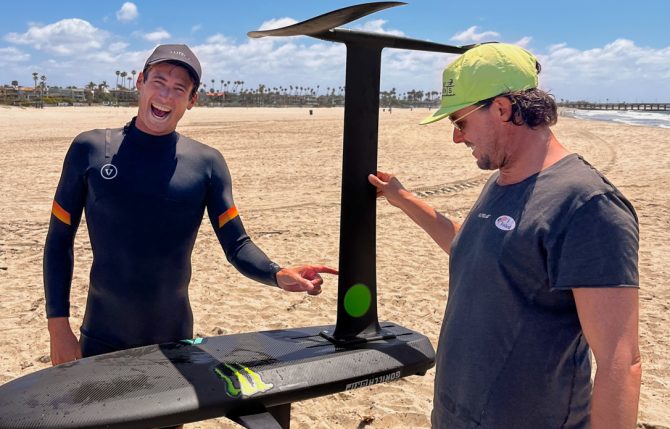
Pro riders Eric Geiselman and Adam Bennetts with the Flitelab* AMPJet 5’0”, 82cm UHM mast, and 1010 foil. Photo: Bowen Dwelle//The Inertia
Notable Features
Propulsion
While all of the other e-assist foil solutions so far use a propeller on the mast, the AMPJet uses a water jet impeller embedded in the board itself in the form of a pluggable, modular Jet-Set cartridge that can be inserted, removed, and swapped in seconds. While limited to providing propulsion when the board is on the surface of the water, the AMPJet system does offer several advantages over mast-based props—and, next year, AMP will be coming out with a mast that routes the jet power through the mast.
Aside from the fact that there’s no spinning prop, the AMPJet system is also entirely self-contained, with no power or controller connections from the board to the mast. Not only does this make the whole thing much cleaner, there’s no risk of losing or breaking small connectors and parts—and, since there’s nothing on the mast, you can actually use any foil system you want, and you can easily swap foil setups and masts. As opposed to props and external battery boxes under the board, the integrated jet system creates zero extra drag. One of the other pros is that with its much cleaner design, the AMPJet is definitely more suited to e-assist winging or parawinging than prop-based systems.
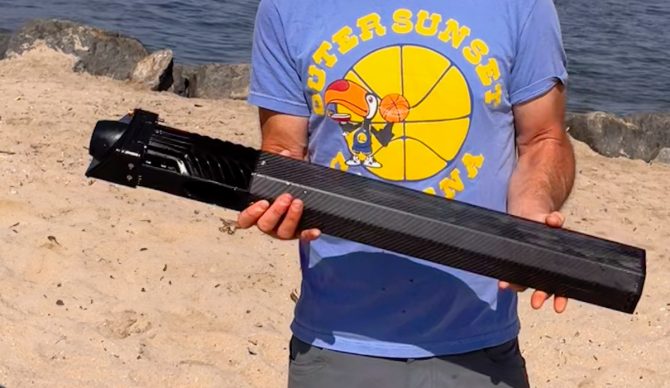
Our tester with the propulsion and battery cartridge. Photo: Bowen Dwelle//The Inertia
Flitelab cites 25kg (55 lbs) of max thrust, which translates into a significant kick that will enable skilled foil surfers to get into waves that they otherwise couldn’t paddle into – and give beginners a major leg up in their foiling progression. The AMPJet is designed to give you a boost as you paddle into a wave prone or downwind with a paddle, or with a wing – and it does that incredibly well – but it’s not enough to get you up on foil in flat water, unless you’re quite small and very, very skilled. There’s also a “paddle assist” mode that runs at something like 10% of boost mode to give you some help as you paddle out. Both paddle assist and boost mode can also be used when duck-diving.
The AmpJet Jet-Set propulsion system is really slick. It all fits in this rectangular cartridge that plugs in through the rear end of the board and puts all the weight in the center line and right over the center of lift of the foil. In practice, this means that while, of course, there is some extra weight, you feel it much less than with other e-assist systems that have their battery and/drive unit beneath the board and attached to the mast.
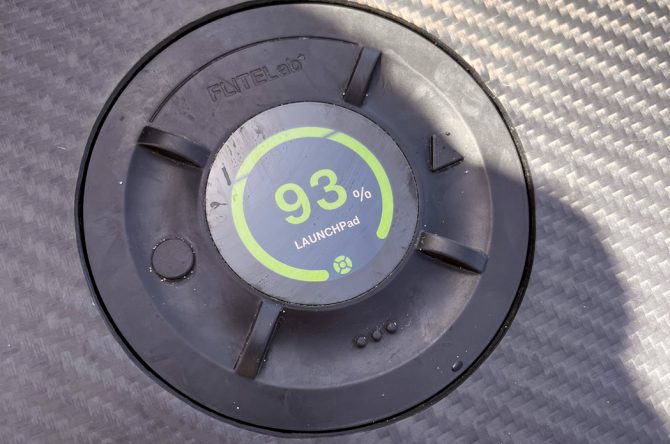
The LAUNCHPad controller is simple and intuitive to use. Photo: Bowen Dwelle//The Inertia
LAUNCHPad Controller
The AMPJet LAUNCHPad controller is a little puck that fits into a recess in the front of the board and connects wirelessly to the rest of the system. It’s super simple, and the UI works well. Clearly designed with prone foilers in mind, you just punch the triangular boost button on the right as you begin to paddle for a wave, and there you have it – AMPJet super-powers! The round button on the left is for paddle assist mode, and the three dots take you through the menu system. Battery life, prone/downwind/wing mode, and boost profile customization are all right here, although there’s an app too, of course, which also lets you fine-tune your settings, including boost delay, boost time, and the power curve.

FLITELab’s Evan Netsch demonstrates how the battery splits in two for legal air travel. Photo: YT Screenshot//MACkite
Batteries
The AMPJet cartridge itself weighs 2.2kg, including the jet impeller, and can hold two batteries at 1kg each, making for a total system weight of 4.2kg, which is roughly comparable to the FoilDrive Slim Endurance setup. Each battery module provides 142 watt hours of power, so the standard AMPJet setup has a combined 284 watt hours. You can of course compare weight and raw battery capacity with other systems like FoilDrive, but it’s apples to oranges because on one hand the AMPJet drive is probably going to be used less because you’re not going to be motoring around in the flats, but on the other, the jet drive is less efficient than a prop at transmitting propulsive force to the water.
FLITE claims a run time of up to 3+ hours with two batteries, but that’s for an experienced rider using boost in short bursts. As a total novice, I was out for about an hour and ran it down to about 40%. Charge time is about 50 minutes for a full charge using the included Ampcell charger, which can charge two batteries, and FLITE has a more powerful smart charger coming soon, which will charge up to four batteries simultaneously. The batteries link together, and the battery management system syncs it all up automatically. As an added bonus, the individual batteries are small enough to be legal for air travel.
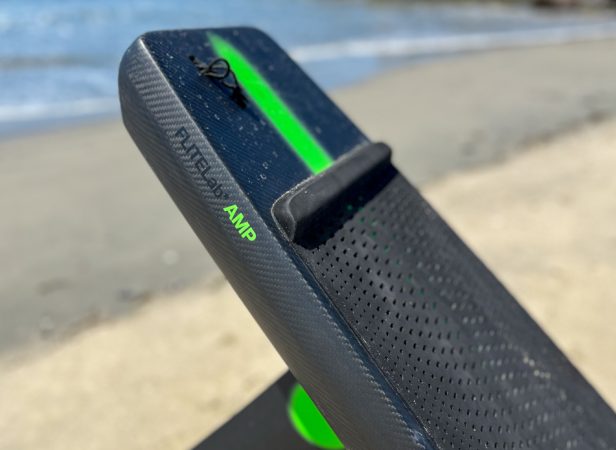
The FLITELab* AMPJet. Photo: Bowen Dwelle//The Inertia
Boards
FLITELab* has an entire series of bad-ass boards lined up for 2025, including five AMP boards that will accept the AMPJet cartridge, and four RAW foil boards designed for unpowered foiling. All of these boards are mostly aimed at prone foiling, but they can be used for e-assist downwinding as well as wing and parawing foiling, too, of course. The S series boards are more of a prone surf shape, while the M series have a more mid-length outline. All of the AMP boards can be used without the power system; just slap in a “blank” and ride unpowered.
AMP Board Lineup
S Boards: 4’2” @ 27L | 4’6” @ 32L | 4’8” @ 40L
M boards: 5’0” @ 45L | 5’8” @ 65L
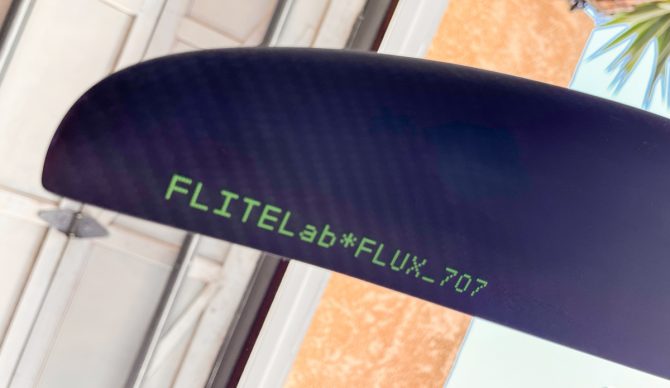
FLITELab* FLUX 707 foil. Photo: Bowen Dwelle//The Inertia
Foils
In line with the fact that this isn’t just an e-assist rig but a full foiling system, the FLITELab* foil lineup includes 707, 808, and 1010 sq cm sizes to begin with and will grow over time to add smaller and larger foils. These are modern, high-aspect foils optimized for prone/downwind foiling, and they can also be used for winging and parawinging. As a beginner, the 1010 was the call while the pros were ripping the 707. You gotta dig the naming convention – a nod to the legendary Roland 808 drum machine, a favorite of Mr. Bennett’s DJ alter-ego.
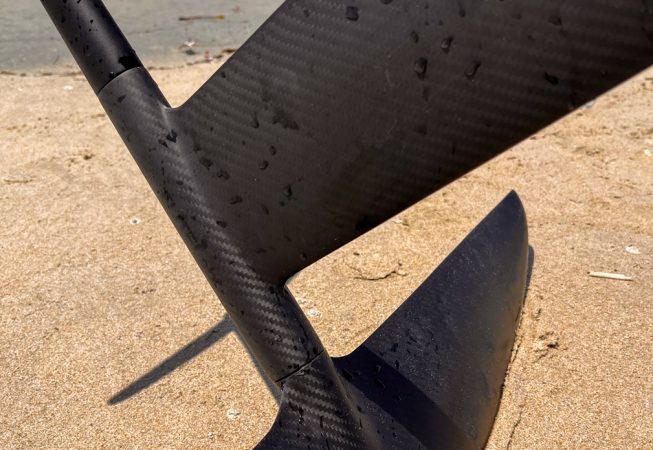
FLITELab’s integrated mast and center fuselage. Photo: Bowen Dwelle//The Inertia
Integrated Mast/Fuse
FLITELab* uses a state-of-the-art integrated mast-fuselage connection – it’s all one piece, but done in a way that leaves only a short center fuse attached to the mast, so it’s not awkward to travel with. Their innovative conical foil mount is designed for strength, rigidity, and long-term durability, and the AMP mast is “hyper-stiff” UHM carbon in 82cm and 87cm lengths.
Of course, since the AMPJet board has a standard mast track, you can mount whatever mast and foil system you want, radically increasing your options and making it possible to leverage your existing foil quiver.
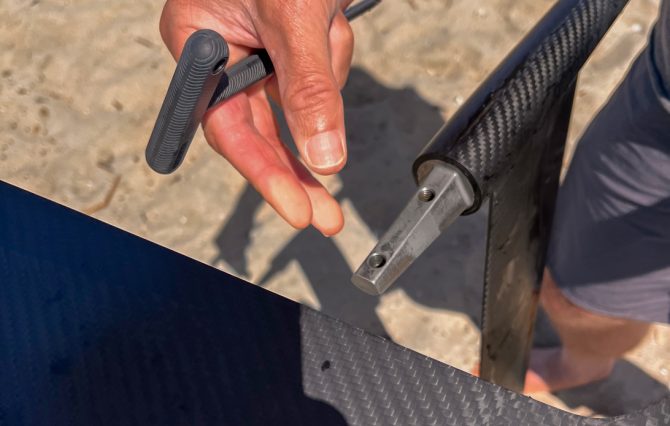
FLITELab’s conical fuselage to foil connection. Photo: Bowen Dwelle//The Inertia
Drawbacks
The only real drawback of this killer e-assist system is that…you still have to paddle! Seriously – I get that it’s designed for prone foiling – which, I know, does involve paddling – but it seems to me that a lot of people interested in e-assist systems are going to be older surfers and others whose reason for looking at a system like this in the first place is that they’re simply done with paddling. Where it nets out is that if you really don’t want to paddle at all, you can get a full-on e-foil, and if you still want to paddle (or at least look like you’re paddling), the AMPJet is the answer.
The Competition
| FLITELab* AMPJet | Lift X | FLITE Ultra L2 | Foil Drive Max Sport | |
| Cost | $11,813 (5’0” x 1010), $8,254 w/out foil | $14,499 | $17,300 | $5,050 – not including board or foil |
| Propulsion Method | Water jet impeller | Prop low or high on the mast | Prop low on the mast | Prop low or high on the mast |
| Possible to reuse existing foil quiver? | Can use any foil/mast, easy to swap | With fuselage adaptors | With fuselage adaptors | Can use any foil/mast, but hard to swap |
| Prone (Paddle Assist) | ⭐⭐⭐ | ⭐ | ⭐ | ⭐⭐ |
| Flat Water Start | ⭐ | ⭐⭐⭐ | ⭐⭐⭐ | ⭐⭐ |
| Downwind | ⭐⭐⭐ | ⭐⭐⭐ | ⭐⭐ | ⭐⭐ |
| Wing/Parawing | ⭐⭐⭐ | ⭐ | ⭐ | ⭐⭐ |
Foil Drive
FoilDrive is the OG e-assist foil system, and the closest point of reference for most riders who want to prone or downwind with some assistance. FD wins for having more power and the ability to motor up in flat water, but the AMPJet comes out on top in terms of simplicity and elegance, and for keeping the connection with the mast and foil clean so that it’s actually possible to swap foils and/or use the AMP board without the power system.
FoilDrive is also a little fiddly in terms of all the little parts, seals, wires, and clamps. For us, the AMPJet vs FD decision comes down to whether you can deal with the componentry of the Foildrive in exchange for the versatility and ability to get up on foil without paddling, or on the other hand if you want a simple, clean, elegant system that is going to challenge you a bit more – and probably push you to actually learn to paddle as opposed to just finger-blasting into waves. See our Foil Drive Assist Max review for further details.
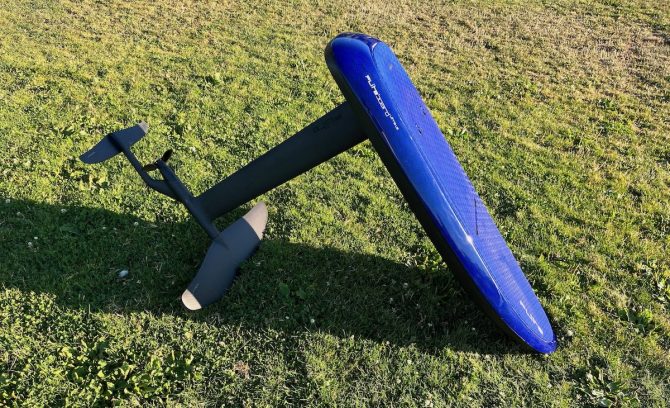
The FLITE Ultra L2 e-foil is a beast in the waves, but it’s still an efoil. Photo: Bowen Dwelle//The Inertia
FLITE Ultra L2 (UL2)
I was super impressed with UL2 when I rode it in 2024, and I would still recommend it if you want something with more juice than the AMPJet in an integrated package. The direct competitor for the UL2 is really the LiftX system. As for UL2 versus AMPJet, the question is whether you want an ultra-light wave-capable (and quite expensive) e-foil, or an even lighter e-assist solution designed specifically for prone foiling. Some of the biggest differences between the two are that the UL2 allows you to motor around on foil, which you can’t do with the AMPJet, and the AMPJet lets you use whatever foil you choose, while the UL2 is only compatible with FLITE foils. See our E-Foil Buyers Guide for further details on the UL2.
Lift X
I haven’t done a head-to-head of the LiftX yet, but since it’s very similar in capabilities to the FLITE UL2, the comparison with the AMPJet is going to be similar. Get the AMPJet if you want to spend and carry less. Get the LiftX if you want to be able to motor around on foil. Our E-Foil Buyers Guide will be updated soon with further details on the new Lift products as soon as we’re able to get hands-on to conduct our own testing.
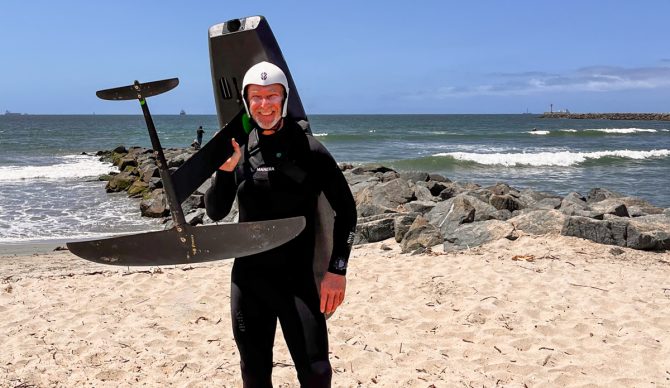
Bowen, out testing the FLITELab* AMPJet. Photo: Bowen Dwelle//The Inertia
Final Thoughts
The FLITELab* AMPJet is a major innovation in e-assist foil systems. Well thought out and beautifully executed, it’s the new standard for prone foilers who want a boost. However, it’s not just for prone-foiling – it also provides some interesting potential applications for winging and downwinding, as well. The FLITELab* boards, masts, and foils are top-notch, too, and so if you want to ride like Bennetts, this is your jam, for sure!
See the AMPJet on MackiteRelated: Best E-Foils | Best Wetsuits | Best Surf Helmets
Editor’s Note: For more gear reviews and features on The Inertia, click here.

