
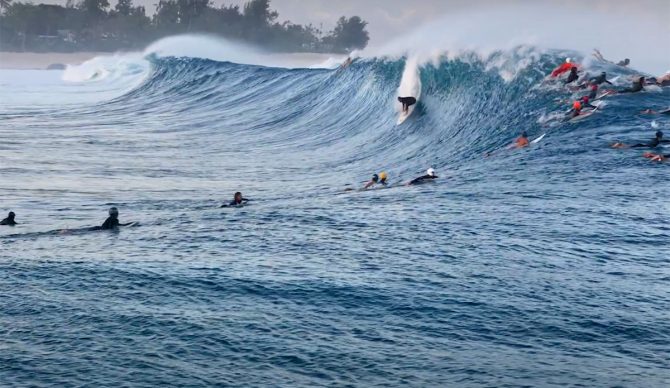
In the shadow of Phil Edwards: When it comes to Pipe, no one does it quite like John John. Photo: YouTube//Screenshot

There are thousands of surf breaks around the world. Many have names, of course, but some have yet to be discovered (we hope). The names of many famous surf spots have become ingrained in our surf psyche from hearing them so frequently. So we often take them at face value. And although some breaks are named with no rhyme or reason, a handful have interesting back stories. These 10 famous surf spots bear monikers with unique origins.
Maverick’s – Half Moon Bay, California
Located in Northern California, Maverick’s is one of the biggest and scariest waves in the world. But surprisingly, the deadly wave was named after a dog. In the early 1960s, before the wave was officially on the map as a big wave surf destination, Alex Matienzo, Jim Thompson, and Dick Knottmeyer surfed off Pillar Point because it was protected from the northwest wind. They enjoyed the mellow waves located roughly 100 yards offshore and each time they paddled out, Matienzo’s roommate’s German Shepherd would swim out with them. His name? Maverick. Eventually the break was officially named Maverick’s after the beloved dog.
Banzai Pipeline – North Shore, Oahu
Banzai Pipeline is one of the most famous surf breaks in the world, known for its powerful, barreling waves that break over a shallow reef. The Banzai portion comes from the name of the beach itself, which earned its name during WWII. There was a Japanese battle cry “tennōheika banzai,” which translates to “long live His Majesty the Emperor,” and was shortened to banzai. After the war, veterans settled along Oahu’s North Shore and when the waves at Pipeline marched towards the shore and broke on the beach, it reminded them of charging soldiers. So, they named it Banzai Beach.
In 1961, Phil Edwards was traveling the North Shore with filmmaker Bruce Brown and his shaper Mike Diffenderfer. They stopped at Banzai Beach and Brown captured Edwards riding waves. At the time, there was a construction project on an underground pipeline and Diffenderfer suggested they name the break Pipeline. The name was first officially used in Brown’s film, Surfing Hollow Days, and it stuck. Eventually, the name of the beach and the wave were combined to become the famous Banzai Pipeline.
Cloudbreak – Mamanuca Islands, Fiji
According to 11-time world champ Kelly Slater, Cloudbreak is one of the best waves in the world. We can’t argue with the GOAT, but how did the legendary spot get its name? The name Cloudbreak was inspired by a Fijian expression, “Nakuru Kuru Malagi,” which translates to “Thundercloud Reef.” The freight-train of a left hander delivers powerful, barreling waves over a shallow reef, so Thundercloud is definitely an appropriate name.
Jaws – Maui, Hawaii
A big wave surf spot on Maui, Jaws attracts surfers form around the world annually to ride its massive waves. The Hawaiian name for the spot is Pe’ahi, which originated from the word ahupua’a, a Hawaiian term referring to a large subdivision of land. In Hawaiian, pe’ahi means wave.
In 1975, Pe’ahi was officially given its nickname, Jaws. Surfers John Roberson, John Lemus, and John Potterick noticed the swell quickly changing from small, friendly waves to massive, dangerous waves. They compared the sudden shift to the unpredictability of a shark attack and named the wave Jaws, a nod to the classic film.
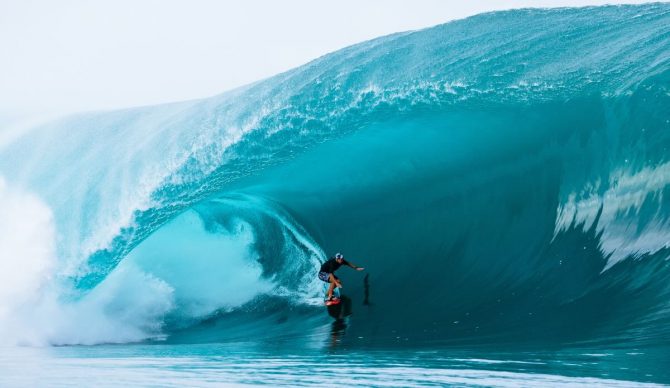
Kauli Vaast x Teahupo’o. Photo: Brent Bielmann//World Surf League
Teahupo’o – Tahiti
Teahupo’o and the surrounding area makes for one of the most picturesque surf breaks in the world. That, and the fact that it consistently delivers powerful, barreling waves, is why it served as the surf venue for the Paris 2024 Olympics. But the origins of its name are much more gruesome than you might think.
In English, Teahupo’o means “to sever the head” or “place of skulls.” The translation is fitting as the wave got its name from the neighboring village where a bloody tribal battle once took place. Once the battle was over, the victors proudly displayed their enemies’ skulls. A fitting name for one of the scariest waves in the world.
Lower Trestles – San Clemente, California
Home to multiple WSL Championship Tour events and numerous WSL Finals, Lower Trestles is widely celebrated as a world-class surfing destination. While many surf breaks have rich history surrounding the origins of their names, Trestles is straightforward. The A-frame point break was simply named after Trestles Bridge, the wooden trestle bridge and railroad that you walk under to access the break. Presumably, Lower Trestles was deemed “Lowers” because it sits south of the bridge and Upper Trestles.
Snapper Rocks – Gold Coast, Australia
Snapper Rocks is a cool name for a surf break, but its origins date back to the early 1800s. Located on the northern side of Point Danger (also a killer name), Snapper is an often hollow, right-hander that breaks over the man-made Superbank. Although there isn’t definitive proof, it is believed that the break was named by W.L. Edwardson, captain of the HM Colonial Cutter Snapper. After sailing by Point Danger in July of 1822, Edwardson named the now famous surf break (or point of land) after his vessel.
Macaronis – North Pagai, Mentawais Islands, Indonesia
One of the premier surf breaks in the Mentawais, Macoronis is known to work on all tides and delivers a mix of barreling sections and open faces. The break was originally discovered in 1980 by Chris Goodnow, Scott Wakefield and Tony Fitzpatrick. They named the spot P-Land, after Pasangan Bay/Pagai Islands. Macoronis is believed to be the first break ever surfed in the Mentawais.
In the late 1980s and early 1990s, surfers began camping out in the bay, hoping to score some waves. During their stay, macaroni was a staple food, so the spot was renamed Macaronis. Additionally, the wave is thought to resemble a macaroni noodle, perfectly shaped and hollow, and curving as the wave detonates along the reef.
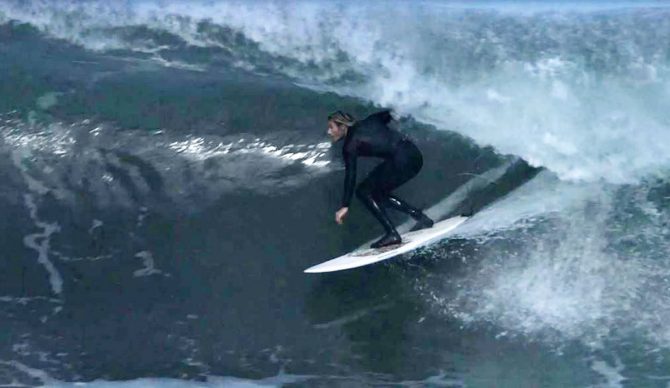
Torren Martyn at Winkipop. Photo: Screenshot
Winkipop – Torquay, Australia
Winkipop is just fun to say and an epic spot to surf. The high-performance right-hander delivers world-class waves year-round, attracting surfers from around the world. But the origins of its name might surprise you.
Surfers from Melbourne were surfing the break in the 1960s and a girl who was traveling with them had a code name for sexual intercourse: winkipop. One day, after surfing, they were walking in over the rocks when they saw two crabs doing the deed and joked that they were having a winkipop. The name stuck.
Cokes – Thulusdhoo, Maldives
Cokes is regarded as one of the best surf breaks in all of the Maldives. It’s relatively easy to access and is a barreling right-hander located a short paddle from the island of Thulusdhoo. The break was named after the Coca-Cola factory located on Thulusdhoo and is typically referred to as Cokes or sometimes Colas.

