
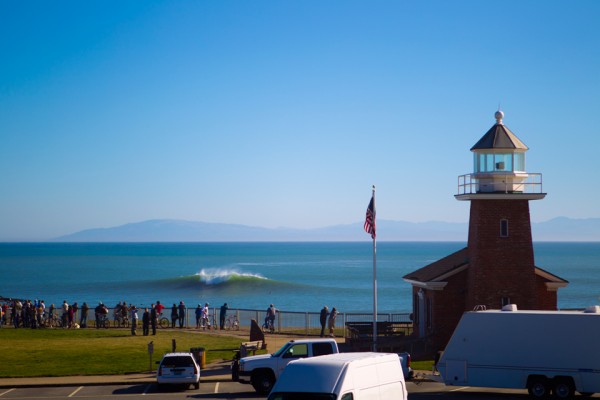
An iconic view from the Lane. Photo: O’Neill Cold Water Classic Santa Cruz//Prefontaine

Santa Cruz, California is renowned for its waves. And those waves don’t just provide leisure to surfers. They pump cold, hard cash into the pockets of residents. A new report by Save the Waves Coalition quantified the value of surfing in the city and warned that without stronger coastal protections against sea level rise, the local economy could take a hit.
According to the report, Santa Cruz sees 783,000 surf visits annually. Those visitors generate $44.5 million in local spending, while another $150.2 million flows into the wider surf economy on gear, lessons, and services. Altogether, surfing brings in an estimated $194.7 million per year to the city. The study, which began in May 2023, examined 31 local surf breaks, surveyed hundreds of surfers and community members, and held workshops with residents, businesses, and advocacy groups to reach its findings.
“We now understand at a granular scale how a local economy is bolstered by the sport of surfing,” said Trent Hodges, lead of the study for Save The Waves Coalition. “We knew we needed more than Surfonomics. So we studied how that economic value is threatened by climate change through the loss of surf breaks to sea level rise.”
The report highlights and quantifies how rising seas and outdated coastal defenses put surfing’s economic value at risk. Most of Santa Cruz’s surf breaks are already modified by seawalls or riprap – large stone or concrete barriers placed along the shore. The report instead calls for more nature-based solutions, such as sediment management and managed retreat, to make waves more resilient. In some cases, the researchers suggest replacing riprap with seawalls.
“Ultimately, the project showed that all surf breaks in Santa Cruz are highly vulnerable to climate-change induced sea level rise in their present day conditions and the surfability of all of the waves in the study area will greatly diminish with each foot of projected sea level rise,” the report states.
The study estimates that each additional foot of sea level rise will cost Santa Cruz millions in value: $12.8 million for the first foot, another $12.6 million for the second, and $9.1 million more at three feet.
Nature-based approaches, however, could help preserve surf breaks by extending their “surfability” – the amount of time waves remain rideable – while bolstering resilience to sea level rise.
Save the Waves hopes the findings will guide local policy and eventually expand to other California surf regions.
They recommend developing a statewide strategy focused on key surf regions. Such a framework, they argue, should treat high-value areas as a connected network of surf reserves and provide long-term management plans “ensuring California’s surf breaks continue to deliver benefits for all.”
“Surfing is more than a sport in Santa Cruz, it’s a cultural, economic, and environmental cornerstone,” said Nik Strong-Cvetich, CEO of Save The Waves Coalition. “This study confirms what many in the community have felt: climate change is not a future issue. It’s impacting our coastlines now and it’s happening for more surf cities in California than just Santa Cruz.”

