
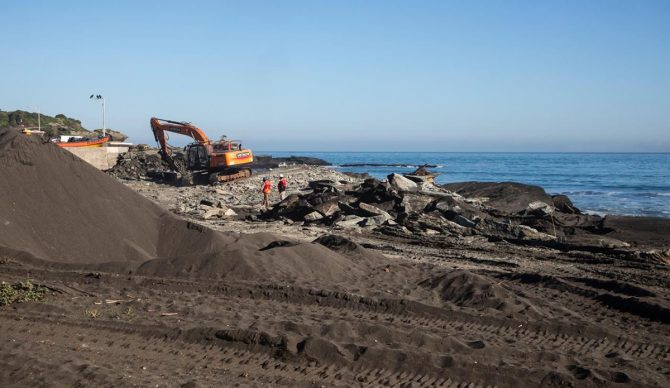
The construction has already begun. Photo: Ramon Navarro

Chilean big-wave surfer Ramón Navarro says one of his country’s “world-class” waves is about to be permanently transformed. Construction crews have begun placing two jetties that extend into the lineup at Caleta Pellines, a remote left-hand point 80 miles south of Pichilemu. Navarro shared a video on Instagram showing heavy machinery moving massive rocks in front of perfect barrels, warning that it’s already too late to stop the project.
“We’re for sure going to lose the wave that we know right now,” Navarro told The Inertia by phone on Wednesday. He noted that no one can say exactly how the wave will change – for better or worse – but expects the jetties to shift the takeoff spot, move sand farther offshore, and potentially reshape the wave.
Pellines, he said, is one of the gems of Chile’s southern coast, though it sees little traffic due to its isolation and small local surf community.
The project carries an estimated price tag of USD $4.5 million. Government plans show a 75-meter jetty will be built at the south end of the bay – intersecting the current takeoff zone – using boulders weighing up to 10 tons. A second, smaller 25-meter jetty will go up on the north end. Crews will also clear 1,600 square meters of rocky beach material to open more space for boat launches.
According to government documents, the project is meant to protect fishing boats, create safer conditions for fishermen, and extend the number of fishing days per year. But the same report acknowledges that the new structures will alter currents and swell patterns, possibly leading to sediment buildup in some areas and erosion in others, with potential negative impacts on wave quality.
Navarro believes both surfers and fishermen will ultimately lose.
View this post on Instagram
“We understand fishermen need better access, and we believe fishermen and surfers can be together and live as a community – we’re not against them and they’re not against us,” he said. “But we already have a couple places where they made exactly the same jetty and the whole thing got covered in sand, making the access for fishermen even worse.”
Public notices on the beach state the project must be completed within 300 days of May 23, which sets a deadline of March 21, 2026. According to Navarro, surfers were shut out of the decision-making process and only learned of the project a few months ago.
Navarro says the surf community has appealed to the government over the years, and while a national law to protect waves is moving through Congress, the process has been too slow to help Pellines.
“We’re trying to get more attention from the politicians, government, and president, to (let them know) how important it is to protect a surf break,” said Navarro. “We’re trying to explain that in places like Australia, the States, and Europe, people protect waves, and the government puts in money (to do so). We have world-class waves here and people want to destroy them.”
For now, Navarro says there is nothing left to do but watch and wait. He plans to monitor the project and share updates on how the wave evolves once the jetties are in place.
“(Pellines) might be a sacrifice wave to show everyone – politicians and fishermen,” he said. “This is not the way to have better access for fishermen at a surf break.”

