
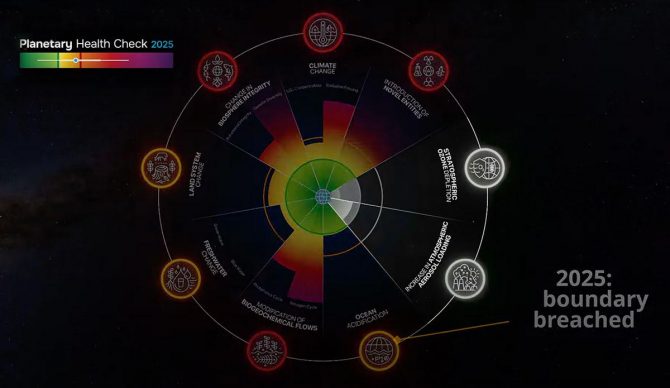
Seven of nine Planetary Boundaries have been crossed now. That’s… not good. Image: Official Planetary Health Check 2025

For a while now, it’s become increasingly apparent that we’ve created some serious planetary health issues. Ocean acidification is just one of the things that’s worrisome, and for the first time, it was added to the list in the 2025 Planetary Health Check.
The Planetary Health Check is released every year. “It presents the most up-to-date assessments of the Planetary Boundaries, gives thorough introductions into cutting-edge science, and spotlights especially relevant aspects of our planet’s health,” reads the report’s description.
The Planetary Boundaries are basically a framework that describes the upper limits of the impacts of human activities on the Earth system. Blowing by those limits means the our environment may not be able to regulate itself, and we’ve got our foot planted heavily on the gas pedal. There are nine Planetary Boundaries, and we’ve breached seven of them. The two remaining are Increase in Atmospheric Aerosol Loading and Stratospheric Ozone Depletion — the latter of which, you may remember was a wonderful example of how humans, if we use science and cooperation, can fix global issues.
The boundaries on the list that we’ve already exceeded are Climate Change, Biosphere Integrity, Land System Change, Freshwater Use, Biogeochemical Flows, Novel Entities, and Ocean Acidification. Together, they form Earth’s basic operating system. It’s all connected, and when one fails, the others struggle not to.
In the 2025 edition of the Planetary Health Check, the ocean is in sharp focus. That’s because ocean acidification crossed the threshold into the danger zone. That’s a big deal because the ocean is… well, it’s pretty damn important to life on Earth.
“The consequences are already noticeable: Ocean Acidification has now gone beyond what is considered safe for marine life and ecosystems are already feeling the effects,” Oceanographic magazine wrote. “Cold-water corals, tropical coral reefs, and Arctic marine life are especially at risk as acidification continues to spread and intensify.”
Johan Rockström, the director at the Potsdam Institute for Climate Impact Research that is responsible for the Planetary Health Check, isn’t mincing words about the dire straits we’ve put ourselves in over the course of our race for wealth and comfort.
“More than three-quarters of the Earth’s support systems are not in the safe zone,” he said. “Humanity is pushing beyond the limits of a safe operating space, increasing the risk of destabilizing the planet.”
In the grand scheme of things, it’s surprising how quickly we’ve changed the ocean’s pH levels. According to Oceanographic, those levels have increased some 30-40 percent. Sea snails are showing shell damage from it, as well as a host of other creatures. But sea snails are a bit of a canary in a coal mine, because they’re incredibly important in the food chain. That food chain ends with us, so we’d be smart not to ignore that canary’s anguished song.
“The movement we’re seeing is absolutely headed in the wrong direction,” said Levke Caesar, Co-lead of Planetary Boundaries Science Lab, and one of the lead authors of the report. “The ocean is becoming more acidic, oxygen levels are dropping, and marine heatwaves are increasing. This is ramping up pressure on a system vital to stabilize conditions on planet Earth.”
Although we already know what the cause of the problem is, it appears we’re not willing to do what needs to be done to solve it.
“This intensifying acidification stems primarily from fossil fuel emissions,”Caesar explained. “Together with warming, deoxygenation affects everything from coastal fisheries to the open ocean, the consequences ripple outward impacting food security, global climate stability, and human wellbeing.”
Although the future of the Earth feels shaky, we’re not completely screwed just yet. “We’re not yet in the high risk zone of irreversible, unmanageable change of the planet,” Rockström said. “Which suggests that we can still turn this around. The window is still open, even though it’s closing fast, and we have so much evidence of scalable solutions across all sectors, from the food sector and the built environment to the energy transition that we can bend the curves and bring ourselves back within a safe operating space within the next decade.”
It remains to be seen, however, if we’ll actually get it together as a society of human beings to ensure a healthy planet for future generations. As the old saying goes, “A society grows great when old men plant trees whose shade they know they shall never sit in.”

