
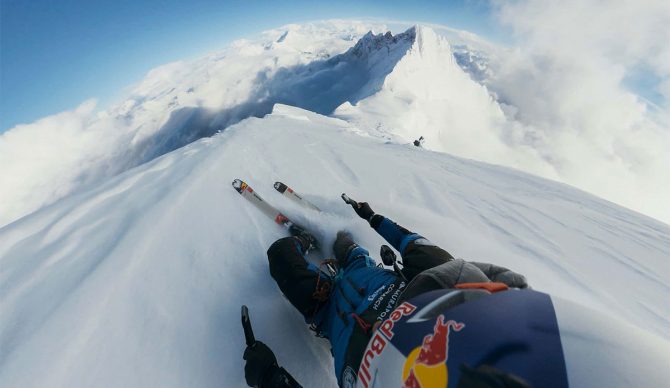
Andrzej Bargiel brings new meaning to the saying “earn your turns.” Photo: Red Bull Content Pool

Andrzej Bargiel, a 37-year-old Red Bull athlete, made history on September 22 when he became the first person to climb Mount Everest without oxygen and then ski down to Everest Base Camp.
As you’d imagine, it wasn’t easy. “After climbing from Camp IV for nearly 16 hours in the mountain’s ‘death zone’ above 8,000 meters,” a press release reads, “he clipped into his skis at the summit on September 22, and descended via the South Col, reaching Camp II by nightfall, making safe navigation impossible, and resting for the night. The following morning, he resumed skiing, navigating the treacherous Khumbu Icefall before arriving safely at Everest Base Camp.”
Bargiel is no stranger to feats like this one. He’s already a supremely accomplished athlete. He’s the only person to ski from all of the Karakoram’s eight-thousand-meter peaks without supplementary oxygen, as well as the first (and only) person to do a full ski descent of K2 in 2018.
“If you look at human physiology with such a small amount of oxygen in the air, what Andrzej has achieved goes beyond human capabilities,” said Dr. Patrycja Jonetzko, an expedition doctor and an expert in high-altitude climbing. “At this altitude, without supplemental oxygen, the body has to fight for every single step.”
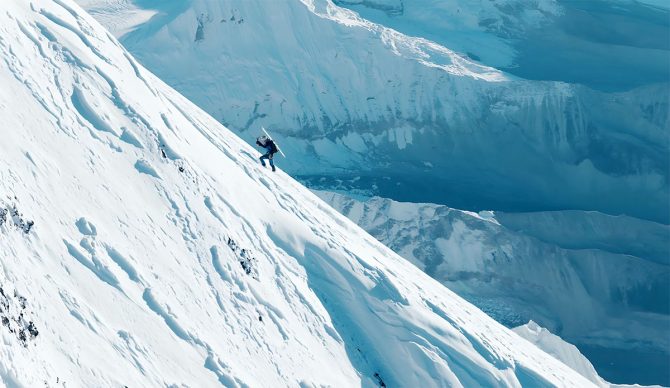
Not only is it steep, but the air is about as thin as it gets. Photo: Red Bull Content Pool
Although Bargiel has certainly ticked a lot of boxes in his ski mountaineering career, Everest is the literal top of the mountain.
“It’s one of the most important milestones in my sports career,” he said. “Skiing down Everest without oxygen was a dream that had been growing inside me for years. I knew that the difficult autumn conditions and plotting the descent line through the Khumbu Glacier would be the greatest challenge I could ever face.”
His Everest expedition was called the Everest Ski Challenge 2025. It took him four days, four hours, 15 minutes to go from Base Camp at 4:30 a.m. on September 19, up to the top of the highest peak in the world, and back down to Base Camp for 8:45 a.m. on September 23. The journey was filmed for a documentary that’s set to be released sometime next year.
Climbing Everest, as you likely know, is not just an up and down climb. Because of the height, Bargiel needed to follow a strict acclimatization protocol that included several ascents and descents between the camps on the way up to the top. When he finally was able to stay at Camp IV on the South Col, he was ready to push for the summit on September 21. He left the camp at 11:30 p.m. with fresh snow on the ground. That made breaking the trail more difficult than it already was and made getting to the summit take longer than he’d planned for. After 16 hours in the death zone — which are “altitudes above a certain point where the pressure of oxygen is insufficient to sustain human life for an extended time span” — before finally reaching the top of the world at around 3:00 p.m. on September 22. Then, of course, came the fun part.
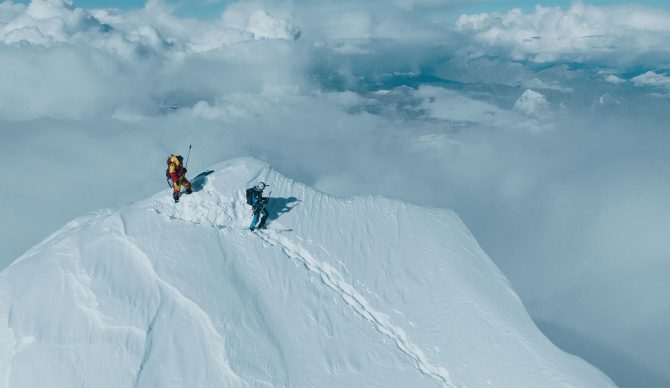
Bargiel barely stopped to enjoy the view before skiing down to Base Camp. Photo: Red Bull Content Pool
“After reaching the summit at around 15:17 local time, Bargiel spent only minutes on top before clipping into his skis and beginning his descent,” Red Bull explained. “By 15:35, he had passed below the famous Hillary Step, continuing on towards the South Summit. At 15:45, he was seen riding along the ridge before reaching the Balcony and later the South Col. By 17:20, Bargiel had descended below Camp IV and continued left of the Geneva Spur en route to Camp II. He arrived at Camp II (~6,400 meters) at 20:30 local time, by which point it was already dark, making safe navigation impossible.”
After spending the night at Camp II, Bargiel got back onto his skis the next morning at 7:00 a.m.
“By 07:50, he had passed Camp I, continuing across the slopes of Nuptse, crossing the treacherous Khumbu Icefall on skis, navigating a labyrinth of shifting ice and deep crevasses — without ropes or fixed lines, guided in part by a drone flown by his brother, Bartek,” Red Bull continued. “He reached the end of icefall and the snowline at Everest Base Camp at 08:45 local time, completing the first-ever ski descent of Mount Everest without supplementary oxygen.”

