
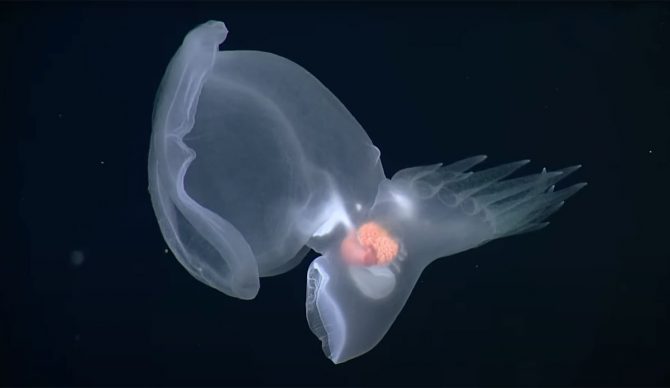
After two decades, researchers have finally described the “mystery mollusc… but they’re keeping the name. Photo: MBARI//Screenshot

Researchers at the Monterey Bay Aquarium Research Institute (MBARI) recently discovered something pretty remarkable: a new species of sea slug that lives in the deep sea. Now, you might be thinking to yourself that sea slugs are not, in fact, all that remarkable. But just you wait.
Back in 2000, about a month after the world as we know it didn’t end because of Y2K, researchers from MBARI were piloting a remotely operated vehicle (ROV) called Tiburon when they first spotted what they called a “mystery mollusc” floating around at around 8,500 feet deep.
“With a voluminous hooded structure at one end, a flat tail fringed with numerous finger-like projections at the other, and colorful internal organs in between, the team initially struggled to place this animal in a group,” MBARI scientists wrote. “Because the animal also had a foot like a snail, they nicknamed this the ‘mystery mollusc.'”
Over the next 20-something years, those researchers remained dedicated to finding out more about the strange gelatinous blob, and with the help of MBARI’s advanced and innovative underwater technology and 150 more sightings, they’ve finally published a detailed description of the animal.
“Thanks to MBARI’s advanced underwater technology, we were able to prepare the most comprehensive description of a deep-sea animal ever made,” said MBARI Senior Scientist Bruce Robison, who led the efforts to describe the mystery mollusc. “We’ve invested more than 20 years in understanding the natural history of this fascinating species of nudibranch. Our discovery is a new piece of the puzzle that can help better understand the largest habitat on Earth.”
After they collected a specimen, they were able to confirm that the mystery mollusc was indeed a mollosc. As a part of the nudibranch family, which consists of soft-bodied marine gastropod molluscs that drop their shells as they grow up. You probably known nudibranches as sea slugs, but this new one has been named (by scientists, at least) Bathydevius caudactylu.
Living in the bathypelagic zone — the midnight zone for the layperson — it requires a few adaptations that are interesting, to say the least. It’s cold down there, completely devoid of light from the surface, and the pressure is immense. It’s the first nudibranch that we’ve found that lives down there, and so far, we’ve only found it in the waters offshore of the Pacific coast of North America. There was, however, a sighting in the Mariana Trench by NOAA researchers of a similar animal, which could suggest that the mystery mollosc is a little more widespread.
“The mystery mollusc has evolved unique solutions to find food, safety, and companions to survive in the midnight zone,” researchers said. “While most sea slugs use a raspy tongue to feed on prey attached to the seafloor, the mystery mollusc uses a cavernous hood to trap crustaceans like a Venus fly trap plant. A number of other unrelated deep-sea species use this feeding strategy, including some jellies, anemones, and tunicates.”
Thy mystery mollosc is almost exclusively found in open water, not on the surface of the ocean or on the sea floor. They move by flexing their bodies up and down, or, if they’re feeling lazy, just drifting with the current. That would make them fairly easy prey, but they’re completely transparent. They do, however, have little finger-like danglers off their flat tail that can shimmer with bioluminescence that MBARI researchers were able to see using an underwater, low-light camera system that they developed.
If threatened, the mystery mollusc can light up with bioluminescence to deter and distract hungry predators,” scientists explained. “On one occasion, researchers observed the animal illuminate and then detach a steadily glowing finger-like projection from the tail, likely serving as a decoy to distract a potential predator.”
Another strange but not surprising thing about the mystery mollusc is that it is hermaphroditic, meaning it’s got both male and female sex organs, like all nudibranches.
Detailed examination of specific gene sequences confirmed that the mystery mollusc is unique enough from other known nudibranchs to merit the creation of a new family, Bathydeviidae. Two shallow-water nudibranchs — the lion’s mane nudibranch (Melibe leonina) and the veiled nudibranch (Tethys fimbria) — use a hood to capture prey; however, this appears to be convergent evolution of a similar feeding method, as the mystery mollusc is only distantly related to these species. In fact, genetics suggests the mystery mollusc may have split off first on its own branch of the nudibranch family tree.
“What is exciting to me about the mystery mollusc is that it exemplifies how much we are learning as we spend more time in the deep sea, particularly below 2,000 meters,” said MBARI Senior Scientist Steven Haddock. “For there to be a relatively large, unique, and glowing animal that is in a previously unknown family really underscores the importance of using new technology to catalog this vast environment. The more we learn about deep-sea communities, the better we will be at ocean decision-making and stewardship.”

