
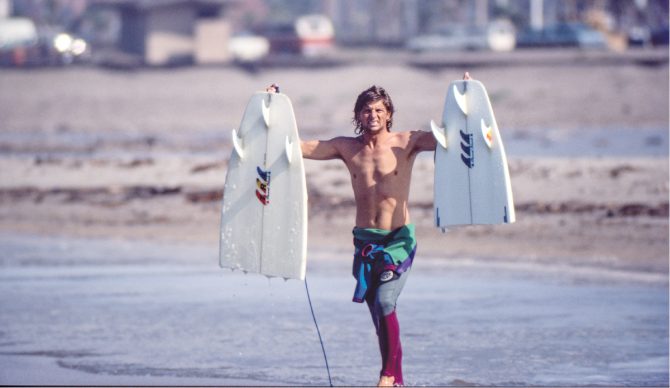
Count the fins: more heartbreak than initially meets the eye. Photo: Jimmy Metyko

Editor’s Note: “Scrapbook” is a limited series from The Inertia’s Sam George, in which the longtime surf scribe draws from a vast trove of personal stories and photos to present a collection of entertaining tales that, while spanning decades of his surfing life, are easily relatable to any of us who’ve joined him in that pursuit.
I was recently reading a story about a surf trip to a remote area on the Indonesian island of Java where a hardcore crew, including Bali ace Tai Graham and New York goofy-star Balaram Stack, having parked at a super-gnarly left reef slab, broke a total of 15 boards — with Stack accounting for seven of the casualties himself. Fifteen broken boards at one time. I found that level of foam and fiberglass demolition hard to fathom, having once, in younger days, worked at a surf shop whose entire surfboard inventory rarely reached that number; having not snapped that many boards during my entire 58-year surfing career. And Balaram’s seven casualties? I can so clearly remember the day I first broke a surfboard, and it took me months to get over the trauma. But I’m getting ahead of myself. First, a bit of broken surfboard history.
Modern surfing’s pioneers (those hardy men and women who took up the sport in the 1950s) never had to worry about breaking their surfboards: they were made entirely of wood, virtually unbreakable. And even with the advent of polyurethane foam and fiberglass in the very early 1960s, the idea of snapping a board glassed with several layers of 10-ounce fiberglass cloth and a 2×4’s worth of stringer(s) was rarely foremost in any surfer’s imagination. In fact, throughout the most of the 1960s, and well into the 1970s, there were only three spots where a broken board was an accepted potentiality: Oahu’s North Shore, Honolua Bay on Maui, and the Huntington Beach Pier. Putting the awesome power of Pipeline, Sunset Beach, Waimea, Honolua’s hungry cliffs, and a concrete collision with HB’s pilings aside, a broken surfboard back then was a rarity — and why this was so is an issue I’ve long pondered.
Why was it, I wondered, that Seventies surf sojourner Kevin Naughton, for example, could literally circle the globe on an extended surfari, including Central America (Costa Rica, El Salvador), West Africa (Spanish Sahara, Ghana, Angola) and the Caribbean (Barbados, Tobago) with only a single orange 7’4” Harbour roundtail in his canvas boardbag? Or that Paul Heussenstamm, Lenny Foster, Billy Pells and the rest of the Newport crew didn’t break all their Russell pintails on their early forays to Puerto Escondido’s “Mexican Pipeline”? It’s not like any of these guys were exactly shy when it came to thundering, 15-foot beach break. But then why was it, that beginning in the mid-to-late 1980s, beach parking lots everywhere began being littered with bisected remnants of broken thrusters?
A possible answer came when working on an early ‘Oughts SURFER story about ‘alternative’ surfboard construction. Consulting a nonendemic structural engineer, it was explained to me that a surfboard is basically an I-beam structure, with the wood stringer connecting both top and bottom layers of fiberglass, functioning like the center portion of a steel construction beam. And that with every incremental increase in the distance between the top and bottom sections of an I-beam structure, the strength of said structure increases exponentially.
“Your solution is pretty simple,” the learned engineer concluded, perusing the dimensions of a typical mid-‘80s surfboard we provided. “If you applied at least four layers of six-ounce fiberglass cloth, top and bottom, and then increased the thickness of this board from two and seven-eights, to, let’s say, five or six inches, you wouldn’t have to worry too much about breaking it.”
Or riding it, I told him. But his explanation did go far to explain why broken boards were much less prevalent back in the day. Using Naughton and the Newport Point Brigade as examples, I’d bet that their boards were all in the 3.5” to 3 5/8″ thickness range, with that seemingly inconsequential extra three-quarters of an inch providing the exponential strength factor our structural expert indicated.
An extra three-quarters of an inch I did without when ordering boards from master shaper Al Merrick in 1983. Prioritizing performance over paddling, I rode comparatively thin boards for someone my size and weight, and to good effect in just about any surf conditions I normally encountered. Or so I thought, when after picking up a brand new 6’2” one fine winter morning and rushing south past marginal Rincon, I joined a talented crew of locals (and visiting dignitary and fellow Channel Island team rider Davey Smith) in grinding, eight-to-10-foot Santa Clara Rivermouth tubes.
Cold parking lot wax jobs are never good, and almost always rushed. But I’m not going to blame anything on the wax — I would have to take complete responsibility for the disaster that occurred that morning. In hindsight, trying out a new board in four-foot, morning-sick Rincon probably would’ve been a much better call than debuting it in pumping beachbreak, where any sort of illuminative test-riding would be limited, if even possible. You don’t learn a whole lot about a new 6’2” when the only option is drop, pump and go. And I had my trusty older board in the car. I could’ve paddled out on it and had no surprises. But that new board smell, the deck without dents, a new sponsor’s stickers — I couldn’t resist getting that thing wet and putting it though its paces. Oh, and should I mention that SURFER mag contributing photographer Jimmy Metyko had set up his tripod and big lens down the beach. I may have known this then, but certainly wouldn’t have owned it: the line between a healthy ego and bald egotism is 16th-inch spruce stringer thin. Hey, look at me, Jimmy!
First wave: an overhead left, lots of foam on the face, but the board felt okay, meaning it didn’t do anything noticeably errant. Felt good when aggressively leaning into the backside kickout. Second wave, much bigger and more critical. I got in late, dropping in just ahead of the lip, and really laid it over hard off the bottom, projecting down the line on what I immediately judged to be a fast-peeling closeout. But did I track as far across the wall as I could before straightening off and taking the whitewater bounce? No, on my beautiful, brand new, freshly waxed Al Merrick thruster I pulled up into the barrel, striking a heroic pose right before the curtain fell. Hoping for, what, the shot? What I got, when finally surfacing, sputtering in the foam after a long beatdown, were the two pieces of my brand-new board, snapped cleanly at the back third, right above where Al, in his characteristically stylish handwriting, thoughtfully penned “for Sam” right along the stringer. Two waves, two halves, one monumentally embarrassed surfer.
Which could explain why, when along with my shattered board (and ego) I made it to the beach, I averted my gaze from any bystanders, and instead sprinted back to the parking lot to get my trusted older board, figuring that redemption might supplant humiliation. And I may have also been experiencing a bit of shock. A custom Al was something special, not easy to get, something to be cherished. I had never even badly dinged any of mine before this, let alone snapped one. What would I tell Al?
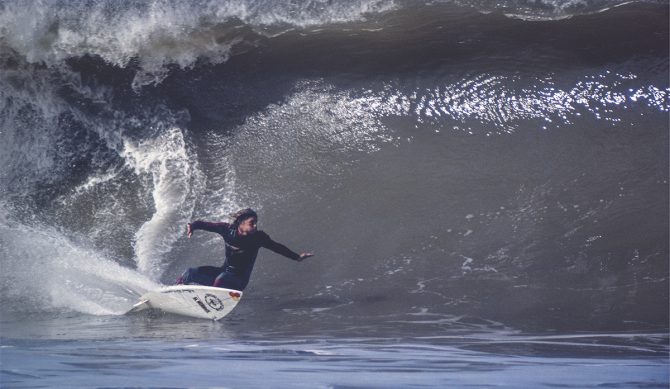
Second wave on a new board with only seconds to live. Photo: Jimmy Metyko
Couldn’t think about that now. I rushed back down the beach, threw myself into the rip and scrambled out on Old Faithful. Paddled deep, deeper even than where top Ventura locals like Ray Call were sitting. Then, before even sitting up myself, I whipped around on the first big set that came my way, got in late, free fell with the lip and…
…and when standing outside Al’s shaping room door later that afternoon, I took a long, deep breath, eyes closed, looking for the words I might use to explain what had just happened. As it turned out, the conversation went something like this.
Me: Hi, Al.
Al (pushing up his mask): Hey, hi, Sam.
Me: Uh, yeah.
Al: So, how’d it go? I heard Santa Clara was pretty good.
Me: Yeah, it was pretty good. Big lefts.
Al: So, how it’d go?
Me: It went great.
Al: Okay.
Me: Until it broke.
Al: What?
Me: I broke it, Al.
Al: You broke your brand-new board on the first day.
Me: On the second wave, actually.
Al, a devout Christian, looked as if he was about to utter something decidedly non-Christian, but after a few deep breaths of his own, quickly regained his composure. He shook his head.
Al: Unbelievable. Well, I hope you like your old board. You’ll be riding it for a while.
Me: Well, that’s the thing, Al. I broke it on my third wave.
This time Al did utter something decidedly non-Christian. Then he sternly narrowed his eyes, looking right at me.
Al: Out. Out. I don’t ever want to see you in this shaping room…
He must’ve seen something on my face, the look of abject desolation. Because right before pulling up his mask and firing up the planer, he finished the sentence.
Al: …for at least a month.
Bad, very bad, but at least it was no life sentence. I’m not sure how I would’ve handled that. And I certainly can’t fault Al. Two broken boards in one day? He had every right to be mad.
But I have to admit, all these years later, I can’t help but wonder what the conversation was like when Balaram got home from Java and told his shaper that he’d broken all seven of his boards on one surf trip. Like, how long was his sentence?

