
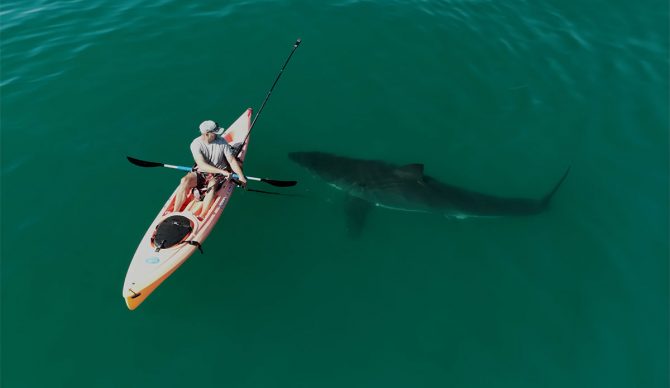
Great white sharks like to check things out, which can feel a little unsettling. Photo: YouTube//Screenshot

If you spend enough time somewhere, you’re going to get to know the locals. The dive bar down the road with the guy who’s always at the same stool. The woman who gets the same coffee from the same coffee shop every morning. The same group of surfers sitting at the peak at their wave. For Carlos Gauna, the locals he likes to get to know are sharks. Recently, he found an old pal off the coast of California.
“There’s this one white shark I’ve gotten to know pretty well this year,” he said. “I’ve seen it show up in a few different places I’ve surveyed. It has the same markings, the same shape, and honestly, the same attitude. It’s one of the more curious sharks I’ve come across.”
The great white shark is a naturally curious animal. They’ve evolved to be that way likely because a curious shark will inspect more possible prey than one who is less curious. Even though we’re not prey, the shark doesn’t know that until they know it, and unfortunately for us, they way they know it is by test biting.
“There are around 5-10 attacks a year, but researchers believe that, rather than preying on humans to eat them, the sharks are instead taking a “sample bite” out of curiosity, before swimming off,” National Geographic explained.
Gauna spends a lot of time flying drones over the coast of southern California looking for sharks, so he’s more aware than most about their habits. Here, he shows the shark being its curious self — and getting really, really close to a kayaker that shows just how big this shark is.

