
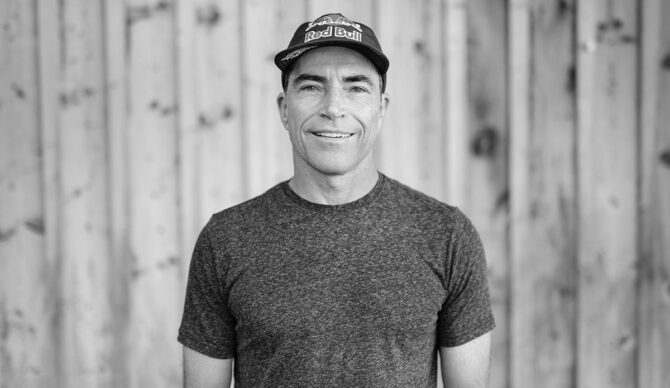
As much as he’s been through already, Burle says he learned even more from this most recent wipeout. Photo: Red Bull

Carlos Burle says his recent Nazaré wipeout was the worst hold-down he’s ever experienced. After taking multiple waves on the head, the 58-year-old Brazilian big-wave surfer was brought to shore and given oxygen.
The severity of the situation led him to question whether he should have been holding a GoPro. He believes the camera distracted him, slowed his reflexes, and complicated the rescue in a situation where seconds can mean the difference between life and death.
Now back home in Brazil, I caught up with Burle to talk about the wipeout and elaborate on his comments about using cameras in heavy surf.
First off, how are you feeling?
Everything’s okay. I have no side effects, but I’m going to do vestibular physiotherapy, something I’ve never done before. It works on the ears. I didn’t like the sensation of being underwater without knowing where I was. I had to work hard on my intuition, just to feel the elements around me and read the situation. That feeling was terrible.
You said that was your worst hold-down ever, but not your worst wipeout?
I’ve had a wipeout that took me out of the water for six months (Jaws, 2013). For me, (what just happened at Nazaré) wasn’t an accident. That was an incident. I could go back to Nazaré and surf tomorrow. I just came back from my workout. I did 20 minutes of cardio, 30 minutes of legs, and then physiotherapy.
As someone who has been underwater many times, yes, that was the worst hold-down. But I didn’t break my leg. My arms didn’t come off. I didn’t swallow any water. I’m feeling amazing.
You said holding a GoPro hindered your rescue. How have people – and other pro surfers – reacted to that comment?
Well, I haven’t seen many of the reactions myself. I’ve just been talking to my team and understanding what we should do next time, or what not to do. Nowadays, we are always looking for footage, and that can get to a point where you have a lack of attention or a delayed reflex, as I had in my situation. And you know what I see? There are a lot of accidents happening because people are filming all the time. I’m not only talking about big waves. I’m talking about our daily lives as human beings. You look around, and people are driving or riding a bike with a cell phone, trying to be connected all the time. I don’t like that very much. But for me, it was a huge lesson. I totally underestimated the situation.
Did you ever consider just letting go of the camera?
I went through the hardest part at the beginning (of the incident), but by the end, I was automatic. I wasn’t thinking about the GoPro anymore. From what I remember on the beach, someone took the GoPro out of my hand. I didn’t even notice that I had it anymore – somehow I had this reflex. I was even swimming with the GoPro in my hand, like it became part of my body. I was just in survival mode. I think I was in a state of shock, and that was the reaction of the body.
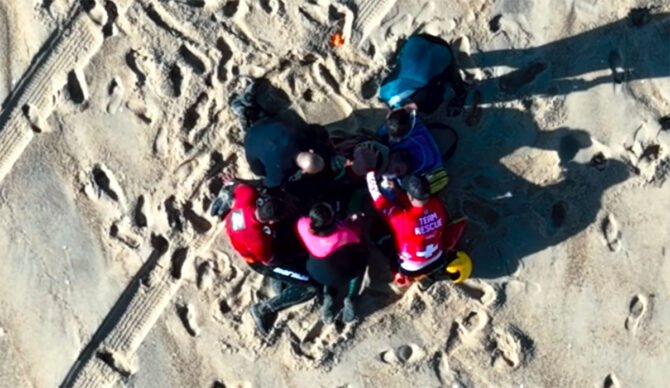
It was not a good scene at Nazare. Photo: Screenshot
What adjustments are you going to make going forward?
I’m going to change my approach in many different ways – the GoPro, the safety equipment, the flotation equipment I wear, etc. I wear too many layers on my chest. I’m not going to do that anymore. It’s too much pressure underwater. I couldn’t breathe very well because of that. I’d also change my line on the wave, too. I just wanted to go all the way to the bottom, but Lucas (Chumbo) told me, “Carlos, if you had chosen a different line from the beginning, turning a little bit to the left, it would have been much safer.”
I could use a mouth mount or put the GoPro on the nose of my board. Next time I’ll do that – much easier. I also noticed that it’s important to have flotation on the legs, butt, lower back, and arms.
Another special thing that came up during a conversation with the team was that before you go out, you can always blow up your CO2 vest. You find the comfortable zone of inflation where you can breathe, but still have extra flotation. Then you have the combination of the pads on your wetsuit – in the right positions – and you have the extra flotation around your chest. I don’t care if I use up a cartridge for that, because there are still three more inside my vest. That’s good enough.
Do other surfers need to hear your message about not using a camera in the water to avoid accidents?
For sure. And not only the surfers. The whole industry has to hear it and keep improving the technology so you don’t have to worry about it. The mounts that they have are amazing, but they have to invent something easier for us. And I think they will. As soon as they put out a smaller camera that works for the wrist, making it so you can swim easily, and you can have maybe a shot inside and outside the wrist, so it’s 360 degrees, that would be amazing.
When will you be back out there this big wave season?
I’m leaving for Hawaii in a couple of weeks to spend two months. I’m looking for some waves there. I’m not going out on the biggest days – places that are very dangerous, where you have to have a lot of strength – because I don’t have that stamina anymore. But I have a lot of knowledge. I have a lot of experience. And if I have a good team around me and good equipment, I can handle very bad situations.
I’m not planning on going back to Nazaré (this season). I don’t like this time of the year there because it’s too cold. From now to March, your fingers are always numb. We have to wear gloves all the time, too much wetsuit. I like October, November, and December, at the latest.

