
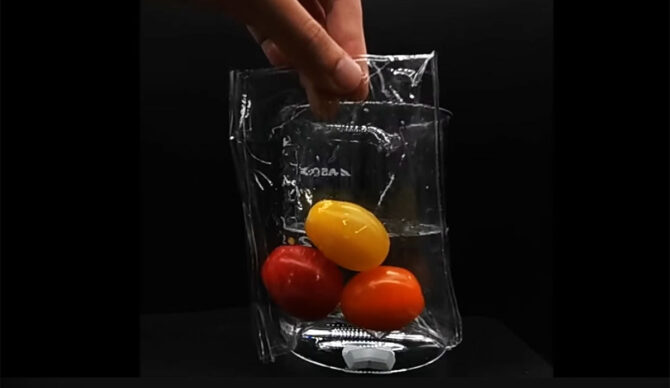
Plastic is a scourge. But this new biodegradable stuff might solve a whole host of environmental issues. Photo: RIKEN CEMS

Researchers in Japan have made an extraordinary leap in the fight against plastic pollution. A new study published in the Journal of the American Chemical Society has been released, and it could be the beginning of something amazing.
You likely know that our addiction to all things plastic is killing the planet. Microplastics are everywhere, from the snow to the sea to the blood in our veins. In our quest for ease, we’ve created something pretty magical, but that magical thing we created is having some unforeseen and devastating consequences. Animals are dying. We’re killing ourselves slowly. And yet, despite the fact that we know this, we just keep puking it out at a ridiculous pace. If only we could make a plastic that worked just as well as the toxic stuff, but was biodegrable, right? Well, we’re in luck. Maybe.
A team of researchers led by Takuzo Aida at the RIKEN Center for Emergent Matter Science (CEMS) in Japan made a new type of plastic from plant cellulose. That is, for the the unaware, the most abundant organic compound on the planet. According to the reports, it is “strong, flexible, and capable of rapid decomposition in natural environments.”
Recycling, as it stands today, is surprisingly ineffective overall. It does save resources and energy and creates jobs in the recycling industry, but the overall recycling rate of plastic is around a trifling nine percent. Things like aluminum, paper, and glass are far easier to manage, but plastic? Oh, is it ever a scourge. It’s nearly impossible to avoid if you live in a society, so don’t feel guilty about reading what I’ve written on a computer made of plastic, on a phone also made of plastic. It’s the way we’ve set our society up that’s the problem.
Around a year ago, Aida and his team created a cellulose-based plastic that degraded in salt water within a few hours. No microplastics were left behind because the material was made from a pair of polymers that are held together by interactions that can be reversed. When salt water is introduced to it, the bonds that hold them together are broken and the “plastic” stopped being plastic. Although it was indeed an amazing creation with plenty of uses, Aida knew it wasn’t what he set out to create. It wasn’t practical in a real-world situation, so he and his team kept on slogging away.
What they came up with is very similar to that original prototype. It’s still made of two polymers, but now one is an FDA approved, biodegradable wood-pulp derivative called carboxymethyl cellulose. The other took a bit of effort to find, since it meant they had to mix and match for a while before finding which one worked. What they eventually landed on was a cross-linking agent made from positively charged polyethylene-imine guanidinium ions. When the cellulose and the guanidinium were mixed up with water, they formed a plastic-type material that was held together by “salt bridges.” When salt water is introduced, those salt bridges break apart and the material rapidly begins to decompose into its original elements.
“Even though the new plastic decomposed quickly, it initially suffered from being too brittle because of the cellulose,” reads a news release about the discovery. “The resulting plastic was colorless, transparent, and extremely hard, but had a fragile glass-like quality. What the team needed was a good plasticizer, some small molecule they could add to the mix to make the plastic more flexible, yet remain hard. After much experimenting, they discovered that the organic salt choline chloride worked wonders. By adding varying amounts of this FDA-approved food additive to the plastic, the researchers were able to fine-tune exactly how flexible they wanted the plastic to be. There’s a video that shows a bag made from the new plastic decomposing in just a few hours.
Like any good product, the technology is relying on previous trials. “While our initial study focused mostly on the conceptual,” Aida said, “this study shows that our work is now at a more practical stage.”
There’s still a bit of work to be done, but the scientists say the new plastic — called carboxymethyl cellulose supramolecular plastic and dubbed CMCSP — is “as strong as conventional petroleum-based plastics and its mechanical properties can be adjusted as needed, without spoiling the intrinsic transparency, process-ability, seawater dissociability, or close-loop recyclability.”
By using cheap ingredients that are already FDA approved, it’s not a stretch to say that we could see the new plastic in the real world at some point in the near future.
“Nature produces about one trillion tons of cellulose every year,” says Aida. “From this abundant natural substance, we have created a flexible yet tough plastic material that safely decomposes in the ocean. This technology will help protect the Earth from plastic pollution.”

