
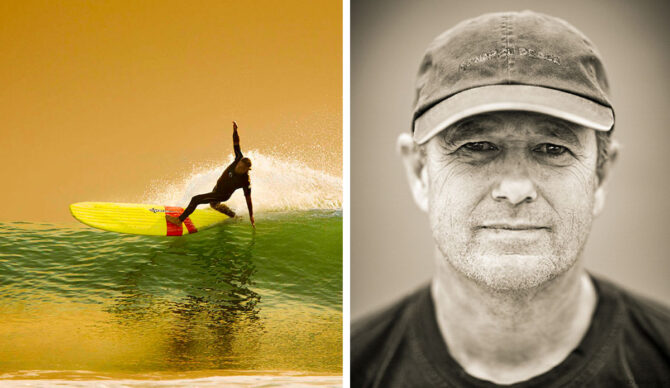
Tom Servais, and his iconic shot of the influential Herbie Fletcher (left).

Tom Servais has lived a life that would make most envious. As a staff photographer for SURFER magazine, he spent years traveling the world with the best surfers, shooting perfect waves in far-flung locations, and earning enough to buy a home in California. But the landscape that shaped his career has changed a lot in the last few decades.
Servais, who was inducted into surfing’s Hall of Fame this year, says the digital photography revolution, the advent of social media, and shifts in marketing trends – among other factors – have made it far more difficult to survive solely as a still-surf photographer. Today, that career path is viable for only a handful of people.
Servais still shoots and has no regrets about the life he chose, even if it wasn’t the most lucrative. We caught up with him to talk about the state of surf photography – the realities of making a living, what advice he’d give to newcomers, and the images catching his eye these days.
In past interviews, you’ve said that there aren’t many iconic surf photos anymore. Can you elaborate on that? Is social media the culprit?
Social media has a lot to do with it. I wouldn’t say that iconic photos don’t exist, but it’s harder for photos to become iconic because they don’t live in anyone’s mind for very long. Think about Kai Lenny and the aerials he does on giant waves. Is there one particular wave that you remember him doing it on? There’s just so much content, and people look at photos so quickly. In the old days, a photo would be on the cover of a magazine or a spread, and people would look at it for a month before they’d see any more surf photos, that made photos iconic since they were embedded in peoples minds.
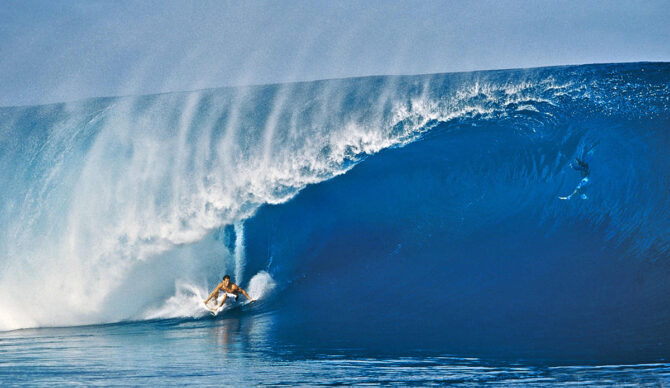
Andy Irons, with Shane Dorian’s twigs barely visible. Photo: Tom Servais
Is there a recent surf photo that has impressed you?
Recently? Photos from Jaws, Teahupo’o and some of the slab waves. Not so recent, I think of Brian Bielmann and his photo of Nathan Fletcher at Teahupo’o on the Code Red swell. There were still magazines at that point. In 2018, there was an XXL swell where Ramon Navarro got the wave of the day, if magazines still existed that may have become iconic. And there are so many great photos of Matahi Drollet at Teahupo’o, but which one sticks out in your mind?
What makes a photo timeless?
A lot of it has to do with timing and how it was published. There are probably different things responsible for timeless photos. With the Tom Curren cutback photo, he was such a popular surfer and you didn’t see him out in front of the camera as much as you might see Kelly Slater. And his style is iconic in itself, especially on this turn. Then the magazine published it and he didn’t have any logos on his board, so that added to the story. And it kept being published many more times and many times in the digital era now. It struck a nerve for some reason. The Andy Irons photo with Shane Dorian swimming in the wave face at Teahupo’o, Andy did interviews about that wave and saying it was the wave of his life, and Shane was in the photo. Again, in the old days print made a more indelible mark on people’s minds. Probably the most iconic surf photo of all time is Greg Noll standing in front of Pipeline in his striped trunks.
What do you think about the Gabriel Medina viral kick-out shot at the Olympics? It’s likely the most-seen surf photo ever.
I’m jealous it wasn’t my photo. Maybe, it was so popular only because the Olympics ran it so much and the media picked up on it? It’s a great photo. And even though there was countless photogs there, it was just that one angle that lined it up so well. It’s kind of a lucky photo, and to be honest, a lot of iconic/timeless photos are lucky. You have certain photographic skills, but you have to be in the right place at the right time and have the right angle whether you’re in the water, on a boat or on land.
The surf community seems to be split on that photo. Some are bitter that it wasn’t a core surf shot.
It doesn’t bother me that it’s not a hardcore surf photo. I think it’s cool. There’s a surfboard in the photo and it’s a surfer. I think almost every single person in the world looks at that picture and relates it to surfing. It is a surfing photo. It’s a flyaway kick out. It’s part of the ride.
You’ve spoken a lot about how digital photography opened the door for more photographers and improved the overall quality with autofocus. Has there been a similarly game-changing innovation in, say, the last five to 10 years?
I don’t think so. It was about 1990 when Canon came out with the first professional autofocus camera. That was a game-changer because, all of a sudden, you had a much higher percentage of your photos being tack sharp. Digital opened up a lot of areas, like being able to shoot in different light conditions. But the best part of digital for established surf photogs was being able to stay out in the water without coming in after every 36 shots. Now you can stay out at Pipeline for as long as you want instead of making trips back and forth to unload and reload your camera. Before digital if you wanted to shoot 140 water shots at Pipe, you literally had to swim in and out four times – and getting in and out of the water at Pipeline was always the hardest part about shooting there. The other thing is that in the days of film, it was expensive, film was $20 a roll for the film and processing, and exposures were critical. So for new photogs wanting to get in the game, they might shoot five rolls and get nothing at a cost of $100, so that discouraged new talent.
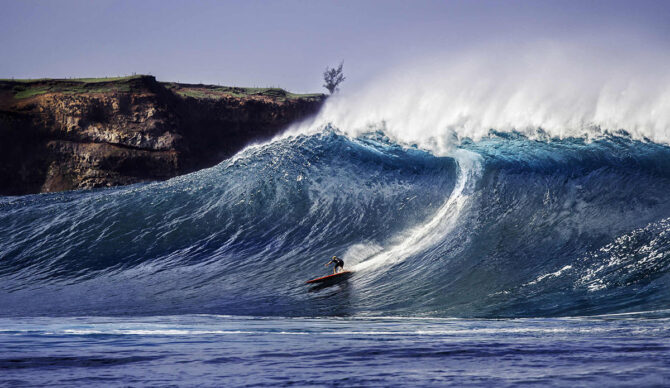
Coconut Willie on a keeper at Jaws. Photo: Tom Servais
Then what will the next big breakthrough be? Phones? Drones? AI?
I have never had a drone. They’re fantastic. I’m not going to say anything negative about them. We used to kiddingly call them a poor man’s helicopter. But with drones you can follow the surfer which you can’t really do in a helicopter, the drones are actually better than helicopter photos, and obviously a lot cheaper. I guess phones will just keep getting better and better quality. I don’t know if they’ll ever catch up with cameras. As far as AI, I have a friend who has been taking some of his stills and turning them into videos. They say with the RED camera, you can take stills from the video. But I don’t think the quality is quite the same. There might be a time when the actual quality out of those might be just as good as a still camera, and that would allow you to shoot video and then pull super high-quality stills from your footage.
Are the days of full-time surf photographers over?
It seems like a lot of the photographers, especially the still photographers, have second gigs. They shoot weddings, product stuff or some side job. Back in the older days, surf photogs were turning down trips. I was very lucky, as others, to be on retainer with SURFER magazine, and we could pick and choose where we wanted to go and shoot with the surfers we preferred. And we had most of our expenses paid for to travel.
Most of the companies don’t have still photographers working for them anymore from what I’ve heard. They don’t market their surfers as much, they rely on their surfers to market themselves on social media. The highest-paid surfers get a budget for hiring their own video guy. There are a few full time still surf photographers, but I don’t think too many are making a good living at doing that anymore?
What kind of a living was it back then? Like a “buy a house” kind of job?
Well, I was able to barely buy a house, when it was more affordable. Some photogs like Jeff Hornbaker (who shot campaigns for Quik and Roxy) or Art Brewer (who did a lot of commercial work outside of surf) were two of the very most successful surf photogs financially and creating some of the most memorable images, the very best and most well-rounded photographers in surf and commercial work. I never made a six-figure income, and I was doing pretty good compared to others. Back then, a lot of photographers couldn’t afford to buy a house, but they were making enough money to travel and enjoy the lifestyle. When I first came to California in the early ’70s just to surf, I was washing dishes, waiting tables, I worked at a clothing store and a gas station, eventually landing a job in the photo department at a junior college. I had these blue-collar jobs making minimum wage, but I was able to live a comfortable life. Nowadays, it seems like if you don’t have a good job, you can barely pay rent. I don’t know how these photographers make it nowadays, lot’s of sacrifice and passion.
Do your old photos still generate passive income?
Yes, still selling photos, mostly from my archives for various projects like books, movies or stories on the internet, and limited edition prints, but not a lot of money, but enough to be comfortable. I live a pretty frugal lifestyle. I don’t have expensive tastes. I still have a lot of freedom.
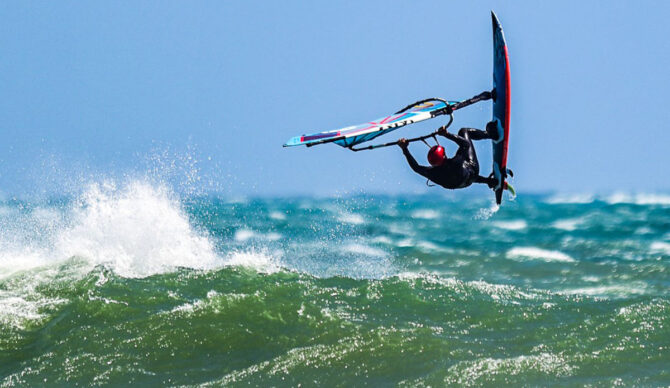
Still an active waterman, this is Tom doing what he really loves these days. Photo: Courtesy Tom Servais
What gets you excited to pick up a camera nowadays?
Going to Hawaii every winter shooting the very best surfers in some of the world’s best waves. I’m not going to make it this winter, but I usually go to Hawaii in the winter for six weeks and I shoot on the really good days when I think I can get something special. Maybe, chase a swell in Fiji?
Any life lessons that you’ve learned through surf photography?
One thing I was taught when I was young was that you’re probably going to work your whole life. I was never motivated so much by money – not that I want to be poor, I want to be comfortable – but I wanted to do something that I enjoyed doing, and I always loved sports. Sometimes now I go, “Gosh, maybe it would have been nice to have made more money, or maybe I should have been a little more careful with my money and saved it.” I probably could have been smarter with some of my money at times, but I had a great time, lived a great lifestyle, and I got to travel the world. I have this giant photo collection that I’m still able to make some money off of, and I have the flexibility and freedom that I’ve always had, which, to me, is as valuable as being rich.
What advice would you give to someone who wants to get into surf photography?
Sometimes I tell people, “You know what? It’s a better hobby than a profession.” But I also tell them if you’re really passionate about something, and you work hard enough at it, you will succeed at one level or another. Your personality and how you get along with people dictate how successful you’ll be in life. I think unless you’re an absolute genius, it really helps to be likable. That opens a lot of doors for you. Photography in general is very competitive nowadays, because everybody wants to be a photographer, whether it’s for fashion or surfing. Next to being an influencer, it’s probably one of the most sought-after jobs.

