
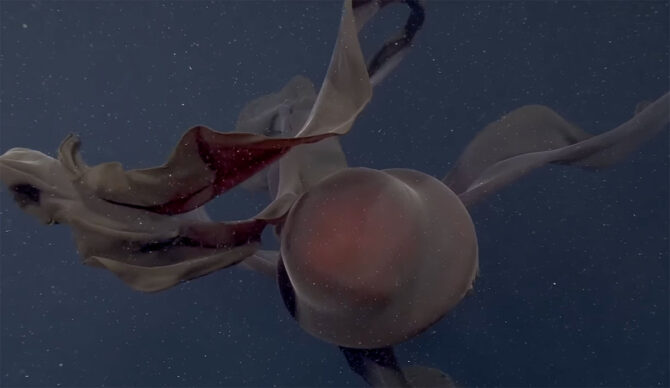
If you see one of these, don’t worry about being stung. Worry about the fact that you’re probably four miles under the surface of the ocean. Photo: YouTube//Screenshot

Sea monsters are myths. We know that. There are no real sea “monsters” in reality, but reality sure does come close. Take, for example, the giant phantom jellyfish — which is a decidedly sea-monsterish name — and you’ll understand just how close.
Sea monsters from old tales likely came from sailor’s stories of the high seas. Giant squid have long been thought to be the foundation of many of them, but the giant phantom jellyfish easily could be one as well. The colossal jellyfish is extraordinarily rare and there has only been a handful of sightings of them since the first one was dragged up from the depths in 1899.
“Despite their size, there have been just over a hundred recorded encounters of phantom jellies,” BBC Science Focus wrote. “Rare sightings have been made all around the world, in the Atlantic, Pacific, Indian and Southern Oceans, where they generally occupy extreme depths. They’re known to roam more than six kilometers (four miles) down.”
They truly are something out of a science fiction story. A huge bell that can measure over three feet wide, arms that grow to over 30 feet in length, and a strange, reddish glow from within all make them look, for an inhabitant of Earth, very alien.
If you happen to run into a giant phantom jelly (unlikely), you don’t need to worry about being stung to death. You don’t have to be worried about being stung at all, in fact, because they don’t have the stinging cells that some jellyfish do. Instead of stinging their prey, the giant phantom jelly reaches its huge, billowing tentacles out and scoops small fish and zooplankton towards the mouth.
A few years ago, researchers from the Schmidt Ocean Institute were aboard the R/V Falkor exploring the seas in the Antarctic. In particular, they were getting a closer look at the site where an iceberg calved off an ice sheet. What it exposed was a giant area of ocean that, until then, had been unexplored.
The researchers deployed a remotely operated vehicle called SuBastian (cute, right?) to peer at the seabed that had been hidden from view, and they found a whole host of weird stuff. They were excited about all of it, but nothing got their scientist hearts beating like the giant phantom jellyfish.
They also obtained spectacular footage of a giant phantom jellyfish drifting past. According to the BBC, there’ve been more sightings by tourists than researchers. That’s because those super expensive Antarctic cruise ships often have personal deep-diving submersibles that are capable of taking passengers down below the surface. The footage they get — mostly on cell phones — is nowhere near as crystal clear as the footage you see here, though.

