
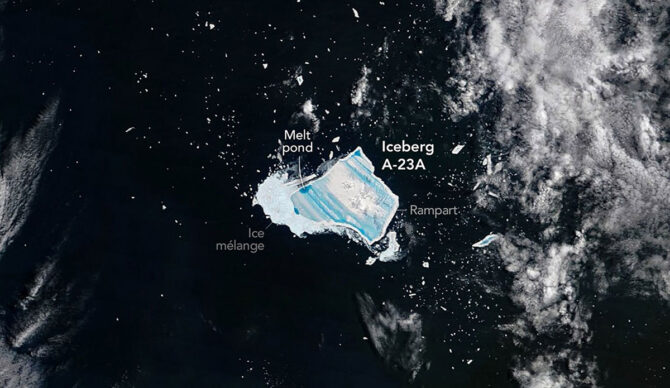
The A-23A iceberg, as seen from space on December 26, 2025. Photo: NASA

According to NASA, one of the biggest and oldest icebergs ever tracked has turned blue as meltwater covers it over. Called A-23A, the iceberg is roughly the same size as Maryland and Hawaii combined. Scientists keeping a close eye on it said on Thursday that it is “on the verge of complete disintegration.”
In 1986, A-23A broke off from the Filchner–Ronne Ice Shelf. For a few years, it stayed basically where it was, stuck on the sea bed. But in 2020, it broke free from its shackles and began to drift. Five years later, in January of 2025, it was still the world’s largest iceberg.
Back in 2020, the iceberg weighed almost a trillion tons. Late in 2025, however, it became apparent (from space, anyway) that it was rapidly deteriorating. As it melted, it drifted into warmer waters, where the melting accelerated. Where it was once nearly 4,000 square miles in size, now it has shrunk to about 456 square miles — still huge, but smaller than it once was, causing concern.
“I certainly don’t expect A-23A to last through the austral summer,” retired University of Maryland, Baltimore County scientist Chris Shuman said in a statement.
It should go without saying that an iceberg of this size breaking up would have consequences. As usual, it appears that those consequences are slow-moving enough that they don’t properly register with our human brains that work on our time scales. But it’s a canary in a coal mine, and it has stopped singing.
“Scientists warn that the breakup of this icy giant could accelerate sea level rise, disrupt ocean currents, and affect marine ecosystems worldwide,” CNN wrote. “This event is being described as another red alert for humanity — a visible sign of how quickly Earth’s climate is destabilizing.”
Late in December of 2025, NASA’s Terra satellite captured a few images of the remainder of the once-massive iceberg.
“Extensive pools of blue meltwater were visible on its surface,” NASA wrote in a news release. “Though much smaller than it once was, what remains is still among the largest icebergs in the ocean, covering an area larger than New York City. An astronaut aboard the International Space Station captured a photograph showing a closer view (below) of the iceberg a day later, with an even more extensive melt pool.”
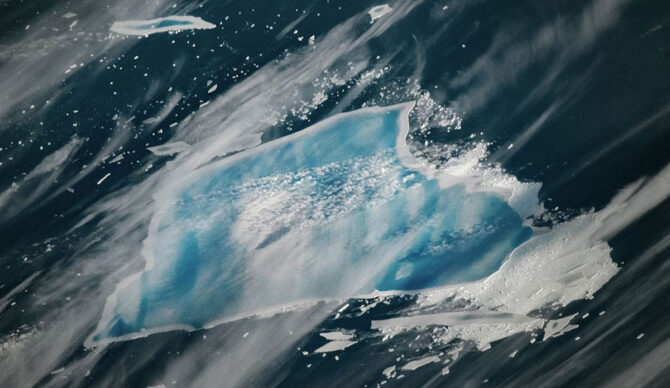
The “blue-mush” areas are likely the result of ongoing disintegration events. This photo was taken on December 27 2025. Photo: NASA
Ted Scambos, a senior research scientist at the University of Colorado Boulder, explained the image to the layperson.
“The ‘blue-mush’ areas are likely the result of ongoing disintegration events,” he said. “You have the weight of the water sitting inside cracks in the ice and forcing them open. Note also the thin white line around the outer edge of the iceberg seemingly holding in blue meltwater—a ‘rampart-moat’ pattern caused by an upward bending of the iceberg plate as its edges melt at the waterline.”
That suggests that the iceberg has a leak, and the water from beneath is coming up from a crack somewhere in the middle of it, accelerating the melting. The blue and white stripes clearly visible in the image are interesting, as well. Likely caused by the ridges in the Antarctic bedrock, they were carved into the iceberg hundreds of thousands of years ago. They are having an effect on how the berg is melting.
“The striations formed parallel to the direction of flow, which ultimately created subtle ridges and valleys on the top of the iceberg that now direct the flow of meltwater,” said Walt Meier, a senior research scientist at the National Snow & Ice Data Center.
Although it is frightening news, it’s a good example of just how important scientific endeavors like this are. If we know what to expect in the future, we can better prepare for it.
“I’m incredibly grateful that we’ve had the satellite resources in place that have allowed us to track it and document its evolution so closely,” said Shuman. “A-23A faces the same fate as other Antarctic bergs, but its path has been remarkably long and eventful. It’s hard to believe it won’t be with us much longer.”

