
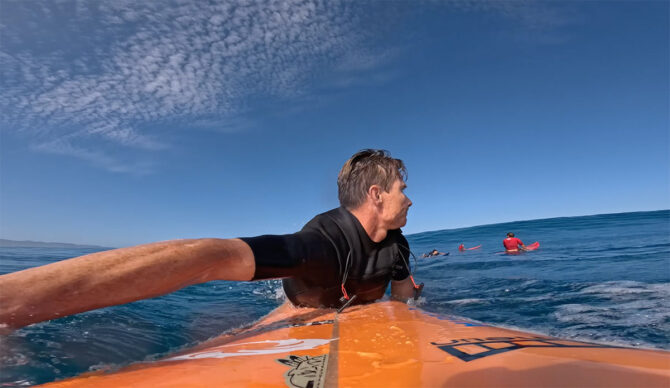
Mark Healey, paddling for a monster. Photo: YouTube//Screenshot

Among all the video clips of the amazing surfing being done at the Banzai Pipeline this winter came a surprising entry that was sure to delight anyone who can remember when Billabong boardshorts came down well below the knees: 52-year-old Shane Dorian, dropping into a Backdoor bomb, pulling in behind the curtain, only to casually get spit out at the closeout section like it was 1995. Yet it seemed to me that there was something decidedly different about the ride, especially when contrasted against many of the other Pipe highlights on offer. And upon a third viewing it hit me: it wasn’t the way Shane rode the wave, in his timeless, masterful “Backdorian” style, but in the way he paddled into it.
Not like so many of Pipeline’s incredibly talented New Breed, not like Mason Ho, who thrashes into his choice of set waves, kicking and squirming on his tiny …Lost like a lizard on a hot-plate, or John John Florence, who atop his tiny Pyzels appears to paddle in place until, firmly encased in the lip, he gets to his feet and drops in as if jumping out of a second-story apartment window. But in Shane’s case, smoothly stoking into the wave with noticeable impetus, setting up a long barrel that will no doubt qualify as one of the North Shore’s “waves of the winter.” The difference was in the details, I discovered, at least as laid out in Dorian’s Insta explanation: he was riding a giant surfboard, at least by today’s Pipeline standards, his 7’3” John Carper measuring more than foot longer than those of his Pipe peers. Which, naturally, got me to thinking not about riding surfboards, but about paddling them.
Paddling a surfboard in an attempt to catch a wave (or in some cases trying not to get caught by a wave) is a desperate act. And a ridiculous one, at that. When viewed in terms related to the sciences of kinesiology and biomechanics there is probably no more inefficient mode of locomotion in the realm of sport. Picture how we surfers spend the majority of our physical effort through this lens, and never mock a rollerblader again. Laying prone on our stomachs, compressing the diaphragm and restricting proper breathing, our backs arched, necks craned back, further compromising oxygen exchange, engaging relatively small muscle groups, with the most strain exerted on the body’s least-stable, mechanically-weakest joint, all while trying to drag a partially submerged flotation device not on, but through the resisting water with two puny, five-fingered paddles. No wonder all those GoPro selfies of surfers paddling for waves, not to mention getting caught inside, depict them looking anything but confident. Athletically speaking, paddling a surfboard at any rate of speed is the equivalent of running a 10K on your hands.
Interesting, though, how some of the earliest descriptions of surfing focused almost as much on the paddling of Polynesian surf craft, as the riding of waves. History’s very first illustration of a surfer, as rendered by official expedition artist John Webber’s depiction of Capt. James Cook’s landfall at Kealakekua Bay in 1777, shows a Hawaiian paddling a blunt-nosed board out to meet the British ships — no illustration of a surfer actually riding a wave would appear until more than a half-century later, in the front piece of “Polynesian Researches,” by Rev. William Ellis, published in 1833.
Written descriptions, however, abound, many reflecting the observer’s keen interest in the act of paddling, or, as referred to in many cases, the “swimming” of surfboards (understandable, keeping in mind that archaic wooden surfboards offered neutral buoyancy.)
A passage from George Gilbert, a midshipman on Cook’s flagship Resolution, included in 1784’s published account of that expedition’s “first contact,” recalls:
“Hawaiians who have not got canoes have a method of swimming upon a piece of wood in the form of a blade of an oar. Which is about six feet in length, 16-inches in breadth at one end, and is about nine inches at the other…in the middle tapering down.”
An early 19th century account provides a bit more detail on this unique mode of recreation:
“When using the board [Kona’s Chief Kraimokou (sic)] lies down flat on his stomach, head toward the rounded end,” wrote French explorer Louis Freycinet in 1825. “…and uses his hands like paddles, and with his feet directs this sort of float with astonishing skill and swiftness.”
One of the most insightful descriptions of surfboard paddling appeared in an 1875 travelogue written by intrepid Victorian traveler Isabella Bird, who drilled down on the actual catching of waves.
“What they seek is a high roller,” Bird wrote, describing a session witnessed in Hilo, Hawaii. “On top of which they leap from behind, laying down on their boards. As the wave speeds on, and the bottom strikes the ground, the top breaks into a huge comber. The swimmers appeared posing themselves on the highest edge by dexterous movements of hands and feet, keeping just at the top of the curl, but always apparently coming down in a slanting motion.”
The most comprehensive early examination of paddling, however, can be found in Jack London’s volume The Cruise Of The Snark: A Pacific Voyage, first published in 1911, in which the famous American author dedicates a good deal of his chapter titled “A Royal Sport” to the technique, and travails, involved with paddling a surfboard. I’m asserting that none better has ever been written, his descriptive skills presenting a scenario easily relatable to any boardrider today.
“One slides down the face of a breaker on his surfboard,” London penned. “But he has to get started to sliding. Board and rider must be moving forward at a good rate before the wave overtakes them. When you see a wave coming that you want to ride in, you turn tail to it and paddle shoreward with all your strength, using what is called the windmill stroke. If the board is going fast enough, the wave accelerates it.”
London, famous for his groundbreaking, masculine prose in novels like The Call of The Wild, and The Sea Wolf, waxes downright breathless when describing his first foray out past the shorebreak.
“I shall never forget the first big wave I caught out there in the deep water,” he writes. “I saw it coming, turned my back on it, and paddled for dear life. Faster and faster my board went, until it seemed my arms would fall off. What was happening behind me, I could not tell. One cannot look behind and paddle the windmill stroke. I heard the crest of the wave hissing and churning, and then my board was lifted and flung forward. I scantly knew what happened…though I kept my eyes open I could not see anything, for I was buried in the rushing white of the crest. But I did not mind. I was chiefly conscious of ecstatic bliss at having caught the wave.”
Like I said, a desperate act. Whether, like London, you’re a neophyte catching your first green-water swell at Waikiki, or, judging by all those GoPro shots, a professional big-wave rider stroking into North Shore outer-reef monsters.
Strange, then, how London’s “windmill stroke” has prevailed for so many decades. Only as of late have any new forms of propulsion crept into the mainstream surfing consciousness: Sailboarding, kitesurfing, tow surfing, foiling, wing foiling, not to mention stand-up paddling, modern surfing’s “love that dare not speak its name.” And yet all these applications, every one characterized by advantages not afforded by traditional, bare-handed paddling, are so often categorized as a surfing subtype, as if any technique used to catch waves other than with the windmill stroke is somehow not “real” surfing; not hewing to authentic surfing origins. Not offering the surfer the opportunity to truly experience what Capt. Cook’s naval surgeon William Anderson so eloquently described in 1784 as the most supreme pleasure of “…being driven on so fast and so smoothly by the sea.”
Oh, wait, that’s right. The Tahitian surfer the good doctor observed was catching his waves in an outrigger canoe. Using a paddle.

