
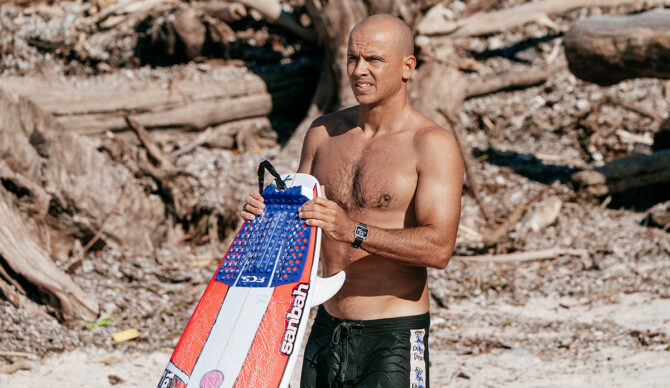
Julian says he had a choice: re-qualify or save his business. Photo: Andrew Shield

Last year, the WSL gave Julian Wilson a pathway back to the Championship Tour. They awarded him a Challenger Series wildcard to re-earn a spot after stepping away from competition in 2021. But after lobbying for the opportunity, he didn’t use it. He was a no-show at three of the first five events.
That absence was curious, especially given that Wilson showed he could still compete among the world’s best when he finished second as a wildcard at the Gold Coast CT stop. The reason, Wilson says, was the fallout from Donald Trump’s tariff scheme.
Back in December, Wilson posted on Instagram that his WSL dreams were fading as he shifted his energy toward building his brand, Rivvia Projects.
I speculated that his absence from the Challenger Series might have stemmed from underwhelming results at his first two events – a 49th in Newcastle and a 65th at the U.S. Open. He didn’t enter Ballito, Ericeira, Saquarema, or this week’s event at Pipeline.
However, Wilson later got in touch with The Inertia to refute that notion. So we jumped on a phone call and, according to the CT veteran and former tour runner-up, the U.S. Commander in Chief is to blame. When President Trump implemented his global tariff policies, it put Rivvia Projects – headquartered in Long Beach, California – in a tough spot because the clothing brand’s production was outside the U.S. Wilson says he was forced to choose between pursuing a return to the CT or saving the company. He chose the latter.
He described the shift in the global business landscape as “diabolical” for his company.
“I’ve basically been rescuing my business since the Gold Coast (CT) event, which is why I haven’t been able to make it to Challenger events,” Wilson said. “I have had to decide to save my business and all the effort that I put in there, or otherwise, I would have had to walk away from it to chase the dream of going back to the CT.”
Wilson says it was no longer sustainable to operate in the U.S. As a result, he moved Rivvia’s headquarters from California to Australia to dodge the tariffs, taking a more hands-on role in running the business. He said the company had to shift its focus away from the U.S. and toward Australia, Japan, and Europe, though he hopes to return to the American market when conditions improve.
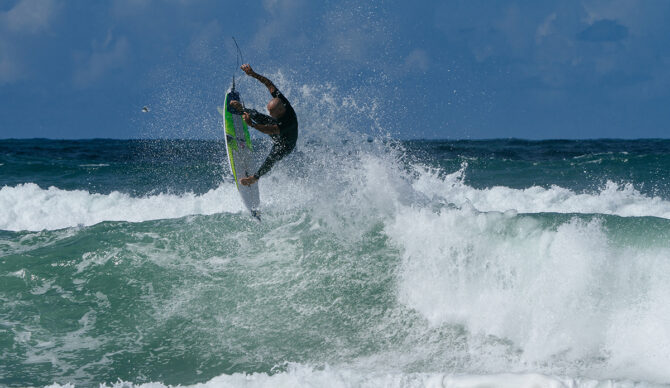
Mr. Wilson can certainly still surf at a Championship Tour level. Photo: Andrew Shield
“At this point in my life, my career, I can’t have my cake and eat it too,” said Wilson. “I had to choose.”
Rivvia wasn’t alone in that dilemma. FCS also briefly ceased operations in the U.S. around the same time.
Wilson says he hasn’t been in contact with the WSL regarding CT wildcards. John John Florence’s recently vacated slot was awarded to Ramzi Boukhiam, whom Wilson agrees was the most deserving replacement. He acknowledges that the WSL may not be thrilled that he skipped several Challenger events, but he still plans to compete in the season finale in Newcastle.
Amid the demands of running his business, Wilson admits he hasn’t been surfing much lately. However, he revealed that Rivvia is currently working on a film project in which he plans to play a prominent role. Filming has already begun in Australia with team riders Matheus Herdy, Ryan Callinan, and Caden Francis.
As for Rivvia’s transition to Australia, Wilson says the move is gaining momentum.
“We had an amazing response to setting up shop in Australia in the back half of last year,” said Wilson. “There’s still a lot to go to become a proper, established business and profit, but it’s definitely stabilizing.”
Whatever comes next, Wilson says that his second-place finish on the Gold Coast last year stands out as a career highlight, even without the win.
“The most satisfying competitive experience was last year on the Gold Coast with my three kids there, and coming back after four years of not competing,” said Wilson. “I really went to the Gold Coast just looking forward to surfing in the trials and having a family holiday that I could enjoy. I was able to get second in the event and have a competitive run unlike anything that I’d ever experienced.”
Wilson makes it clear that his shift toward business doesn’t amount to full competitive retirement. He remains committed to competing in the final Challenger event of the year and hopes to enter trials in 2026 for more shots to compete at the CT level.
He’s also had preliminary discussions with the Surfing Australia program, exploring potential ways to mentor the next generation of Australian surfers.
“I’m definitely open to those things,” Wilson said. “It’s just a matter of whether it makes sense. Between running the business, going surfing, and raising three kids. That’s where my focus is.”

