
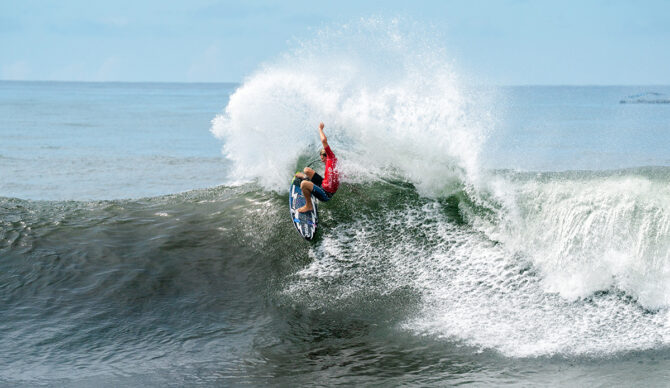
Leader of the new school, Dane Henry at the Junior World Champs. Photo: ISA

“The fact is that when you are a young emerging rookie from Australia or South Africa, you not only have to come through the backdoor… but you also have to bust that door down before they hear ya knocking.”
That was Rabbit Bartholomew’s famous quote that appeared in a SURFER article in 1976. He was referencing the aggressive, “no-fear” attitude the Aussies felt they needed to crack the hostile North Shore.
Now, sure, roughly six months later, Rabbit found himself locked in a cage in the back of Eddie Rothman’s pickup with two pitbulls. He was then forced to hole up in a Turtle Bay hotel room, banned from surfing by the locals, and would later need Eddie Aikau to broker a safe passage off the island.
But the quote endured. It would come to represent not just the birth of professional surfing, but an attitude that led to an early Australian domination of the sport. In the Men’s, Rabbit, Cheyne Horan, Mark Richards, Tom Carroll, Barton Lynch, and Damien Hardman collected the majority of world titles omitted on offer through the ’70s and ’80s.
And then Slater came, followed by Andy Irons. Since Occy’s world title in 1999, only Fanning and Parko have added to the tally. Mick’s title, won in 2013, was the last one on the men’s side for the Australians. In the decade and a bit since, the sport has been taken over by the Brazilians. Medina, De Souza, Toledo, Ferreira, and Dora have taken eight of the 11 titles on offer, the only bulwark being John John Florence.
Yet, if we take the recent world junior titles as a barometer, it might be perhaps the first time in decades that there are signs that the balance of power could be shifting back to Australia.
“This year at the World’s, the Aussies took over, which is pretty sick,” said 2024 and 2025 semifinalist, Lennix Smith. “It’s good to see a couple of my mates do well, like Winter (Vincent), Dane (Henry), and Hughie (Vaughan). We are the middle-aged crew of the juniors, and in our last year, there was pressure, but we stepped up.”
The Aussies filled three of the four semi places in the men’s, and all of the women’s. The USA’s best surfer was Will Deane, who was knocked out in the Round of 16. The Brazilians fared little better. Unlike last year, when Indonesia’s Bronson Meydi took the title, the Aussies had a victory when Dane Henry took out the title.
Now, just how much of a future indicator junior world titles are is up for debate. For every Andy Irons, Joel Parkinson, Adriano de Souza, and Gabriel Medina who captured junior titles and went on to be world champs, there is a Finn McGill (2016) and Lucas Vicente (2018).
Yet Henry seems better placed than most of his contemporaries to parlay a junior title into a senior version. One of the world’s best aerialists (see these Snapt5 leftovers here), he is also blessed with an Ewingesque rail game, and is known for putting his head down and charging when it gets serious.
View this post on Instagram
“Yeah, he’s pretty fucking good,” was Smith’s typical Aussie appraisal. “His all-around ability is crazy. In our semi, he milked a one-footer for five points in the last 10 seconds, and got the score. So he can grind as well.”
Henry now gets a wildcard into the Challenger Series, and with no Championship Tour rejects being put back in the pack, it seems his inevitable path to the CT has had a few potholes removed. In fact, the Aussies’ road to elite surfing is as smooth as it’s been in generations. There has been a decade of unrivaled government funding, headlined by its world-leading High Performance Center in Casuarina. Three of the seven Challenger series events are held Down Under (and they currently occupy half of the top 10 promotion places), and it hosts 1/4 of the CT schedule.
Now the big dogs like Medina, Toledo, and Ferreira may be a bottleneck at the top of the sport, but all are over 30 and have already stepped away from the sport once (or twice) before. While Dora, Ewing, Colapinto, and Robinson are a few years younger and ready to pounce, there’s a significant talent gap to the next batch of potential world title contenders.
This generation of Aussie’s look best to fill it. “We’re coming at it pretty hard,” said Smith. “‘We’re fired up for sure to get back and take on the world again. We just gotta be better at winning and not be losers.”
Less busting down the back door, the Aussies might be simply pressing the doorbell and waiting to be let in the front.

