
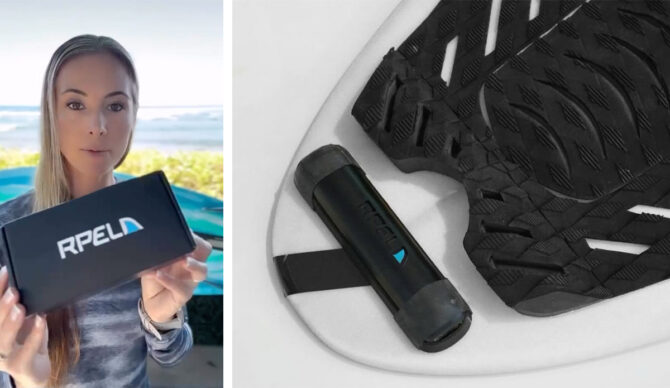
Ocean Ramsey says she’s seen RPELA work in real life. Photos: RPELA

Ocean Ramsey knows sharks. She knows them so well that she was the focus of a Netflix documentary called Shark Whisperer. She knows them well enough that The Inertia created a course about shark safety with her. She’s often the center of some debate about how she goes about her interactions with sharks, but there is no denying that she’s extremely knowledgeable. Which is why I was surprised to see her promoting a shark deterrent called RPELA.
I was surprised because shark repellents are famously not very useful. There are a million and one of them kicking around, from LED lights to magnets and eye stickers to zebra stripes, but so far, they’ve all felt a bit like snake oil.
A hundred or so years ago now, I hopped aboard a little boat leaving from Haleiwa Harbor. Ocean was there on the boat, quietly explaining to us what to expect. We saw sharks, and plenty of them. It was unnerving, but eye-opening, and it was abundantly clear that Ocean knew how to act around sharks. Her comfort with them was infectious, and by the time we were back on land, I had a whole new outlook on sharks. A better one that was more informed by information rather than by watching the movie Jaws.
The thing about shark repellent devices is that they are not always going to be successful. It’s hard to accurately say if they’re working or not, too, since we can’t ask the shark what made it bite or what made it swim away. But Ocean thinks that RPELA, if used in conjunction with the right behavior, really is effective. It’s important to note that Ocean says she was not paid to promote RPELA — she just thinks it works and wants other people to be safer.
“This device is not meant to make anyone ‘invincible,’ she said. “But when combined with informed, adaptive behavior, it can effectively and powerfully help reduce risk. In my hope of helping people to be safer while enjoying the ocean by learning how to coexist with sharks, I wanted to share information about both technological options and other choices/behaviors that can help us adapt to sharks’ sensory systems and ecological role and behavior. I genuinely care about people and sharks, and I hope fellow surfers, swimmers, and divers might find something here helpful or insightful.”
Again, she’s not part of REPLA, but she has used two of their devices with white sharks, tiger sharks, Galápagos sharks, and sandbar sharks in multiple regions around the world, and that she has personally seen it work. She’s got plans to test it with bull sharks later this year.
The way that it works is actually pretty simple, and it’s an idea that’s been floating around for quite some time. Sharks have an interesting organ called the Ampullae of Lorenzini that lets them detect electrical fields in the ocean. In short, it’s a crawling network of mucus-filled pores in the skin of sharks, rays, and a few bony fish like the sturgeon. The thought is that by creating an electrical field around the surfer or swimmer, the shark will be repelled. There are a few promising studies around it, but as Ocean pointed out, it’s not going to make you invincible.
She does, however, have a few tips that might help the RPELA device work better. They’re basic things to avoid if you’re worried about sharks, like avoiding areas near fishing activity, educating yourself about seasonal shark aggregation sites, not splashing around like an injured seal, and generally not looking like prey.
So while the jury is still out on just how effective these things are, Ocean Ramsey believes that if used in conjunction with safe practices, RPELA could lessen the chance of a shark attack.
View this post on Instagram

