
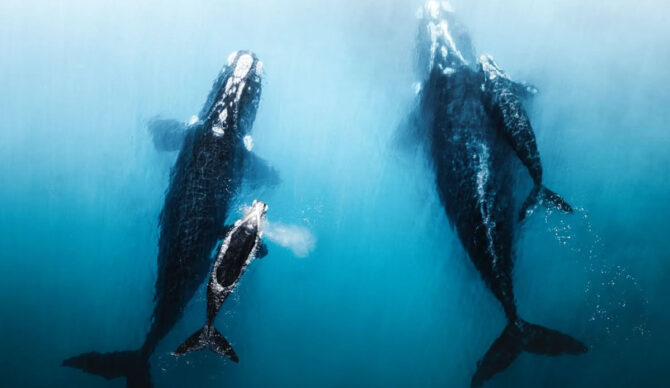
Once touted as a success story, scientists are worried about recent reproductive trends with the southern right whale. Photo: Phil de Glanville//Instagram

Research out of Australia casts a gloomy shadow over the future of the southern right whale. In a new study published in Nature, scientists at Flinders University and Curtin University say climate change in the Southern Ocean is harming how quickly the whales reproduce.
The study used more than three decades of photo data, observing 1,144 calving events among 696 individual whales. They note that the southern right whales’ strong tendency to return to the same coastal calving grounds makes them a species that can be studied using photo data.
Over the past 15 years, evidence across at least three Southern Hemisphere populations shows a concerning increase in the interval between births. While the species was growing at an estimated seven percent annually in 2009, new findings reveal a decline in females following the typical three-year calving cycle. Instead, an increasing number of whales now require four to five years between births.
The whale’s historical birth cycle is three years: one year of pregnancy, one year of lactation, and one year of rest before repeating.
The University of Tasmania published research showing that calf numbers have declined from 222 in 2016 to 200 in 2024.
Researchers hypothesize that the reason behind the decline is none other than climate change. The whales have two primary feeding grounds: krill-dominated high-latitude zones close to Antarctica, and copepod-dominated zones in mid-latitudes to the north. Reduction of sea ice has particularly affected the availability of krill in the high latitudes, constraining the whales’ foraging zones. Plus, food availability in the mid-latitude zones has suffered from marine heat waves.
“We’ve analyzed the data and looked at links and correlations to various environmental variables, and showing that there is a significant link between the increase in calving intervals and environmental variables,” said the lead researcher on the study, Dr. Claire Charlton.
“With a warming ocean, we’re getting increased sea ice melting, which is leading to a decline in sea ice, and the less sea ice that there is, the less krill that is produced.”
Researchers say the study underlines the need for conservation efforts in the Southern Ocean. The southern right whale, whose population was estimated at around 13,600 in 2009, has bounced back after nearly being hunted to extinction in the 18th and 19th centuries.
Once touted as a success story, the new data shows a concerning trend in the opposite direction.
“In my lifetime, the right whale was thought to be extinct, and their protection and return to Southern Hemisphere coastlines gave hope for their recovery,” said co-author of the study Robert Brownell Jr. “However, based on our findings, their future is now in doubt.”

