
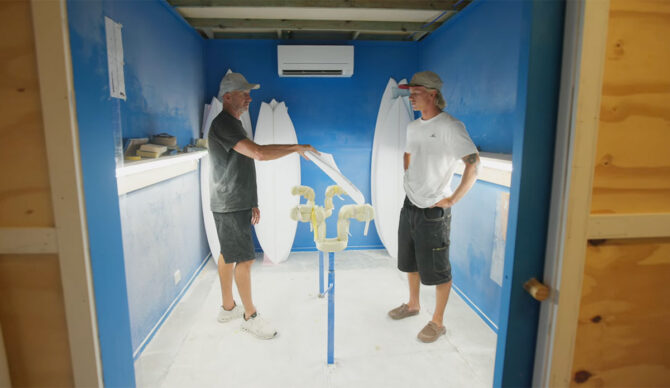
Handley knows how to make a surfboard go. Photo: YouTube//Screenshot

Getting a new surfboard is one of the best things there is. Sure, one off the rack that you’ve bounced beneath your arm a few times is fun, but getting a shaper who knows you and knows how you surf to make one from a hunk of foam is a lot better. There’s a lot that goes into it, so Joel Vaughan headed to the DHD factory to let Darren Handley walk the viewer through the process from blank to finished surfboard.
You likely (hopefully I’m not breaking tragic news to you) know that the surfboard you bought off the rack is not made entirely by hand. Machines do the brunt of the work, and if you’re lucky it’ll be hand finished. Years ago, I designed a few surfboards for a small company that made mostly promotional shapes. From start to finish, they were made in a factory. We sent off the specs, waited a few months, and then recieved boxes of finished surfboards. They floated and surfed, yes, but that was about it.
There is, I think, a bit of a misconception with factory produced boards — for the most part, machines just cut away much of the excess foam and create the rocker profile. The bottom contours, rail foils, and fin placement still requires a ton of skill, so machines aren’t all that capable of making a very good surfboard from start to finish. It’s easy for the big brands these days to plug in the specs, fire off an order, and let a factory do the big cuts, but they still need a bit of a haircut and some makeup.
And it makes sense, too — it’s pretty hard to scale up when you’re doing everything custom. It’s a weird thing, though, because while we all want to “support our local shaper,” sometimes a shaper is better supported by selling a shape to a bigger company that will recreate them on a machine. But that’s not always the case, and in my experience, hand-shaped boards made for me and my supremely average surfing just seem to go better. It could be a placebo effect, but whether it is or it isn’t doesn’t matter. If I think my hand-shaped surfboard goes better… well, then it goes better. Surfing for the everyman isn’t about points, it’s about feeling.
When you get to a certain level of surfing, you will not be buying a board off a rack. You’ll likely be pretty involved in the process, and you’re likely going to get a hand-shape. Vaughan is getting those, and for good reason. Darren Handley knows how Vaughan likes his surfboards to feel, and he’s very, very good at doing that.
“You get some people who get a machine to do everything and people finish them off,” Handley said. “I like to shape them. I like to leave a little bit there so you can shape them. You can get better results when you’ve got something to play with.”
A custom surfboard for a professional surfer is generally more custom than a custom for the average surfer. Millimeters of difference in fin placement, millimeters of difference in the rails, and millimeters in difference in thickness. It’s the tiniest of tweaks that the best surfers in the world require, and for the majority of us, they might not even be noticeable.
We’ve all likely got a decent idea for the basics of how a surfboard is made, but watching a master at work from blank to finished product is a masterclass in surfboard construction.

