
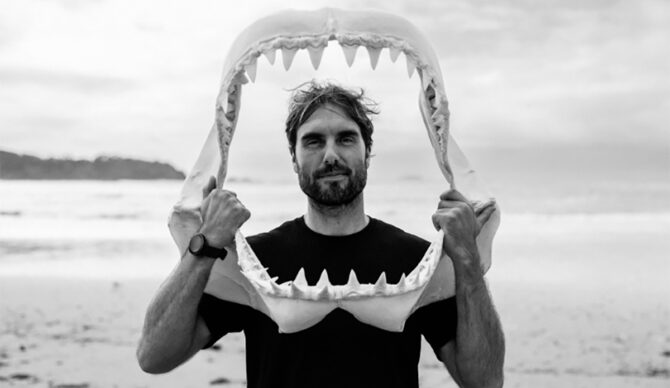
Brett Burcher’s project will tell his story, but also delve into the broader shark issue in Australia. Photo: Crossing the Tideline

“If it wanted me, I was gone,” said Alex Preston. “There was no sound on the surface. There was no visible sign of it under the water. It just got up on me so quickly and quietly.”
Preston was surfing Dee Why, on Sydney’s Northern Beaches, last week, around 7 a.m. Small waves, sunny skies, clear water. He caught a small right-hander, and then, noticing a splash and a black shadow beneath the surface, turned and bolted for shore.
It was only after a friend reviewed the cam footage of the incident that he realized how lucky he had been. The shark was far closer and behaved more aggressively than he had realized. It was ready to lunge just as he caught the wave.
The near attack came a few weeks after a spate of shark incidents in Sydney. A 12-year-old boy had died following a bull shark attack in Sydney Harbor. The next day, a surfer was lucky to survive after he was bitten at Manly. Last year, Mercury Psillakis died surfing Long Reef, less than a mile to the north of Dee Why.
“It’s pretty chilling watching that footage,” said former slab hunter and pro surfer, writer and now breath work facilitator Brett Burcher. “The difference was mine was a great white shark, which was much, much closer, and was all caught by a drone camera directly 20 meters above me.”
This was in 2023. Burch was surfing at his home break of One Mile Beach at Foster, on the New South Wales mid-north coast. Less than 300 meters away, just up the sandy path that leads to the beach, his partner and three-month-old daughter Maggie were at home.
Burch grew up on the South Coast of NSW in Ulladulla, well known for its sharky zones, and throughout his 20s chased some of Australia’s gnarliest, most remote and sharkiest slabs in Tasmania, South Australia and Western Australia. So he’d encountered them before, but nothing remotely like this.
“About 20 minutes into the surf, I was paddling out. In the middle of an unbroken swell line, I saw a submerged black outline pushing water forward,” he recounted. “Within two seconds, it just whipped around from behind and just came at me. I instinctively kicked my feet in the air, and it lunged. It missed, and I sort of kicked it, knocked its nose, and (it nearly) sheared off my legs. It then went back around, circled a few times and I thought it was definitely coming for another hit.”
Burch was in the water with just a handful of surfers, not unusual for that sleepy part of the world on a weekday morning. What was unusual, though, was that a mate, Kirk Owers, had checked in earlier. Kirk, a well-known surf writer and photographer, couldn’t surf with Burch, as he was doing disability support work that morning, helping a teenage client. The client was a keen photographer and videographer who owned a drone camera. Owers said he’d bring him down and film Burcher’s surf, as part of the day’s support.
Burch couldn’t watch the footage for a few weeks. When he eventually worked up the courage, it showed what he calls an ambush, in crystal clear 4K, viewed from directly above. The shark was a 3.5-meter great white, and even in the subsequent viewings, he couldn’t quite believe he survived. Like in Preston’s case, he caught a wave just as the shark was ready to lunge again.
“We locked the footage down straight away. I knew how rare it was to see a surfer get attacked and survive,” he said. “But I was also traumatized for a few months. I had a new daughter, and it was so close to home. My trust in the ocean and surfing, key pillars of my life, had been stripped away completely.”
People react differently to trauma. For Burcher, the incident and the rare footage sparked his own hunt for education and research. That has eventually led to a documentary project called Crossing the Tideline.
“The film is really about me personally trying to rebuild that trust I lost,” he said. “So it’s a personal journey; however, the first time I watched the footage, I clocked that it could be educational. I figured it could be more constructive than a sensational news piece and be used to generate some positive outcomes.”
Burcher would enlist the help of director (and Russel Bierke’s longtime collaborator) Andy Kaineder and Damon Gameau, the award-winning filmmaker known for his documentaries on the hidden sugar in foods in That Sugar Film, and 2040, which looks at the effects of climate change.
View this post on Instagram
Burcher has spoken to a bevy of shark behavior experts, scientists (including Dr. Cliff Kapono), medical and mental health professionals, and attack survivors, as he grapples with what is both an intensely personal, and highly contentious, subject.
“I approached it without an agenda, as I know of the impacts and unanswered questions that have rippled through coastal communities, car parks and lineups around the country as the shark-human interactions have increased,” he said. “But the film sits not just with those questions, but with trauma, PTSD and mental health.”
Having lived through the experience, he wants to create space to examine fear, perception and reality, and to ask how surfers might coexist with sharks in the ocean. As he’s gained education on the ocean conditions that might favor shark attacks, and the best way to be prepped before and after any incidents, he hopes future audiences can also gain the insights he’s been gathering. Just without a shark trying to bite his legs off.
However, unlike his lucky escape with the great white, he’s discovered that making documentary films is neither quick nor painless, even with the experienced crew he’s working with. “After two years, Damon told me we are actually moving pretty quickly,” he laughed. “I thought the surf industry was tapped, but the film world is wild. Hats off to anyone who has actually got one off the ground.”
After securing two rounds of development funding, the team is awaiting further investment to complete the doco, and get the considered message out there.
“The time is now. You can debate all you want about culling, nets and overall government strategies, but those measures will still only affect the future,” he says. “For me, getting as much of the bigger picture as I could, and applying it to the way I connect with the ocean right now gave me at least some personal element of control and trust.”

