
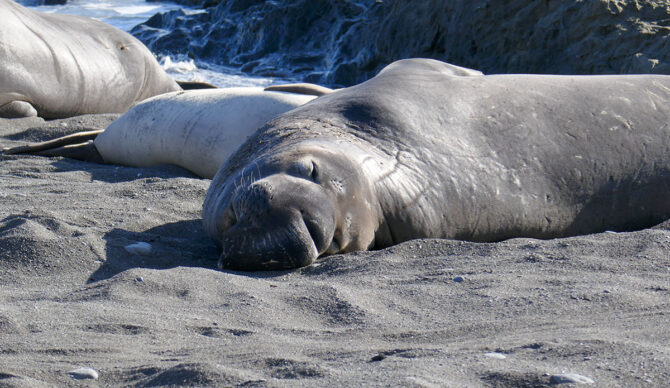
A virus that has proven deadly for colonies of southern elephant seals was discovered in a California population. Researchers are closely monitoring the spread. Photo: Evan Quarnstrom

Seven elephant seals at Año Nuevo State Park in California have tested positive for a strain of bird flu that proved disastrous for similar species in the Southern Hemisphere. Researchers monitoring the situation are worried about the well-being of the population.
Researchers announced Wednesday that they had confirmed cases of the virus in deceased pups at the Northern California colony. On Feb. 19 and 20, they noticed seals with “abnormal respiratory and neurological signs, including weakness and tremors.” Since last week, 30 seals have died at the park. The colony numbers around 5,000 seals, with 1,350 present on the beach when the outbreak began.
“I think we’re really nervous about the trajectory of this outbreak, which, of course, we can’t predict,” said Roxanne Beltran, an ecologist at the University of California, Santa Cruz, which is leading the seal monitoring. “Our primary concern right now is to limit spread in this colony.”
The virus, H5N1, has already proven catastrophic for closely related southern elephant seal populations. In late 2023, it killed an estimated 17,400 pups on Argentina’s Valdés Peninsula and more than 50,000 adult females on the island of South Georgia.
Still, researchers are cautiously optimistic that the outbreak in Northern California will not be as severe. Most of the colony’s adult females had already departed on their routine migrations before the outbreak began, and the virus has so far remained clustered at the southern tip of the beach.
“There are some hopeful signs,” Beltran said. “One of them is that we haven’t seen an exponential uptick in mortalities.”
In the case of Northern California, it’s still unclear how the virus is spreading — whether seals transmit it to one another, as occurred in Argentina, or contract it from infected birds. State Park officials closed beach access and canceled guided tours for the remainder of the season.
H5N1 was first discovered on a goose farm in China in 1996 and has since spread across the world, reaching Antarctica in 2024. The virus spreads particularly fast among birds, but can also spread to animals and humans, though the risk for humans is considered low. The CDC has received 70 reports of human cases since 2024, including one death where a man contracted the virus from birds in his yard.
Beltran’s team will continue monitoring the colony through samples and observation.

