
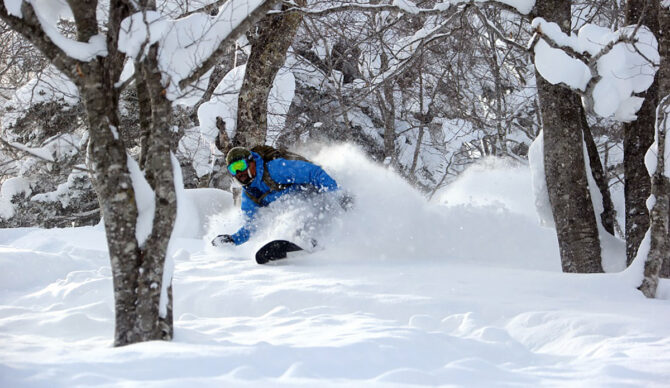
With snow like this, who needs summer? Photo: Photo: Hachimantai Ski Resort

While surfing made its historic Olympic debut at the 2020 Tokyo Games (held in 2021) at Chiba’s Tsurigasaki Beach (where American Carissa Moore won women’s gold), come wintertime adventure-seekers flock to the Land of the Rising Sun to shred its powdery slopes, not its waves. Skiing, snowboarding, sushi, sake, and hot springs…what’s not to like about Japan? On my trip to the main island of Honshu’s Myoko region this season, an area rimmed by as many ski resorts as onsens, I learned a few things you might not find in the guidebook.
Navigate Tokyo Train Stations Like You Do the Off-Piste: “OK, we want to head down that smooth ramp over there, then dogleg right to that flat area and then descend that other stair-step to that platform where we can regroup.” No, that’s not skiing a line in the backcountry, but traversing the maze of escalators, stairways, turnstiles, and people — all while hauling your overstuffed ski bag behind you — to get to your designated bullet train within a four-minute window (good luck!).
Embrace the Sidecountry: The word’s out on Japan, and most slopes get tracked out quickly. So, bring your touring and avi gear, secure the necessary beta, and beeline to the side- or backcountry, where you’ll find your Instagram-worthy turns. Figure it out on your own if you have the gear, gumption, and experience, or hire a guide, which will make the process easier and more efficient. Most areas — like the ones we visited, including Akakura Kanko, Seki Onsen, Suginohara, and Arai — offer countless off-piste options where a short skin takes you to the goods. Our best backcountry run came on our last day off Seki Onsen, ending at a slow-as-molasses, two-person chair from another lodge (and era), where we eagerly ponied up 300 Yen ($1.50) in coins for a ride that brought us right back to a cooler of Kirins in our parking lot. We sort of bumbled into it, but couldn’t have planned it better.
Bring Rubberized Boots: You’ll want these both for trudging around in the snow and for walking through towns like Nozawa, where they flood the streets with hot spring water for snow control (some parking lots even have hot spring sprinklers pop up to thwart the snow). You might walk through a half inch of water at a time, which will drench a typical sneaker or leather boot. Favorites among our group were Sweden’s fully waterproof Fubukis (try the Niseko 3.0), or my domestically made, get-used-to-the-comments Loon’r’s, out of Boulder, Colorado. Plus, they’re uber-light, so they don’t add any weight to your crammed gear bag.
The Runs Are Long: “I love a run that makes your ears pop,” said my Canadian friend Paul at the bottom of a 3,000-vertical-foot sidecountry run off the Nozawa Ski Resort on an earlier trip. Indeed, ear equalization comes with the territory here — many runs are so long and effortlessly fun that you’ll drop elevation in record time, with an ear-to-ear grin the whole time (which, coincidentally, is good for equalizing).
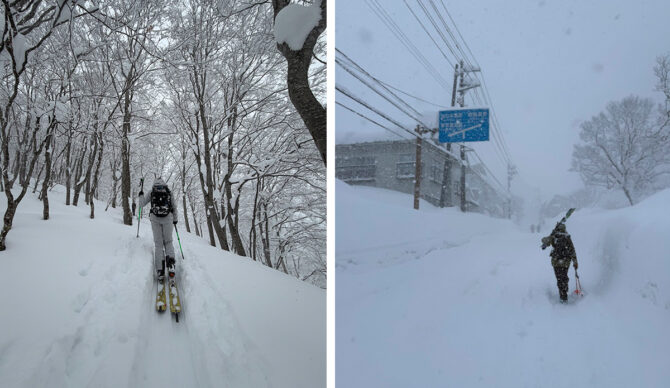
Bring the touring gear. And be ready to walk whether in the mountains or on the street.
There’s a Dearth of Trash Cans: For a country that overpackages everything — from sandwiches to seaweed snacks — there’s hardly anywhere to put your trash afterward. Whether you’re at a ski lodge, store, restaurant, or onsen, you’ll search fruitlessly before finally just stashing the wrappings in your pocket.
It’s Got Heritage: While riding snow here is nothing new — its first resort dates back to 1937 — it’s become more popular than ever thanks to its culture, prized dry snow (shin-setsu, meaning “new snow”), and terrain. Nagano, in the heart of the Japanese Alps, hosted the 1998 Winter Olympics, and Sapporo on the northern island of Hokaido, hosted the 1972 Olympics. And, oh yeah, Japan won gold in this year’s Olympic men’s Halfpipe and Big Air competitions.
Don’t Fret the Tickets: Don’t worry about which resorts might be on the Ikon or Epic pass. Tickets are dirt cheap by U.S. standards, often between $40 and $60. Many resorts also let you just buy a one- or two-ride ticket for accessing the backcountry. At one resort, family-owned Seki Onsen, a lift ticket even included lunch for only $30 — and there wasn’t even anyone checking.
You Might Stay Just for the Toilets: Japanese toilets are the bomb, equipped with everything from privacy settings (i.e. a noise-maker button you push) and obligatory heated seats to perfectly aimed bidets — often with several spray choices — foregoing any need for wiping.
Practice Onsen Etiquette: Onsens, or natural hot springs, are part of the program. They’re everywhere, from hotels to stand-alones, varying in size and amenities like the Who’s in Whoville (which many towns resemble). All are his and hers and be forewarned there’s some onsen etiquette involved: scrub and wash first while squatting on the stool (and spray your stool off afterward); be quiet (no loud blabbing like you do stateside); no drinking; and no splashing or snowballs. And it’s perfectly acceptable to help wash your friend. You’ll hit them every day, taking your avi beacons off in the changing room.
It’s Old School: “In the U.S. you’re just a lift ticket number,” says my nephew Sam, who runs a series of lodges at 67-year-old Togari Onsen resort where a monk works as its head of ski patrol (you can see his temple from the chair), and a snowcat driver owns the Guinness record for growing the world’s most expensive rice. “Here, the resorts are small and family run, and the skiing is way more intimate, with soul and community. And the mountains are alive, with a long history of people taking care of them. You feel like you’re communicating with them every time you ride.” Some resorts, like Seki Onsen, even boast single seat chairs a la Mad River Glen (not that there’s anything wrong with that).
Beware Your Kankos and Onsens: A lot of the resort names sound similar but require different tickets. At Myoko’s Akakura Kanko, Japan’s oldest, backcountry guide Bill Ross of Dancing Snow warned us on our sidecountry ventures to be mindful not to accidentally ski to the adjacent resort of Akakura Onsen. He also advised that the lifts can be confusing; we took lift numbers 1, 2, 3 and 5, but there is no 4.
They Drive on the Opposite Side: Yes, just like Down Under and in the UK. So if you’re renting a car (which is easy, but they run out of inventory quickly), that means the blinker is on the right, not your windshield wipers; look right when turning left; know where the headlights are; get used to picking up drinks with your left hand; and pay special attention in roundabouts. You’ll also get used to walking around to the wrong side.
Pow’s the Name of the Game: I never thought we’d base our morning ski decision on which resort got the “least” amount of snow. But that’s what we did, after getting hammered with about 40 inches overnight. Billsan’s recommendation: Arai, which has the steeps, including a hike/skin-to “freeride” zone. Somewhere between mid-January and mid-February seems to be the magic window for snowfall. (This year we got more than 220 centimeters in eight days — like Groundhog Day in a giant snow globe.)
Gear: My advice? Bring your avalanche and touring gear, with skis or snowboards that withstand the occasional groomed run at the resort. I went with 106mm underfoot — a hair narrow for deep pow but light for touring — and a four-buckle touring boot for beef. A pair of Drift approach skis or Atlas Upland Snowshoes are a good idea for snowboarders (even a splitboard but that means more gear). Also, bring radios like the BCA Link for communicating with your team; just make sure you keep them out of sight at the resort. Cram it all into a ski bag like the Db Snow Roller (ideally one with wheels) and everything else into your carry-on.
Avoid the Creeks: Be careful to avoid creek beds, both in-bounds and out. The valleys aren’t glaciated like many are in the Rockies, so instead of big “Us” they form steep “Vs,” which act as terrain traps. The day before we arrived, Max Martin, a 32-year-old professional big mountain skier from Jackson, died in the backcountry of Hakuba by falling into a hidden crevasse behind a waterfall near Mount Kotomi.
Don’t Channel JP Auclair: As perfectly sculpted as the snow-lined streets are and as much as you might want to, don’t try your own Auclair-style street segment and schuss all the way home. Technically, it’s illegal. We did it once, though, to get back to our lodge. A cop drove by and reprimanded one of our party, who then had to walk, while we waited for him to leave and then street skied to our front door (minus JP’s acrobatics).
Beware the Turnstiles (But Don’t Fret the Lines): Despite priding themselves on being so efficient at everything — like mini-trains delivering sushi — they still don’t have the lift thing figured out. For some reason, triple lifts and quads all have one less ticket turnstile than there are chair seats. You’ll see three turnstiles for quads and only two for triples, which messes up alternations just before you board. And do your yoga; the chair seats are as low as the onsen stools. As for lines, no ropes separate them, so you’re left to your own mayhem trying to alternate (which would never fly in step-on-your-skis Europe). Luckily, the Japanese are overly polite.
7-11s Rule (But Don’t Always Pack a Lunch): Never will you be so enamored by a 7-11 in your life. Everyone hits them on the way to the resort for BYO lunch, where you can choose from sushi, onigiri (rice balls), and onigirazu (rice sandwiches wrapped with nori seaweed), to katsu and egg salad sandwiches to die for. And there are countless other goodies (wasabi beef chips anyone?) that stuff perfectly into a pack. It’s so popular, in fact, that their shelves are often completely emptied the night before. While the 7-11s are incredible, the lodge cafeterias and private slope-side restaurants are even more so — and a welcome change from the corporate-owned cafeterias at stateside resorts. On the menu: katsudon (chicken cutlet over noodles with an egg), miso soup, yakitori (chicken skewers), yakiniku, (Japanese barbecue), and large bottles of Kirin beer. But bring cash for the privately owned ones, as many don’t take credit cards.
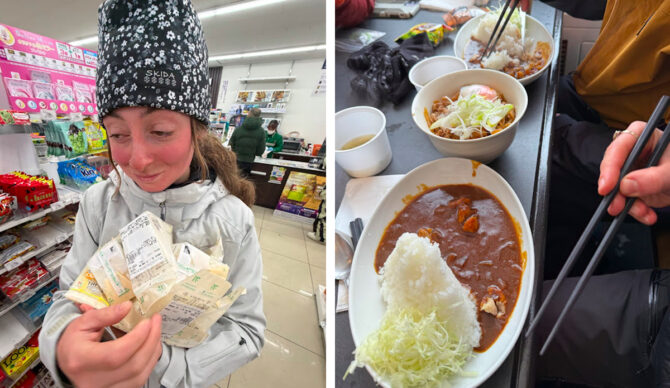
From the 7-11s to the restaraunts, Japanese food is unmatched, much like the snow.
You Can DIY in a Camper: We ran into several people who had rented camper vans, cramming up to four people inside for their week-long tour. One such group from Washington camped each night in 7-11 parking lots, also giving them access to early sandwich pickings each morning. But there are drawbacks as well. One morning, a cop knocked on their door at 4 a.m., telling them to move. Another time their door got snowed in by a three-foot storm.
Hit the Sushi Train: Our concierge Nao took us to the Uobei sushi shop in Joetsu and it was well worth the 45-minute drive. The chain, with branches in different towns, is run by Genki Global Dining and lets you order on a table screen while a miniature train delivers you sushi, sake, and beers right to your table. After our backcountry run at Seki Onsen, our buddy Brownie ordered with reckless abandon to feed a table of six starving guys. We stuffed our faces for an hour straight on nothing but sushi. Final tab? Eighteen bucks per person, including sake and beer.
Use a Ledger: This is a system our gang has been using for years on group trips. Instead of everyone paying separately, driving wait staff bonkers, you take turns picking up various “group” tabs, dividing it all up with a ledger system afterward. It works for everything from train and lift tickets to car rentals and meals. And it encourages you to order that extra dessert or beer.
Accommodations Rock: Ours, at the Alpinist Lodge in Myoko, would’ve run a fortune in the U.S. Here, it was $1,000 a head for nine nights, including breakfasts, uber-concierge Nao, and most of our dinners, enjoyed family style around a large table and cooked by her chef husband Shige. It offered six double rooms with tatami mats, his and her onsens, a mudroom with benches, cubbies, and ski and skin racks, endless Kirin beer on tap, and a sunken living room with couches, fireplace, guitar, and big screen (where we watched the Broncos lose to the Pats at 5 a.m.)
Ski the Forest for the Trees: Japan is known for its tree skiing, especially cutting turns through 200-year-old beech tree forests, or buna, guarding the goods like sentries. While the tree means “useless” in Japanese — it’s too pliable for building — here they’re anything but, holding moisture in their roots, which preserves the prized dry snow (shin-setsu, meaning “new snow”). Plus, they’re perfectly spaced for effortless skiing all the way to the valley floor.
If You Go: Find all you need to know about skiing the Japanese Alps here.

