
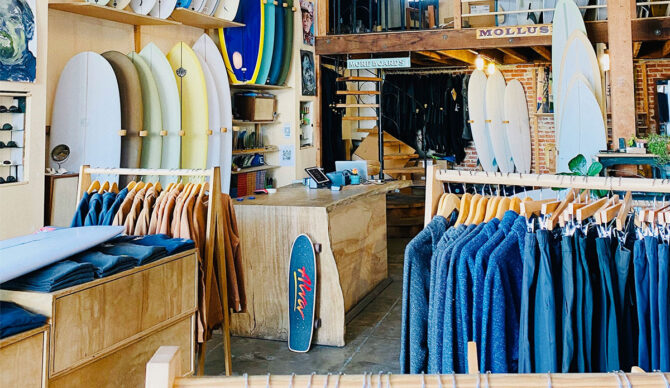
Even though the Supreme Court ruled that some of President Trump’s tariffs are illegal, a surf industry leader says brands have received little relief. Photo: Chloe Lefleur//Unsplash

Despite a recent ruling by the United States Supreme Court that many of President Donald Trump’s global tariffs are illegal, surf industry brands are still struggling to navigate an unstable economic landscape, according to Vipe Desai, executive director of the Surf Industry Members Association (SIMA).
Following the ruling, Trump issued a new 10 percent blanket tariff – at one point threatening to raise it to 15 percent – before ultimately implementing it this week at 10 percent. Even though for some importers, that rate is lower than what they were previously paying, the temporary reduction has done little to ease broader concerns across the surf industry.
“It’s still chaos. The relief is very little,” Desai said.
Desai, who meets monthly with industry executives at SIMA board meetings and maintains a constant pulse on the sector, said uncertainty around when and how tariffs are implemented has been particularly crippling. More than a year after the initial round of tariffs, some of the consequences are still unfolding.
“It’s becoming challenging for brands to operate here,” Desai said. “And I do see brands softening their approach to products in the U.S. – from licensing and distributorships to even wholly owned operations. People are just saying, ‘We’ll bypass the U.S. for now.’”
One clear example of this emerged when Julian Wilson revealed he’d fully removed his brand, Rivvia Projects, from the U.S. market, relocating its headquarters from California to Australia and forgoing a potential return to Championship Tour qualification in the process.
According to Desai, brands are now searching for creative ways to stay profitable – diversifying supply chains to countries hit less hard by tariffs or establishing entirely new manufacturing routes. He describes the industry’s response as unfolding in three phases: first, absorbing costs while trying to understand the situation; second, interrupted budgets and early cost-cutting; and now, a third phase marked by deep cuts.
“Phase three was employees, and we started to see that at the end of last year with layoffs,” Desai said.
He also noted that some companies are still dealing with elevated tariff rates that predate the most recent policy shifts.
“I was speaking with a couple of brands last week – they were dealing with 39 percent tariffs,” Desai said. “Some goods coming out of China are still elevated. So it’s not like all the tariffs are gone.”
Sectors that rely heavily on overseas mass production – such as footwear, eyewear, and apparel – have been hit especially hard, he added.
As for Trump’s stated goal of bringing manufacturing back to the United States, Desai said he has seen very little evidence of that within the surf industry. He emphasized that surf manufacturing operates within a global economy, where raw materials, specialized machinery, and technical expertise are often located outside the U.S.
Desai said surf consumers have so far been shielded from the worst effects. Brands, he explained, have largely absorbed rising costs and introduced price increases gradually, rather than passing them on all at once.
Even before the first round of tariffs, Desai said many brands anticipated disruption and had already begun exploring production in new countries. While the environment has been challenging, he sees opportunity in the industry’s manufacturing expanding to new countries, particularly in Mexico and El Salvador.
“I’ve spoken with some of the folks (in El Salvador) already, and what I’m seeing is really interesting,” Desai said. “There is nearshoring of manufacturing happening, at least within the North and Central American landscape.”
For those considering entering the U.S. surf market during this period of uncertainty, Desai offered a blunt assessment: preparation and capital are essential.
“I would look at where your manufacturing is right now, what it costs to bring product into the U.S., and whether that prices you competitively or prices you out,” he said. “And before a brand enters the U.S. market, they need to ask whether they’re well capitalized. Under this administration and these tariffs, you have to be well funded.”
Despite the widespread uncertainty, Desai does see one bright spot: the consumer.
“I think the only positive thing in all of this is that the American surf consumer is resilient and still passionate about surfing,” Desai said. “As long as surfers are committed to getting in the water, the industry will endure. That’s what we have to focus on.”

