
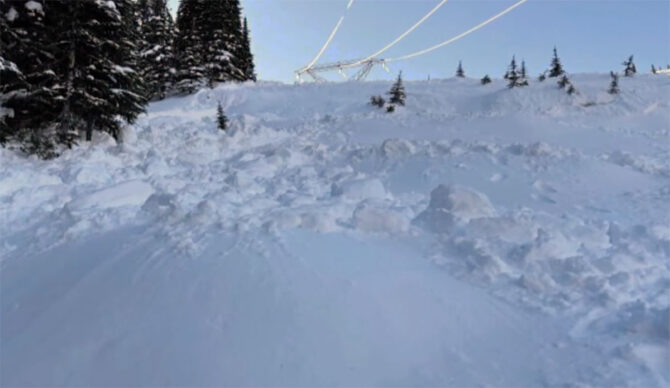
The avalanche was triggered by snowmobilers riding in Kootenay Pass. Photo: Avalanche Canada

A snowmobiler is dead after an avalanche over the weekend. According to the Royal Canadian Mounted Police (RCMP), the victim was riding with a partner in the Kootenay Pass area of the Selkirk Mountain Range in British Columbia when they triggered the slide. Only one was alive when rescuers arrived to dig them out.
Police were notified of the incident at just after noon on Saturday. With the help of an SOS Garmin device, they located the avalanche victim.
“Other snowmobilers in the area provided assistance to the two snowmobilers involved while emergency personnel from the Creston RCMP, Search and Rescue, and B.C. Emergency Health Services responded,” they said in a news release Monday. “Both men were extracted by the other snowmobilers, but sadly a 23-year-old man died at the scene.”
The Kootenay region is a beautiful place. Rugged and vast, it stretches from British Columbia’s Okanagan Valley to the Alberta border. It’s home to some of the most fantastic resorts in North America — Golden’s Kicking Horse, Revelstoke, Whitewater in Nelson, and Red Mountain in Rossland, just to name a few — and many of the people who call the area home are hardy hunters, fishermen, and mountain explorers. Skiing, snowboarding, mountain biking, and snowmobiling are popular there, and that’s becoming a real risk considering the recent conditions.
Many of the mountains in Western Canada are under a high avalanche risk after a strangely warm and wet winter followed by a pretty massive dump of snow. “That’s the situation we have more widely in the Interior right now, which is a very weak complex snow pack with buried weak layers,” said Wendy Lewis, a forecaster with Avalanche Canada. “We’ve had a lot of new snow on top that’s stressing those weak layers. Those conditions contributed to that avalanche.”
This season, four others have died in British Columbia avalanches. The most recent was Stratton Matteson, a well-known splitboarder who died riding near Anniversary Glacier just a few days ago.
The danger levels in the mountains in much of Western Canada are high, and authorities are warning those who choose to explore them to stay as safe as possible.
“Avoid exposure to avalanche terrain” Lewis said. “Stick to non-avalanche terrain, so low-angle slopes free from overhead hazard where you’re unlikely to be affected by an avalanche.”
In British Columbia especially, the snowpack is more dangerous than usual. With a dismal winter in the rearview and now a thick layer of new snow, rescue crews are worried that many folks will flock to the mountains in search of the snow they waited all winter for. Search and Rescue crews are worried, though, since the dangerous conditions paired with an uptick in adventure-seekers could lead to more fatalities.

