
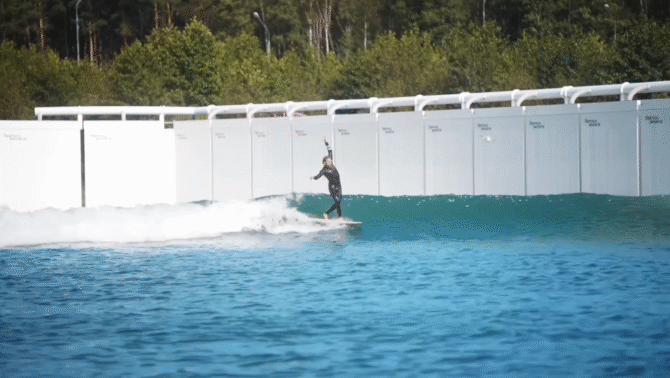
A new wave pool technology out of Russia is focusing on beginner and intermediate surfers to carve out a niche in the surf park industry. Photo: Vertigo Sports YouTube

A Russian company, Vertigo Sports, has emerged as another player in the global wave pool technology race. The company recently posted new videos of longboarders riding its pool in Rostov-on-Don, Russia.
The website claims the pool creates a wave 1.5 meters high that runs for 120 meters. Vertigo Sports says the pool has been operating since 2024, but little was known about it until recently. It has another pool in Leningrad Oblast (northwest of Moscow) that the Vertigo says makes waves slightly bigger, at 1.6-1.7 meters.
The new pool technology claims it can make a wave every two minutes, or 30 waves per hour. The pool can handle eight surfers at a time.
Videos of the pool show waist-high peelers that look fun on a longboard, but nothing that can compete with the wave quality that industry leaders like Wavegarden, Endless Surf, and American Wave Machines have created at their newest pools.
Vertigo Sport’s co-founder, Pavel Churin, says the system is marketed toward new surfers.
“The projects that work are built around beginners,” Churin wrote on LinkedIn. “Beginners book lessons. They come back. They bring friends. That’s where volume and stability come from.”
“Designing for advanced riders may look impressive,” he added. “Designing for beginners is what makes the numbers repeatable. That’s why at Vertigo Sports, our wave pools are built primarily for beginner and intermediate use – to support throughput, structured sessions, and commercial consistency.”
Vertigo Sports claims its competitive advantage comes in construction time and efficiency. Videos on the brand’s YouTube page claim it can construct a pool in 30 days, and its “vacuum” system uses significantly less power than other pneumatic wave systems that transfer energy through compressed air.
“Our system uses pneumatic chamber-caissons,” Churin told WavePool Mag. “It does not rely on mechanical levers. The chambers sit above the water surface and are connected to the pool through submerged intake openings.”
“An important detail is that the system also utilizes part of the return flow from the previous wave to assist the next filling cycle,” Churin added. “This improves energy efficiency and reduces peak demand compared to purely pneumatic systems that rely solely on air displacement.”

