
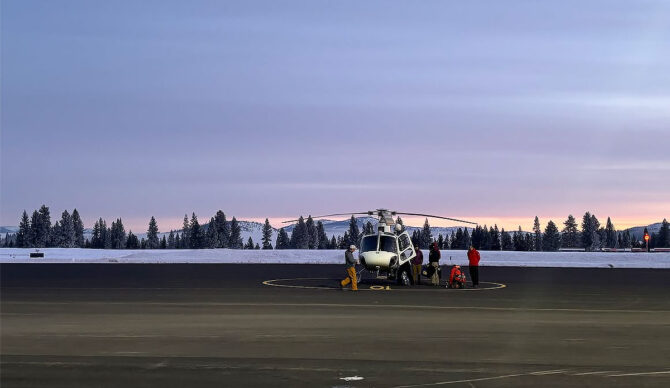
After all nine bodies were recovered from a February 17 avalanche in the Lake Tahoe area, survivors have come forward with their stories of the tragedy. Photo: Nevada County Sheriff’s Office//Instagram

Two of the six survivors of a deadly avalanche near Lake Tahoe, California, have told their version of events in detailed interviews with the New York Times. Their stories add information to the February 17 tragedy that killed nine people, shedding light on their decision-making that determined who survived.
According to interviews with Anton Auzans and Jim Hamilton, two clients on the trip led by Blackbird Mountain Guides, 13 of the 15 skiers were caught in the avalanche while Hamilton and one of the guides were spared from the slide.
The survivors said they were not involved in the decision-making that led the guides to venture out into a severe snowstorm near Castle Peak, northwest of Lake Tahoe, on February 17, with whiteout conditions and wind gusts up to 50 miles per hour. According to the survivors, the guides made the decision behind closed doors and chose an alternate route back to the trailhead with a gentler slope and a lower risk of avalanche.
There was another return route on a one-lane road that was safer, but longer, and it would have left the skiers farther from their cars. The guides also could have chosen to stay in the huts an extra night. They were sufficiently stocked with supplies, but Auzans recalls the guides expressing urgency to get out of the backcountry as soon as possible.
The avalanche occurred around 11:30 a.m. as 13 of the 15 skiers entered a clearing with a gentle 20-degree slope. Hamilton and one of the guides were well behind because Hamilton was experiencing troubles with one of his ski bindings.
The area was not believed to be an avalanche zone, which typically occurs on slopes of 30 to 45 degrees. The group was advancing in a bunched formation, not spread out. Staying spread out is recommended in avalanche terrain so one slide doesn’t take out the entire group. However, it’s possible that due to the limited visibility and ferocious winds, the guides didn’t realize that to the left was the steep, north face of Perry’s Peak, which unleashed a torrent of snow that had piled on its slopes.
Auzans, who was at the back of the group, heard a scream of “avalanche!” and looked up to see the piles of snow tumbling down with people and skis. He found himself buried, but mustered the strength to force his way out and breathe. When Hamilton and the guide caught up with the group, still unaware of the avalanche that had occurred, Auzans was able to communicate what had happened. They frantically began a search for survivors.
Hamilton soon found a man who was buried. He removed snow so he had a breathing hole, leaving him to go find other survivors. Auzans soon managed to extricate himself and join in the search. Then they found a woman, still alive, but moaning, creating an airway for her in the snow. Hamilton went back to dig out the first man they found. They found another woman, also alive and moaning. It appeared that all of the people were buried close together. By now, four of the 13 caught in the avalanche were confirmed alive.
However, further searches discovered a lifeless man. They found another woman, also lifeless, and decided they had to focus on saving the people that they knew were alive instead of spending time finding more people who were likely already dead.
Hamilton, the guide, and Auzans pulled out the three skiers they found in the snow and took them to the trees, where they made a makeshift hut out of a tarp. The women were weak and placed in sleeping bags. Rescuers were already on the way, and they had to survive the blizzard until they arrived, leaving behind the other nine members of the group.
“We were all in danger. We did as much as we could. We pushed until we started finding people that were deceased. Making the decision to stop the search was one of the hardest things I’ve ever had to do,” Auzans told the New York Times. “What are our priorities? We had to save the people we knew were alive.”
“I honestly tried my best,” he said. “I was buried. I helped to save three people.”
Rescuers could not use helicopters or snowcats due to the stormy conditions. A group of 12 rescuers on skis reached the group by 5:30 p.m., six hours after the avalanche. The only way out was on skis, so the rescuers found skis in the avalanche pile that they gave to the survivors who had lost theirs. The six survivors made it out safely, while the bodies of the nine remaining group members were recovered in the coming days.
The incident became the deadliest avalanche in modern California history. It’s unclear what caused it because preventative avalanche measures conducted by rescuers may have covered the evidence. The Nevada County Sheriff’s Office and California’s workplace safety agency, Cal-OSHA, are investigating whether the guiding company committed any safety violations or criminal negligence. So far, no findings have been released.

