
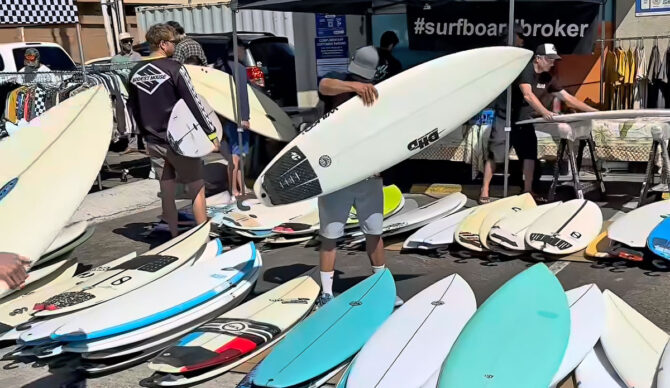
It’s been a good winter for Surfboardbroker in Southern California. Photo: Surfboardbroker//Instagram

Water temps are up, and so are surfboard sales, according to Tyler Meppen, co-owner of Surfboardbroker. Winter sales for the San Diego-based business were 25 to 40 percent higher than a typical winter, when sales usually slow down.
Meppen says several factors influence sales cycles. Summer is the peak season, when warm water draws more people into the ocean. In winter, it’s mostly core surfers who remain active customers, but big swells can still trigger spikes in board sales.
This winter, a widespread marine heat wave kept southern California waters unseasonably warm, largely above 60 degrees. Sprinkle in some fun swells, and it was a recipe for success.
“We had really good waves for the whole month of January,” said Meppen. “December had some pretty good waves, too, and the water stayed pretty warm. So those two variables around here are huge. If the waves are good, boards are selling.”
While many companies in the surf industry struggle with the uncertain economic climate caused by President Trump’s tariffs, Meppen says Surfboardbroker’s business model, selling surfboards domestically, hasn’t felt the effects.
“We haven’t seen too much of a big difference surfboard-wise, because the majority of the boards that we’re getting are still made here in the U.S.,” said Meppen. “And when shapers or accessories are doing that big of volume, (there’s) only a small percentage (price) increase.”
Surfboardbroker was started in 2013. Meppen joined the company in 2014 when he was just 15 years old. By the time he turned 18, he had become a part-owner. The company looked to harness the growing popularity of Instagram to sell used surfboards, which were largely sold on Craigslist at the time. The operation started in a garage, grew into a storefront in Carlsbad, amassed more than 100,000 followers, and expanded operations with Instagram accounts for Florida, Hawaii, Australia, Nicaragua, and Baja California. Now they’re moving thousands of used and new boards per year. They’ve even added an Airbnb in Nicaragua to the business portfolio.
Meppen calls his business model the “Marshalls” of surfboards. They pick up unsold boards from shops or warehouses, make deals with shapers, buy returned team rider boards, and do trade-ins.
“We want the best deals and the best products,” said Meppen. “We grab (boards) as long as the numbers make sense, so that we can still give our customers a pretty good deal.”
According to Meppen, the biggest challenge is keeping a fast-moving inventory of quality boards. He says that 30 to 50 percent of stock will linger on the racks until the right customer walks in, whereas the rest of the product moves fast.
“If you’re having a ton of boards going out, you’ve got to have a ton coming back in,” he said.
He says the best way to sell boards is to make the experience seamless for the customer.
“Try to answer all of their questions before (the customer) asks you,” Meppen said. “So that’s why I started putting all the boards on the website first and uploading videos of them so that they can see the condition. Then there’s a really good description of the board.”
Meppen says the business model has been so popular that they’ve been receiving requests to open up another shop in Los Angeles. The brand has been doing pop-up events in L.A., but Meppen says he and his team are hesitant to grow the business too fast and take on more overhead costs. A second storefront that they opened in Florida had to be shuttered after a few years when it no longer made business sense.
“We’re a small mom-and-pop shop at the end of the day,” explained Meppen. “For now, we like the progress, the organic growth that it’s going at, and we’re taking it one sales a year at a time.”

