
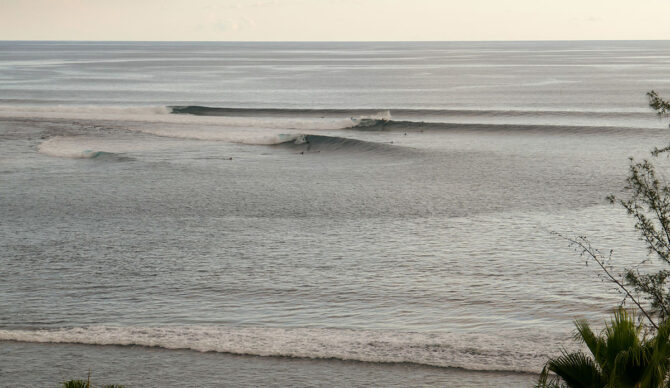
Reunion Island’s coral reefs are home to plenty of great waves, and sharks. Photo: Evan Quarnstrom

For nine years, sharks terrorized surfers on Reunion Island. Between 2011 and 2019, the small French department in the Indian Ocean suffered 30 attacks on its shores, 11 of which were fatal. During that time, the island — home to fewer than a million people — accounted for 18.5 percent of shark fatalities worldwide.
The period, known locally as “the shark crisis,” sparked fierce debate over how to respond. Some called for culls, while environmentalists pushed for stronger protections. Then, in 2019, the attacks abruptly stopped.
Seven years later, locals say surfing has returned to “normal” — crowded lineups, surf schools, tourists, and even the return of visiting pros like Jordy Smith. No one knows why the attacks began, why they stopped, or whether they could resume, but many say there is now a general sense of safety in the water.
“When you look through the (lens of) freesurfing, it’s back to what it used to be in Reunion,” said Quentin Cesard, the former sports director of Reunion’s surf league. “It was a tough time. We lost many friends, but it’s pretty much like everywhere else in the world now. I mean, we’ve got sharks in the ocean, which is normal, but we continue to surf.”
Laury Le Coustour, another Reunion Island surfer who founded a surf shop in the town of Saint Pierre, says lineups now resemble those from before the crisis.
“The summer was very busy, and it’s been so for three or four years,” said Le Coustour. “It gets really busy, especially in Saint Leu, which is the only spot left with water patrol. Now you can count 40 people in the water, which we haven’t seen for 16, 17 years.”
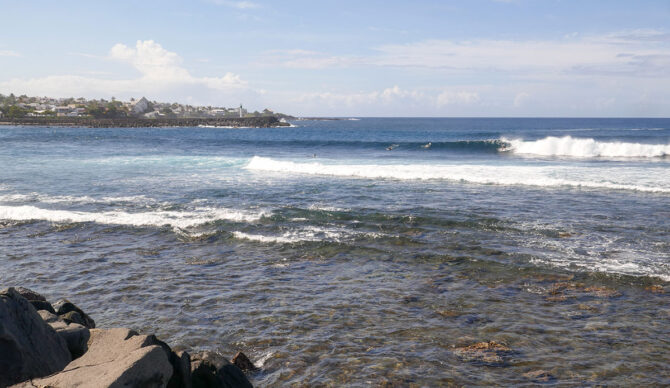
Locals say lineups on the island are as crowded as they’ve ever been. Photo: Evan Quarnstrom
Why did the attacks stop?
Cesard and Le Coustour, like many Reunion locals, have their own theories about why the attacks stopped as abruptly as they began. Explanations for how the crisis started range from overfishing in surrounding international waters to a fish hatchery on the island’s west coast, the creation of a marine reserve that restricted fishing, boats dumping fish waste, and increased development and irrigation on the drier west coast. That development, some believe, led to more urban runoff and murkier water — conditions that attract bull and tiger sharks.
“I’ve witnessed three attacks and lost five friends, so my (mind has been) turning: what could have caused all the shark presence?” said Le Coustour. “For me, it’s multiple factors. It cannot be explained by one reason.”
Local officials and surfers implemented a range of anti-shark measures once it became clear the attacks were not an anomaly but a trend. Shark patrols were established at popular west coast breaks, with Jet Skis, divers, and spotters deployed to monitor lineups during busy hours. Surfers were encouraged to download an app to log shark sightings. At times, surfing was banned altogether, and even now, Le Coustour says it is technically illegal to surf outside designated safety zones — though the rule now serves more to limit state liability than to penalize surfers.
The fish hatchery has since been shut down. Surfers were also required to use electromagnetic deterrent devices worn on the body or board, a technology that, according to Cesard, has proven to have minimal effect in local studies. As the attacks have faded from memory, most surfers have stopped using them anyway — they are expensive and difficult to source on a remote island.
Both Cesard and Le Coustour believe that the most plausible reason behind the sudden decline in attacks is the fact that the island, despite pushback from environmentalists on an international scale, has been culling sharks with drumlines — traps placed in the ocean that hook sharks.
The island’s Shark Safety Center, a body created to reduce shark risk, reported that between August 2022 and February 2026 it caught 20 bull sharks and 308 tiger sharks. From 2018 to 2022, the totals were 53 bull sharks and 314 tiger sharks. The same infographic states that since 2022, 89 percent of bycatch caught on drumlines has survived. Listed bycatch includes turtles, hammerhead sharks, barracuda, and giant trevally.
The center did not respond to the request for statistics on how many sharks have been caught since the beginning of the crisis.
“We’re not so sure about anything,” said Cesard. “The only thing I know is that since we introduced targeted fishing of sharks, I think it might be the only reason why we don’t have that many attacks anymore.”
Le Coustour agreed.
“Maybe (shark fishing) is the reason why there are no more attacks, but we also could say that we are very lucky, because there have still been many sightings,” Le Coustour added.
A missing generation
During the shark crisis, many of the island’s surfers stopped surfing altogether. Le Coustour, 40, says the crisis created a gap in the generation below him, and that those who took up the sport afterward — especially surfers 20 and under — lack a connection to its legacy.
“There’s something missing,” Le Coustour said. “There are a lot of young guys who don’t know how these spots were made, the history of how these spots were built. And there’s a lack of education, a lack of respect for what has been done before them.”
Le Coustour notes that lineups have become increasingly crowded, aggressive, and unorganized — a problem made worse by the reduction in surf patrols, which funnels everyone to the island’s famous left-hander, Saint Leu. Some surfers, he says, have jokingly wondered if another attack might help thin out the crowds.
Cesard has also seen the phenomenon as well: less hierarchy in the lineups compared to pre-shark crisis.
“We lost our history, our culture,” Cesard said. “We were not able to teach the kids anymore, to give the right information to the people who come to the island. Since most of us stopped surfing for a little bit, the people who started when we stopped didn’t have references.”
Cesard, who organized surf contests on the island in the years following the shark crisis, has since stepped down amid a restructuring of the shark safety administration. He says last year the government overhauled the system governing surf spot patrols and competition permits, restricting patrols and sanctioned events to one spot: Saint Leu. But a group of local surfers there have pushed back, making clear they don’t want contests at their break.
According to Le Coustour, if they can’t even run small local events, any prospect of larger competitions — a WSL Qualifying Series stop or a French national event — is a long way off. Opening a new stretch of coast for events, he says, requires assembling scientists, firefighters, and helicopter landing zones, a logistical and financial burden that makes it all but impossible.
“It’s a big headache of administration work,” Le Coustour said. “For now, the government doesn’t allow it. They struggle to pay the lifeguards, so I’m not sure they’re going to give money to a contest.”
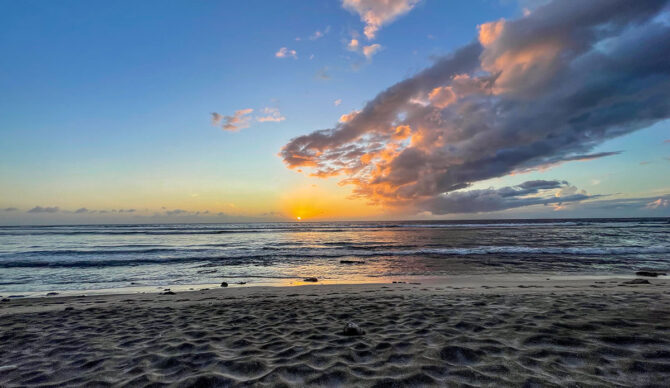
One of Reunion’s placid reef lagoons. Photo: Evan Quarnstrom
What needs to change?
Cesard wants to see the new governing body ease its restrictions. The way he sees it, the current rules don’t reflect what’s actually happening: surfers are out in un-patrolled breaks in large numbers, and, for whatever reason, possibly due to culling, attacks have stopped. He thinks it’s time to open other spots on the island for competitions.
He wonders, too, whether those in administrative positions are influenced by the fact that the end of the shark crisis could put them out of a job.
“We need a turnover in those people, maybe some fresh minds, some younger people,” he said.
Le Coustour thinks the government and community need to support surfers’ desire to get back in the water, opening more “legal” spots with Jet Ski patrols.
“Surfing brings a lot for small communities,” he said. “The young don’t go out doing bad things on the streets; they stay in the water doing sport. It would be good to open more spots with security and educational signs about the places for the new people coming — how to behave, the spot, the waves, the reef.”
But Le Coustour notes that the resurgence of surfing in Reunion and the fragile culture they are attempting to rebuild is only one shark attack away from falling apart again.
“I think (another attack) would be a reminder for everyone: we’re still on a tropical island with biodiversity around sharks,” he said. “It can happen again.”

