
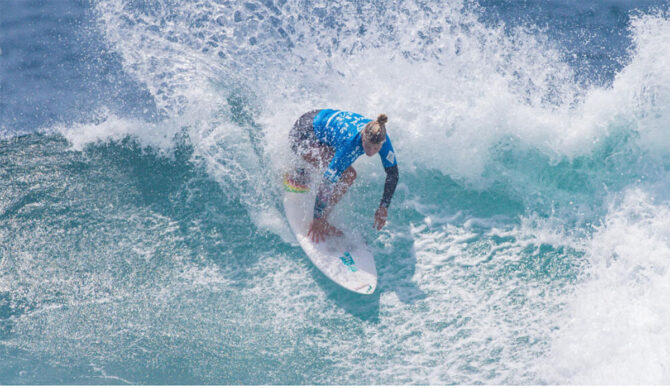
Israel had little representation on the surfing world stage — until Anat Lelior arrived. Photo: WSL

I didn’t grow up rooting for a team. My father lived for college basketball, but that devotion never quite bled into his children. I grew up a skate rat on the streets of Philadelphia. Even when my high school basketball team played Lower Merion, led by a very young Kobe Bryant, I couldn’t have cared less — I was elsewhere, opting to air a three-foot gap rather than cheering for a three-point buzzer-beater.
Even though I was a skater, I still wouldn’t say I had a sport until I found surfing in middle school. Like many surfers of my generation, I was raised on dreams of discovering far-flung perfection, bred on The Endless Summer. I spent my landlocked years scouring the TV Guide for ESPN’s midnight coverage of different surf competitions around the globe. I’d set our VCR to record in the middle of the night, only to find in the morning that I’d scored an hour of figure skating.
Like most East Coasters, Kelly Slater was my idol. I wore his accomplishments as a badge of honor, having grown up making the best of the same slop. I would search through the magazines for images of his mind-bending maneuvers while keeping up with his latest world titles. Slater was why I followed the ASP tour and he’s why I watched Baywatch (although Pamela Anderson certainly didn’t hurt.) In those days, I would have told you my life’s trajectory was headed west but, in the end, my heart was drawn even farther east to Israel, a country with little representation on the surfing world stage — until Anat Lelior arrived.
Post college, I visited the Holy Land for a year of study and, to my own surprise, I never really left. I fell in love with this tiny sliver of land, even though it felt detached from surfing culture. Hitching back from one of my first sessions, the reference I made to The Endless Summer was met with blank stares. “You’ve never seen it?” I blurted out. They had never even heard of it. I couldn’t believe anyone could surf without a connection to the film that birthed surf travel.
Dorian “Doc” Paskowitz was the grandfather of Israeli surfing, having made the first surf trip here in the 1950s. He dreamt of starting an Olympic surf team 70 years before the sport joined the games. Upon his arrival, security forces were convinced he was smuggling weapons and drilled holes into his boards — unaware that Doc was just a surf-crazed Zionist, desperate to share his passion with his Jewish brothers and sisters. In spite of the setback, Doc taught the locals to surf, kicking off the lineage that led to today’s Israeli surf scene.
Despite the culture shock, I found a home in this war-torn land, trading the more consistent Atlantic storms for the inconsistent Mediterranean wind swells. When it’s on, my local break in the town of Ashdod features a hollow right-hander that can rival some of the best reef breaks I surfed in New England. And thanks to the World Surf League, I finally had an excuse to get up at all hours of the night to watch, even though I couldn’t root for the country I now called home.
Things began to change last year when Anat Lelior became the first Israeli to qualify for the Challenger Series. With the Gaza war raging, she feared the atmosphere at the Morocco event could turn tense. Traveling alone, Anat chose safety over national pride and competed under the “World” flag. Nevertheless, she surpassed expectations, and, a year later, arrived at the Newcastle Surfest with a chance to advance to the Championship Tour.
Before the final event of the season began, Lelior needed to finish second or better to guarantee her place on the CT — a tall order for her first year on the CS. While putting in a solid backhand effort, she was knocked out in the Round of 16. Although she had already moved into seventh place on the yearly rankings, her fate rested on the results of those just behind her. In the end, her closest competitors were also eliminated before overtaking her, giving Anat just enough to hold on to the final CT spot — making her the first Israeli on the world stage.
But even before this reprieve from the clutches of defeat, Lelior’s path was nothing short of spectacular. Although the Mediterranean coastline offers up regular shoulder-to-head-high beachbreaks, the waves rarely reach East Coast hurricane swell size. Uncharacteristically, this winter featured back-to-back proper double-overhead swells. It’s the first time in 20 years I’ve seen waves of that magnitude line up with clean conditions. As Lelior put it when she qualified, “I didn’t even surf an ocean growing up. This is mental.” But in Israel, life is all about threading the needle of the chaos surrounding us.
No matter how she got there, I couldn’t be prouder or more thankful as a surfer to have a reason to root for my home country again. For those of us spending more time in bomb shelters than in the water, Anat Lelior’s recent success is the morale boost we’ve been waiting for.

