
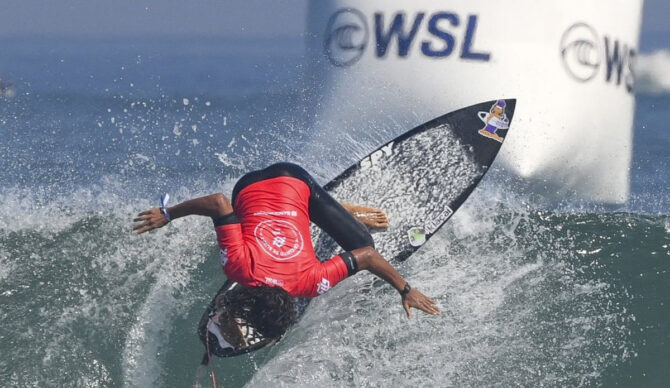
Competition kicked off in Imbituba on March 25, but many competitors who made the trip to compete were left on the sidelines. Photo: WSL Brasil//Instagram

The World Surf League (WSL) Qualifying Series 6000 event, currently underway in Imbituba, Brazil, denied entry to participants, some of whom had already traveled to the event and booked accommodation. The rejections particularly impacted the women’s draw, with 26 competitors left on the waitlist.
Some of the affected women have criticized the WSL’s actions in Brazilian media, saying that the bracket was unfairly reduced to 32 competitors and that they received only three days’ notice of their denied entries. The WSL, however, says surfers were aware of the last-minute nature of the selection process, which was necessary because two other qualifying series events in Brazil in March were used to determine rankings for the QS 6000 event.
According to the WSL’s Rulebook (see page 28), a QS 6000 event must have a minimum of 72 women and 128 men. However, out of the 11 QS 6000 events that took place since the start of 2025, only once — the 2025 Krui Pro in Indonesia — did enough women register to trigger the 72-person format. The event in Imbituba capped the entries at 32 women and 96 men.
The WSL’s explanation
In a phone call with The Inertia, WSL tour president Graham Stapelberg said he consulted with WSL’s Latin America office, and that competitors had been aware of the 32-women cap since March 10, 15 days before the start of the event. Stapelberg explained that in a normal situation, registration could be finalized 30 days before the event, but, in this case, there were two QS events in Brazil — the Layback Pro Taíba March 11-15 and the Layback Pro Costão Floripa March 18-22 — that required they wait for the latter event to update rankings of who qualified for the Imbituba QS 6000.
Stapelberg added that sometimes the sign-ups are left open within the 30-day window when registration numbers remain low. Defending the exception to the rulebook, he said that the 72-women bracket has rarely been used because they often don’t have enough women in QS events.
“Even though we made huge commitments back in 2018 to provide equal prize money for both men and women across all the different tours on the WSL, we struggle to meet the minimum numbers,” Stapelberg said.
He also noted that the events are often held in close succession to minimize costs for competitors. It was too late, he said, to increase the field at the last minute because organizers have a schedule and budget to stick to.
“It’s not something that’s not in compliance with how we’ve conducted every single one of those events in the past,” said Stapelberg.
The criticism
According to UOL, a Brazilian publication, 26 women and 8 men were left on the event’s waiting list. Many athletes, the article says, received vague responses or were ignored when they reached out to the event organizers for clarification as to why they were excluded.
Several Brazilian female surfers shared their thoughts in the UOL article.
“When we have such a limited number of spots in such an important event, it runs counter to everything that has been done to foster the evolution and inclusion of women’s surfing,” said Monik Santos.
“It is sad to see that the sport is growing, yet many women won’t have the opportunity to compete,” said Maya Carpinelli.
“Girls are going to lose an entire year of competition due to an organizational error — one that prioritizes girls who are competing in just a single event rather than those looking to build a career within the league. Girls from Chile, Ecuador, Peru, and various states across Brazil — who had real chances — ended up being left out, and were only notified three days beforehand. Many of us — myself included — had made all our arrangements to be here, only to be caught completely off guard,” said Isabela Saldanha.
Saldanha is referencing another point of contention: “social entries” granted to eight men and four women, independent of the current ranking. Stapelberg said these slots are tied to event sponsor Banco do Brasil and set aside for “socio-economic purposes.” While the WSL rulebook makes no mention of social entries, Stapelberg said they are built into the sponsorship agreement, and that the events would not exist without meeting sponsors’ contractual obligations.
Uruguayan surf journalist Pablo Zanocchi, founder and editor of the publication Duke Surf, says as many as 20 surfers had already paid for their hotels, and some even had traveled to Imbituba, before being informed that their registration had not been accepted.
“Coaches and fathers and girls started looking for the rulebook, and in the rulebook it says clearly that QS 6000’s have a minimum of 72 (women),” Zanocchi told The Inertia in an audio message. “(The WSL) failed in both men and women (categories).”
“There are a couple of surfers who are out of the event, who paid for the accommodation, and they are there (in Brazil),” Zannochi added. “What’s more important is that there was no communication from the WSL. You can make decisions based on weather, or change the minutes a heat has, but you cannot change these kinds of things.”
The Imbituba QS 6000 kicked off March 25, completing the women’s round of 32 and most of the men’s round of 96.

