
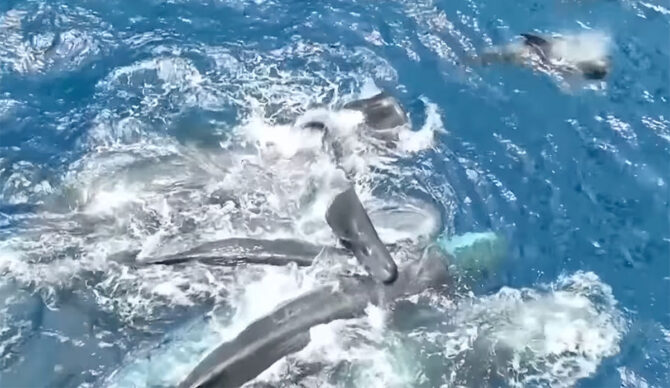
Sperm whales kept the new calf out of the water until it could swim. Photo: CETI//Screenshot

Back in 2023, when India became the first nation to land on the moon’s South Pole, Barbenheimer fever had its teeth firmly sunk in the population, and Taylor Swift was midway through the Eras Tour, researchers studying sperm whale behavior captured the rarest of moments on camera: the birth of a sperm whale.
What the footage showed surprised everyone. As it turns out, the phrase “it takes a village” doesn’t just apply to us — it applies to many creatures in the animal kingdom, as well.
“The group quite literally helps bring the calf into the world,” said Oregon State University behavioral ecologist Mauricio Cantor in an email to the Associated Press.
Moments after the whale calf was born, female whales from two different families worked together to lift the newborn out of the water. Eleven whales worked in sync for hours until it was able to swim on its own. Outside of us humans and a few species of monkeys and apes, that level of coordination between individuals is almost unheard of.
The researchers began filming the birth event while they were trying to learn more about how whales communicate with one another. They were off the island of Dominica in the Caribbean when the whales all began to surface repeatedly, facing each other and “thrashing and diving above and below the water.” The group of scientists put a drone in the air with microphones to try and figure out what, exactly, was going on. For the next 30 minutes, they watched in awe as the whale calf was born.
After the birth was filmed, the researchers delved deeper into what was happening. That research was recently published in the journals Scientific Reports and Science. One of the most interesting (and endearing) things they noticed was the fact that it wasn’t only the family of the new whale that took part in supporting it as it made its way through the first hours of life outside the womb.
“It’s amazing to think about how, when faced with this impossible challenge, these animals come together to succeed,” said study co-author Shane Gero, who works with Project CETI, a listening project that uses advanced machine learning and robotics in an attempt understand what sperm whales are saying.
Since they were there to listen, the scientists took a hard look at the sounds the whales were making during the birth, and they found that they changed the volume, tempo, and length of the sounds they make. It’s theorized that those different sounds could be unique to whale births, and help the huge animals link up for the birth of the calf.
While it’s impossible to know for sure — right now, anyway — if that truly is the case, scientists are excited to have more insight into the lives of such amazing creatures.

