
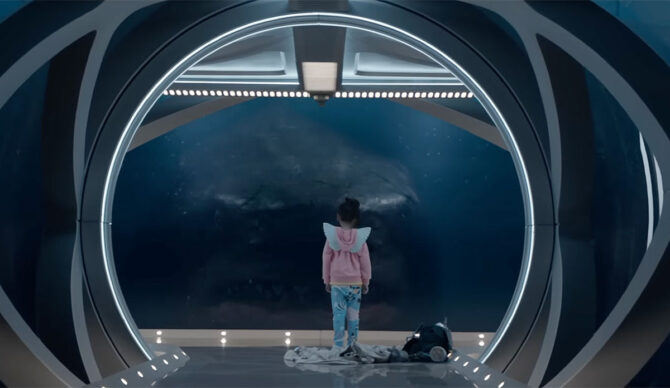
The megalodon went extinct millions of years ago. Unless you believed The Meg. Photo: YouTube//Screenshot

The megalodon was a bad-ass animal. It was the largest shark that ever swam through the ocean, but aside from one fantastically bad Jason Statham movie, it hasn’t been around for a little over three-million years. Even still, the state of Maryland wants the megalodon to become its official shark.
It’s not just a weird decision. There is an actual reason behind it besides the fact that The Meg is so incredibly bad it’s good. Maryland’s east coast is a treasure trove of megalodon fossils. In Chesapeake Bay, it’s not uncommon to find a giant tooth just lying in the sand. That doesn’t mean that megalodons walked on land, though. That means that most of the east coast of Maryland was once underneath a prehistoric sea. Then the plates all shifted around and earthquakes happened and millions of years passed, and now the east coast of Maryland is a wonderful place that just so happens to be full of giant fossilized shark teeth.
“Maryland is an important source of fossils that have taught us about ancient oceans, including megalodon, “Dr David Shiffman, a Maryland-based shark scientist and the author of Why Sharks Matter, told IFLScience. “Some of the finest specimens of megalodon teeth have been found at Calvert Cliffs here, and the nearby Calvert Maritime Museum is a world leader in this space.”
For about 20 million years, the meg was very likely to be the ocean’s apex predator. Loved around the world by little kids who are into dinosaurs and sharks, it’s a creature that has enthralled generations.
“How can anyone not love an animal with teeth so big that a fossil one won’t fit in my hand?” Dr. Shiffman continued. “They were big and powerful enough to bite whales in half. And they ruled the ocean for millions of years before going extinct. We can learn a lot about modern-day species by studying how ancient sharks lived and eventually went extinct.”
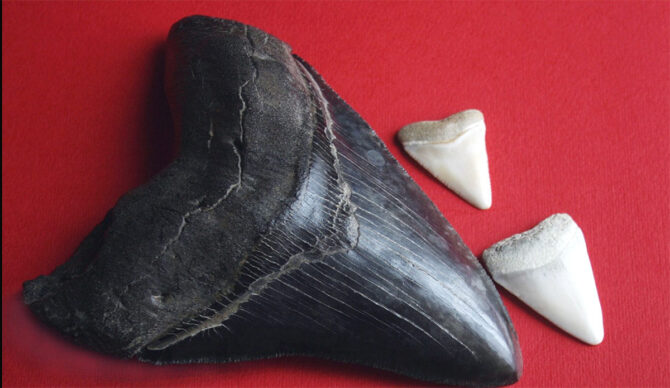
A megalodon tooth beside two great white shark teeth. Extrapolate from there. Photo: Wikimedia Commons
Interestingly, no one has ever found a full megalodon skeleton. Everything we know about them comes from fragments — mostly the hand-sized teeth — so unless that happens, scientists have just been taking educated guesses at the true size of the megalodon. Its enormous size, though, likely played a role in its extinction.
“With such a large body size, the megalodon required ample prey to fuel its body,” wrote the Smithsonian. “Around 2.6 million years ago, around the time when the megalodon disappears from the fossil record, large mammals in the ocean were undergoing significant changes in response to a changing climate. At the beginning of the Miocene, marine mammals were at the height of their diversity and abundance — especially the megalodon’s favorite prey, small whales. But later during the Pliocene, there was a drop in ocean temperatures that likely contributed to the megalodon’s demise.”
Not everyone in Maryland is all that excited with the prospect of having an extinct shark as the state animal, however.
“Securing its designation as the state shark required some last-minute political maneuvering,” IFLScience wrote. “Maryland’s House of Delegates passed its version of the bill, HB97, earlier in the session. However, according to local news, the Senate’s version stalled in committee. At the last moment, it was added as an amendment to another bill, SB0035, which had already passed. This latter bill designates the Natural History Society of Maryland as the State natural sciences museum, but now mentions that the megalodon is designated as the ‘State shark.'”
Since the Senate and the House eventually saw eye-to-eye, all that’s left now is the Governor’s final sign off. If all goes as expected, the megalodon will be Maryland’s state shark on October 1, joining the oriole, which is the state bird, jousting, which is the state sport, and walking, which is the state exercise.

