
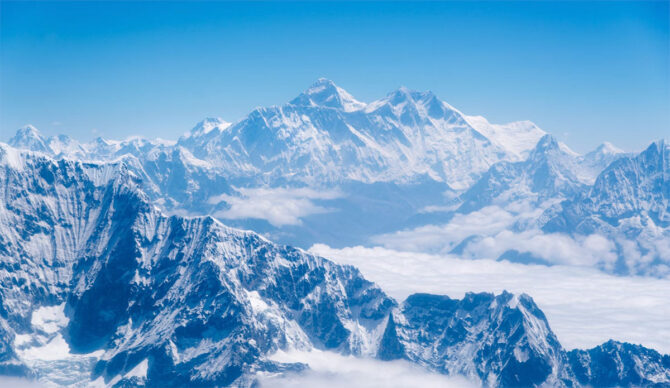
Peak climbing season is likely to be a crowded on Mount Everest this year, thanks to a huge piece of glacier standing in the way. Photo: Unsplash

The route up Mount Everest from the Base Camp in Nepal is blocked by a massive block of ice. It’s bad timing for would-be climbers, because peak climbing season at the world’s most famous mountain is just beginning.
“This is not something you can fix or move,” said Himal Gautam, spokesperson for the Department of Tourism. “It’s natural. We can only wait and assess.”
The ice block, which is a chunk of glacier, is called a serac. It’s about 100 feet tall, and despite many efforts, there doesn’t appear to be a way around it. The only option, according to reports, is to wait for it to melt. Climbing season on Everest is a busy time of year. For such an inhospitable place, it gets dangerously crowded. Litter abounds there — trash and bodies as well — and the lineup to the summit can resemble an August weekend afternoon at Disneyland. It’s not a cheap excursion, either.
The blocked route has the Icefall Doctors worried. Who are the Ice Doctors, you ask? Well, they are a particularly skilled set of Sherpas who spend a few months before the spring climbing season managing the routes in preparation for the busy months ahead.
“People typically imagine climbers along with Sherpas guiding them while facing challenging difficulties when they think about climbing Mount Everest,” writes Himalayan Masters. “The backbone of each successful Everest climb consists of Everest Icefall Doctors, who often receive no public recognition…The Icefall Doctors are highly accomplished Sherpas whose mountain expertise surpasses all others. These Sherpas specialize in ice path management rather than regular mountain guide activities.”
The giant hunk of ice, however, has even those accomplished Sherpas strapped for time. The BBC reports that they’re weeks behind schedule, leading to fears of another season of dangerously long queues.
“We usually climb between Camp I, Camp 2 and Camp 3 back and forth during this acclimatizing process,” Purnima Shrestha, a prominent climber and photographer from Nepal told the BBC. “Delays in the opening of the route have added concerns of possible ‘traffic jams’ to the peak this year.”
At the time of this writing, the route usually would have been set as far as Camp 3, but the ice block is sitting nearly 2,000 feet below Camp I.
“We haven’t found artificial ways to melt it so far, so we don’t have any options other than to wait for it melting and crumbling itself,” base camp co-ordinator Tshering Tenzing Sherpa told the BBC. “We reached it on April 10. The crevasse below is melting.”
The Sherpas are hopeful that it will melt quickly, because its lower section is already weak. Climbing over the ice has been deemed too dangerous — which says a lot, considering how dangerous climbing Everest already is — so they’re considering a few other options to make the best use of their time.
“We are thinking about airlifting the rope-fixing team and their logistics to Camp 2 by helicopter, so they can open the route above that altitude for now,” Ram Krishna Lamichhane, the department’s director general, said.
“We will wait for the ice to melt at the place where there is an obstruction and work there when everything is safe.”

