
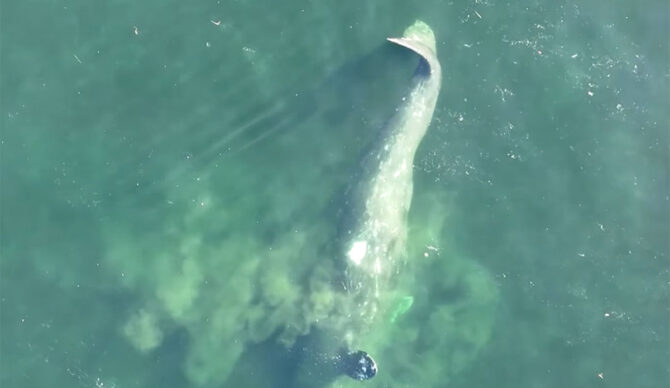
A gray whale feeding off the coast of Vancouver Island. Photo: YouTube//Screenshot

Gray whales are dying in alarming numbers off the coast of British Columbia’s Vancouver Island. In the last 10 days alone, four have washed up on beaches in absolutely terrible condition, prompting researchers to sound the alarm.
“Some of the worst animals I’ve ever seen. Two are severely emaciated,” Paul Cottrell, coordinator for the Department of Fisheries and Oceans (DFO), told reporters. “They’re basically a bag of bones, really sad to see that kind of body condition.”
Vancouver Island’s coastline is stunningly pretty. It’s not uncommon to see gray whales spouting in the distance as they linger in many of the shallow bays littering the coast. Many of them are part of something called the Pacific Coast Feeding Group, which tends to stay a little closer to home instead of traveling all the way to the Arctic.
Early in April, two gray whales were found dead, one in Barkley Sound and a second a day later near Kyuquot Sound on the northern end of the island. A day after that, another was found floating in Barkley Sound, and a fourth was discovered off Sidney on the southern end on April 17.
That makes five dead whales in total in British Columbia waters this year alone. The cause is likely a dramatic decline in food in the Arctic.
“Last year,” Cottrell explained, “feeding in the Bering and Chukchi Seas was really not a great year for gray whales.”
To the south, things are just as bad. Thirteen gray whales have been found dead in Washington state. While a few dead whales per year is expected, the pace at which these grays are dying is alarming. In 2025, five gray whales were found dead in a week near San Francisco.
“Never have they come at this pace this early, so we’re really worried about where this is headed,” said John Calambokidis, a research biologist at Cascadia Research Collective. Gray whales feed mainly on amphipod crustaceansamphipod crustaceans (basically tiny little crabs that live in the mud), tube worms, shrimp, and mollusks, and Arctic populations of these species are in dire straits.
“There has been documentation of declines in those benthic amphipod populations, but all of that is also complicated by the fact that the most dramatic changes in the Arctic ecosystem have been this progressive overall loss in ice cover,” Calambokidis said.
Researchers in B.C. are worried that this year is on track to be the worst for gray whale deaths on record. In 2019, 11 gray whales were found dead. Coupled those deaths with a worryingly low birth rate, and gray whales are in trouble.
“We could be in for a worse year than the worst year that we’ve had,” Cottrell said. “[It’s] the lowest calf production on record, in recent history, so that doesn’t bode well.”

