
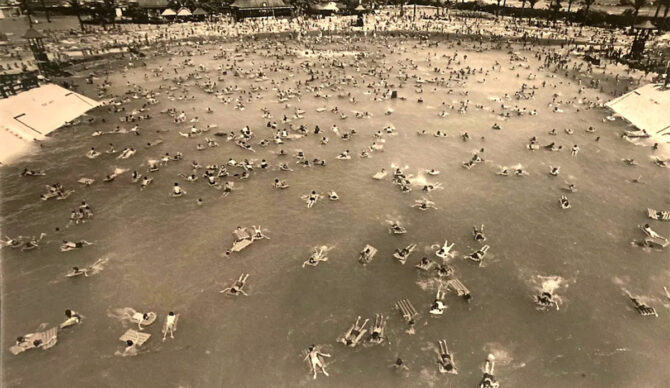
No, it’s not the Superbank, but the eminently accommodating line up at Arizona’s “Big Surf” wave park, circa 1975. Photo: Unknown

As I gazed out toward the Superstition Mountains, a rugged massif rising up from the desert floor approximately 30 miles east of Mesa, Arizona, the legend of the “Lost Dutchman Mine” came to mind. Enduring folklore tells of a fabulous gold deposit allegedly discovered somewhere in the remote resurgent caldera by 19th century miner Jacob “Dutchman” Waltz, who, on his deathbed in 1891, left a single, cryptic clue as to its whereabouts, hinting that “the setting sun shines into its entrance.” Over the century since not a single nugget has ever been found.
I only mention this evocative slice of Southwest Americana because it did actually come to mind when, on a recent day in early May, I found myself beholding in wonder an actual Arizona desert treasure trove: four-foot, right-and-left peaks, peeling in crystal-blue symmetry toward a white sand beach. Nuggets of a different sort, but worth their collective weight in gold considering they’re breaking over 300 miles from the nearest ocean. Once a minute.
Revel Surf Park, the most wonderfully incongruent element of “Cannon Beach, a developing 37-acre retail and entertainment complex” rising up from the desert floor in the outskirts of Mesa, would be my very first wave pool experience. I’m not counting an earlier visit to the Surf Ranch, in Lemoore, because that extravagant site is, in fact, a lake and, in its configuration and intent, a completely different animal than wave pools currently proliferating seemingly everywhere these days.
The difference was evident, starting in Cannon Beach’s gravel parking lot — and I’m not talking about the aroma wafting from the adjacent “Two Hands” gourmet corn dog restaurant. You can’t see what’s going on behind the fencing, but you can hear it. Children laughing and shrieking, water splashing, music playing; the sound of people having fun. Think: a busy summer day at an outdoor YMCA pool. But then there’s a weird, periodic hydraulic pumping sound, reminding you that something extraordinary is happening on the other side of that fence.
Extraordinary is the only word I can come up with to describe when, after pushing through the glass doors into Revel’s bustling lobby/retail space (cool beachfront restaurant off to the right), I found myself gaping at what looked to me like a pretty accurate facsimile of Kaisers, that man-enhanced reef-peak breaking seaward of the Hilton Hawaiian Village, on Oahu’s South Shore. The white sand, beach umbrellas and numerous bikini-ed co-eds completing the tableau. Again, I haven’t personally seen any other wave pools — Waco, Palm Springs or Melbourne, for example — but from the many videos on offer, Revel, as conceived and manifested by designers Matt Gunn, John Bushey and T-Street’s own Shane Beschen, presents itself more like an actual surf spot than merely an artificial wave breaking in a pool.
Make no mistake — it is a surf spot. It just happens to be a surf spot in the middle of the Arizona desert. And why not? Remember, it was way back in 1969 that “Big Surf,” the world’s first landlocked surf park* opened in nearby Tempe, its sloping, plunger tank-generated waves demo-ed on that sunny opening day by none other than 1968 world champion Fred Hemmings, who, although a long way from Makaha, made a fine account for himself riding solo, and even tandem with a lucky Arizona State co-ed.
But regardless of its zip code, it was this surf spot vibe that struck right away, once I was banded for my Malibu MI wave session, walked past what appeared to be a couple of typical groms discussing the merits of a JS Fusion swallowtail laid out on a shaping rack, and made my way outside to the staging area.
Here I might as well have been hanging in the Cardiff Reef parking lot, or any reasonably public surf beach, complete with a crew of fit, middle-aged locals still swearing by their shortboards, weathered older locals (monthly membership holders, all) with their coveted longboards, very obviously intermediate surfers with shiny new board bags, young, lithe, tan surf instructors (male and female) demonstrating “pop-ups,” not to mention the sight of more screaming kids and smiling beginners riding to shore in the whitewater than just about anywhere east of Waikiki.
Oddly enough, considering the inland latitude and longitude, I felt right at home. *
The vibe is by design, as explained to me by Eric Fritze. He’s Revel’s main wave operator and surf ops supervisor, who, as it turns out, I used to sit next to at the peak at Lowers back in the late 1980s. A former Newport Beach hot rat back in the day, he recently found himself a new career at the helm of Revel’s brace of separate chambered hydraulic presses, a veritable “Wizard of AZ,” the man behind the curtain dialing up the park’s varied menu of waves: Malibu MI and MII, Trestles TI and TII, San O, Learn To Surf, and, for the especially daring, V-Land and Combo Swell. The idea being to offer something for just about everyone with a hankering to catch roughly 10 to 12 waves during the hour-long session of their choice.
Then there was the team of unfailingly polite, totally authentic surf instructors patiently working with the learn-to-surf crowd. Authentic, meaning they looked, walked and talked like any tuned-in, teenaged, 20-something surfers you’d find at any beach you’d care to mention, Jude, 18, Gabe, 20 and Sakura, 20, on this particular day without a doubt three of the most stoked employees in the greater Maricopa County area. Who wouldn’t be, coming to work in boardshorts and bikinis, navigating their way around the waterpark on Carver skateboards, and catching plenty of waves of their own during special staff sessions.
Even the lifeguards had impeccable cred. Keeping a watchful eye on all the action was water safety supervisor Tucker, 28, a former Honolulu City and county lifeguard, last stationed at Waimea Bay, who recently moved to Phoenix to attend flight school. A profound transition, described to Tucker by no less authority than legendary waterman/lifeguard Dave Wassell as a cult classic movie plot, except in reverse: young surfer in seek of adventure travels from Oahu’s “North Shore” to an Arizona wave pool.
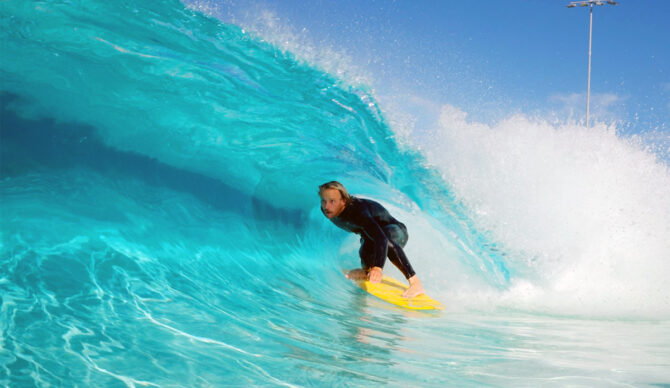
Plenty of nuggets on offer at Revel. Photo: Revel Surf
Here in Mesa, these were my people. And there were plenty of them. Like David, the smiling, ruggedly tanned 60-something former H.B. Pier local (Chuck Dent, Chris Hawk, Carl Haywood, Bob Neishi…he dropped all the right names), who very kindly lent me his shiny Donald Takayama mid-length, having witnessed me having a bit of trouble riding a rented soft-top in the snappy Malibu MI setting. Oh, have I not talked about the actual surfing I experienced between communing with my Grand Canyon State, wave-riding brethren?
Let me put it this way (although I probably don’t need to tell you this): wave pool waves are a lot trickier to ride than they appear in the videos of bantam-weight pros, all high-flying and deep tube-rides. Generated on-site by giant hydraulic presses rather than distant storm systems, they appear suddenly, in some settings rather abruptly, requiring lightning-fast reflexes on takeoff. Once up and riding, the uninitiated can find the uniform speed of their curl line somewhat disorienting at first, so accustomed are ocean surfers to the variable sections and pace of salt-water waves. Add in the anxiety of having everyone, and I mean everyone, intently scrutinizing each and every wave ridden (at one wave per minute, one surfer each in either direction, everybody gets their moment in the limelight, whether they like it or not), one’s first pool session, despite the guaranteed wave count, might not be as relaxing as one might imagine, despite the otherwise chill vibe.
Which, naturally, is another way of admitting that just about everyone sharing the pool with me that day — the cool older guy on the 10’6” Wayne Rick styling on the slopier lefts, the two good natured Canadian snowboarders/snowbirds taking a break from their icy Fitzsimmons Range, the spritely, 12-year-old girl hooting her head off after getting pushed into her very first waves by Jude — rode their waves better than I did, even with the borrowed Takayama.
At least until my last wave, a Trestles TI, which from up in the control booth the Wizard of AZ thoughtfully dialed up for my benefit. It was a bit taller than the Malibu setting, the wall less tapered, and as I trimmed across the center, eying the beautiful blue face as it steepened ahead of me, for those brief few seconds I lost myself in the ride, the fast-approaching, better-kick-out-before-reaching-the-concrete-side-of-the-pool section momentarily forgotten.
I was surfing in the desert, the “the setting sun shining into the entrance” of the curl.
I’m sure you can see where I’m going with this.
*I’m not counting a small Japanese pool, constructed inside a Tokyo shopping mall in 1967, that featured sloshing, non-breaking waves, first promo-surfed by a visiting Californian named Steve Perrin.
*Speaking of home, residing in nearby Scottsdale is one of the true, albeit unsung legends of the sport: none other than Vicki (Flaxman) Williams, the remarkable character who basically invented ‘surfer girl power’ at the real Malibu back in the 1950s. My interview with Vicki will be coming soon.

