
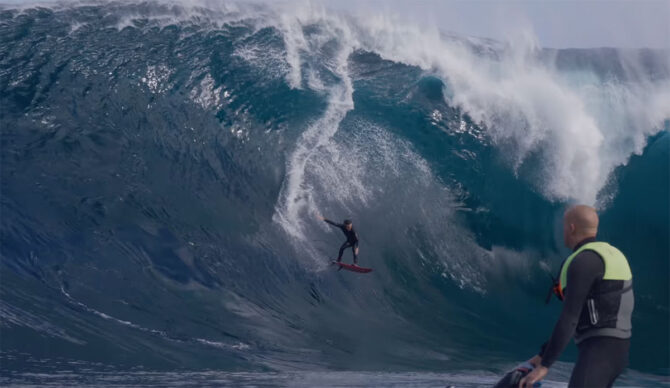
Kipp Caddy knows you’ve got to pay to play, and for everyone who surfs waves like Shippies, it’s worth it. Photo: YouTube//Screenshot

This is going to sound strange, but bear with more for a second. I like getting skunked. I like getting skunked because if it weren’t for those disappointing days, the good days wouldn’t be so good. If every day was firing and perfect, then every day would be average. You can’t have the sweet without the sour, as they say, and that holds true at big wave spots as well as normal spots. In the video you see here, courtesy of the inimitable Tim Bonython, the viewer sees the flip side of big-wave filmmaking.
“This is the part nobody posts when the swell charts look perfect, the forecasts align, and reality still says ‘no,'” Bonthon wrote. “Shipstern Bluff in Tasmania is capable of producing some of the most incredible and intimidating waves on the planet. But getting it right isn’t luck — it’s a chain of decisions, timing, experience, and often, educated guesswork that either pays off… or doesn’t.”
Bonython spends most of his time filming waves or traveling to film said big waves. He’s used to the grind, but he knows what he has to do to continue doing it. It’s behind-the-scenes work, but having a solid grasp on the conditions he might be able to expect is very, very important.
“Before a single frame is shot, the process starts days out with weather models,” he continued. “You’re watching storms form, tracking pressure systems, and trying to understand whether a swell will actually line up with the reef at the right angle and energy. Just as important is the swell period — the time between waves and swell direction which directly translates into the power and punch of the ocean. A long-period swell carries deep ocean energy that can wrap into Shipsterns with serious force, while a shorter-period swell can feel disorganized and lack the critical push needed for those heavy, breaking sections.”
As any surfer knows, though, swell height and period alone do not a good day make. There are other factors that are just as important, depending on the spot.
“Then comes the wind — because even the best swell can be ruined by the wrong breeze,” Bonython went on. “And then tides and timing: at Shipstern Bluff, the tide doesn’t just change the wave height, it changes the entire shape and behavior of the slab. A rising or dropping tide combined with the wrong period can turn a forecasted ‘day of days’ into something completely unrideable.”
Perhaps most importantly, there’s one final, crucial step: knowledge. For Bonython, a knowledgable guy with years of experience himself, that means insider insights.
“Talking with surfers who know the spot intimately, checking forecasts with specialists, and leaning on years of field experience to make the final call,” he said. “Go, or don’t go.”
Once the trigger is pulled, the planning comes into play. And for a filmer like Bonython, there are a lot of them. But even when everything is done, when all the plans have been made, the forecast picked apart, all the factors taken into consideration… things can still go sideways.
“Once that decision is made, the logistics kick in — flights with oversized gear, car hire, accommodation, boat or Jet Ski support where possible, drivers, fuel, food… the cost of a single mission can quickly climb into serious territory,” Bonython finished. “In places like Nazaré, a ski and driver alone can run into thousands of euros. At Shipstern Bluff, it’s different — but no less demanding. You’re often carrying all your gear on foot for a one- to two-hour hike, turning into a packhorse before you’ve even seen the ocean. And after all of that — after the planning, the travel, the money, the anticipation — the ocean can still turn up empty or wrong. Glassy expectations replaced by messy reality. That’s the nature of the job. A calculated risk, repeated over and over, where sometimes you get the magic… and sometimes you get skunked.”
But hey, like I said: the bad makes the good better.

