
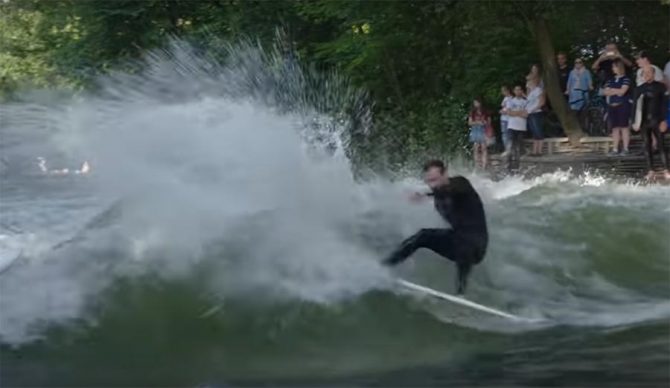
Dylan Graves with the wave in prime form. Photo: YouTube Screenshot

Six months after it disappeared, Munich, Germany’s iconic Eisbach river wave came back, albeit with a new set of government ordinances. While the local surf club never lost confidence that the wave would reform after it vanished in October of last year, the city’s intervention in the wave has concerned them — measures they say are trending towards draconian.
Last year, when city officials lowered the river to remove sediment build-up, the wave failed to form when they released the water. Max Malsy-Mink, a local who has surfed the Eisbach for 30 years and volunteers as the Munich Surf Club’s press liaison, says the city has been getting increasingly involved after a woman drowned surfing the wave in April of last year.
The Eisbach returned faster than locals expected, thanks, at least in part, to sediment and moss buildup that restricted water flow. Since then, the city updated regulations introduced last year that now, in theory, restrict surfing hours from 5:30 a.m. to 10 p.m. Additionally, surfers must be experienced and 16 years or older. Surfers between 14 and 16 are permitted if accompanied by an experienced surfer. Surfing alone is prohibited, and only quick-release leashes are allowed.
According to Malsy-Mink, the city installed a sign displaying the new ordinances at the wave, which appears to be more for legal liability than enforcement. No one is paying any attention to it, anyway, as inexperienced surfers are flocking to the wave.
The city “is dramatically regulating everything, which is not necessary,” he said.
Malsy-Mink called last year’s death unfortunate, but ultimately a freak accident. The government’s subsequent investigation was pointless, he argued, given that they searched the riverbed for foreign objects a week after the incident, when anything that could have snagged the surfer’s leash would have already been swept downstream. So it was no surprise that they never found the cause.
But, as a result, the city has opposed inserting anything into the river, such as wood planks that surfers have historically used to enhance the wave.
“We are in a good spot, because the wave is good,” Malsy-Mink said. “But if you want to make it perfect, you’ve got to put something in there to manipulate it a little bit.”
The success of the new wave pool in Munich, O2 SURFTOWN MUC, became an outlet for local surfers during the Eisbach’s absence. They offered a free session to anyone who could show a picture of themselves surfing a river, awarding 1,000 entries into the pool. But according to Malsy-Mink, most surfers can’t afford to consistently surf the wave, and the Eisbach surf scene was largely subdued during the six months the wave wasn’t working.
Now, the buzz around the wave’s subculture is back. Malsy-Mink says crowds have generally been thick. Surfers have to wait in line, at least for 10 minutes, to get their shot — a generally democratic lineup where anyone gets a turn.
The club has plans to reignite the surf scene with parties at the wave including DJs, free beer, cash prizes for best tricks, and a rail inserted in the river and lit on fire for surfers to grind. They just hope the city keeps its distance, as it had for decades.
“It’s not the wave, it’s not the nature, it’s not how it’s built — that doesn’t worry us at all,” Malsy-Mink said. “It’s how the government and the city council work with (the wave).”

