

The wing foil industry seems fairly stable on the surface, but underneath there’s a ton of change and innovation going on. Photo: Youtube Screenshot//Armstrong

Summer is in full swing in San Francisco, and while that means sun and warm weather, at least until the fog kicks in, it also means wind. Lots of it. I’ll die on the hill that SF deserves the title of “The Windy City” over Chicago, at least from June through September. For surfers, that wind is the enemy. And while I’m a surfer myself, after living in SF for the past six years, I’ve also learned how to harness the wind and get my flow going when the waves are anything but clean.
Wing foiling has become my go-to when the surf becomes wind-hammered, and this spring/summer, I’ve been testing three new releases from Armstrong: a new mast, a new board, and a new wing. And testing each has given me added insight into how the foil industry is currently evolving, and where we might expect to see continued progression. Let’s dive in.
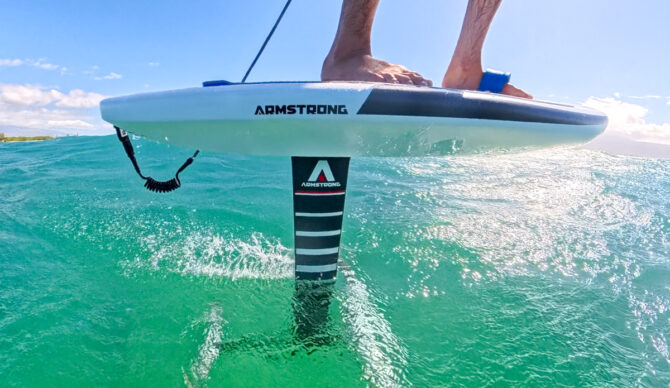
Will skinnier masts become an ongoing trend in the foil industry? Photo: Will Sileo//The Inertia
The Mast: Armstrong Performance-X
Foiling is without a doubt the fastest evolving watersport today. There have been countless paradigm shifts over the past few years, like the introduction of the parawing, better foils, and better boards. The innovation just keeps coming.
That said, foil masts are one of the few areas that have seen relatively little innovation over the past couple of years. Incremental improvements to stiffness, like aluminum options, and some clever interchangeable adapter systems (shout out to Foil Cedrus), but nothing really groundbreaking. Until this year.
In mid-May, Armstrong dropped three new masts: the Carbon Mk II, the Performance Mk II, and the Performance-X. I’ve been on the Performance-X, so that’s where I’ll focus. Designed for maximum glide and efficiency, it’s only the second 12mm chord mast to hit the market, following F-One’s UHM Carbon 12mm earlier this spring.
And after testing the Performance-X, I’m convinced these won’t be the last – give it a couple of years, and I think we’ll all be riding skinnier masts than we are now, as better construction techniques allow for less material without sacrificing stiffness. In fact, despite the reduced chord, Armstrong claims the Performance-X is 10 percent stiffer than the prior Performance MkI masts.
The difference in glide is real, and I don’t say that lightly. Under the Golden Gate Bridge, we get these massive, fast-moving swells that look incredibly fun from shore and are absolutely humbling once you’re actually on them, as they move too quickly for most setups to keep up with. With the Performance-X paired with the UHA 770, I was catching and riding those swells in a way I genuinely hadn’t been able to before, getting in turns rather than just straight-lining until they outran me. Some of that credit goes to the foil, but the mast is the special sauce that’s really unlocked this efficiency for me.
The other two options in the new lineup serve different riders. The Carbon Mk II brings carbon performance to a more accessible price point, making it a great pick for progressing riders. The Performance Mk II is the choice for heavier riders who need maximum stiffness, especially important as wider-span foils like the UHA have become more common. At around 150 pounds, I’m firmly not the target audience for that one, but the Performance-X fits my riding perfectly.

The Midlength MkII is an entirely new shape from Armstrong. Photo: Will Sileo//The Inertia
The Board: Midlength MkII X-Form
Mid-lengths are the hottest foil boards on the market right now, and with good reason. They’re the ultimate quiver-killer — high-performance in strong wind, capable of efficient water starts when things get lighter, and versatile enough to handle both wing and parawing sessions. And as the parawing has exploded in popularity, the ideal mid-length shape has shifted with it.
The original Armstrong Midlength was an impressive board, and very high-performing as one of the narrowest mid-lengths on the market. That narrow profile was great once you were up and flying, but with a parawing in choppy or rolling conditions, getting on foil could be a real challenge.
The Midlength Mk II X-Form addresses that directly. It’s wider with a flatter bottom, which dramatically improves stability on the water without giving up the glide and easy takeoff that define the mid-length shape. The wider tail generates more lift during pump-ups with a parawing, and the board is thinner overall for better connection underfoot. The new X-Form construction adds stiffness and sheds weight, and the boards are now fully FoilDrive compatible, which has been a pain point with Armstrong boards in the past. Durability is also improved through some layered foam density work in the core, which, I’ll be honest, I didn’t expect to hear “lighter weight” and “durability” in the same sentence.
For a deeper look at the construction, Armstrong’s Armie and Matt Nuzzo of REAL Watersports break it all down in a video worth watching.
Overall, it’s awesome to see the way boards these days are optimizing for parawinging in various ways, as well as all the new constructions out there that just keep building on the successes of the prior generation, and chasing the goal of being both stiff and lightweight.
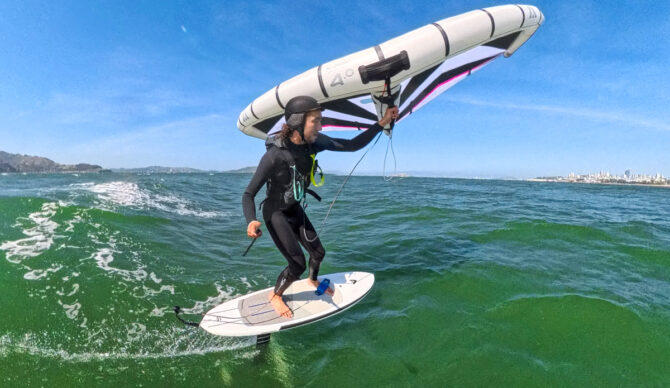
Surfing, upwind speed, easy handling, this wing does it all with an emphasis on high-performance riding. Photo: Will Sileo//The Inertia
The Wing: X-Wing Performance
Wing design felt like it had settled into a comfortable groove over the past couple of years. Then new materials started showing up, and things got interesting again. The X-Wing Performance is Armstrong’s entry into the category.
For a while, Aluula was the clear winner for premium wing construction. Stiff, lightweight, and genuinely performance-enhancing, but with two significant drawbacks. Cost, often close to double a traditional-material wing, and durability, with Aluula wings having a shorter lifespan than traditional-construction wings, with a tendency to fail around the seams of the leading edge and struts. That’s certainly less than ideal for wings that cost upwards of $2,000 apiece.
Well, Armstrong skipped Aluula entirely and developed its own material: ULTRA-PE X-PLY Advanced Laminate Composite. And while words are just words, and fancy material names make me skeptical, when I got on the water with the X-Wing Performance, there’s no doubt that this is a top-tier material. Stiff, but without that crinkle I’ve come to associate with Aluula and similar materials.
The new material allows for a narrower leading edge profile, and the wing has a higher aspect ratio overall than Armstrong’s A-Wing XPS Mk II, translating to incredible efficiency for some of the tightest upwind angles I’ve ever achieved on a wing. And despite all that, it still surfs great. Not quite as good as the XPS wings due to the wider profile (more chance of catching a tip), but the flatter profile keeps it super stable while flagged out for wave riding.
And while these sort of improvements are not radically new by any means, the promise of Aluula-level performance with enhanced durability at a lower price point is a really compelling option. Fingers crossed that durability holds up, but I can already tell the new material feels a lot more forgiving than that crispy crinkle of Aluula.
Side note: no idea if it was intentional or not, but I love the X-Wing Star Wars reference. I can almost hear the TIE fighters in hot pursuit as I rip upwind on this thing.
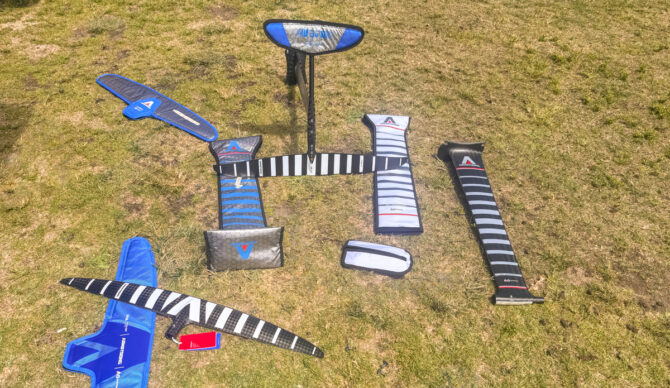
Swapping in the UHA 770, a foil I’ve since fallen in love with. Photo: Will Sileo//The Inertia
Honorable Mention: UHA Foils
The UHA foils from Armstrong aren’t new – they dropped in January 2026 – but they deserve a mention here as well since I’ve been using them throughout this testing. The pitch is accessible, fun, high-efficiency riding, and they deliver on that in a way that a lot of high-aspect foils don’t. Fast and efficient usually means sacrificing low-end and forgiving roll. The UHA throws that tradeoff out the window. And when you get the foil underfoot, there’s no doubt that Armstrong has cooked up something special here – despite all that glide and aspect ratio, the foil is an absolute joy to turn, with a loose, predictable roll that preserves a surfy feel when up and riding.
The incredible low-end is not to be understated either. For all-around parawing sessions, I typically prefer foils in the 800-900cm² range. The Code 850 remains one of my favorites. But on the UHA, I’ve been riding the 770 almost exclusively, and the low-end lift makes that smaller size work in conditions where I’d normally be reaching for something bigger. That’s a meaningful difference in how the gear behaves, not just a spec sheet improvement. True racers may reach for something a tad faster, but for accessible high-aspect glide, this foil is tough to beat.

Surfy and stable, the Midlength MkII takes parawing boards to the next level. Photo: Will Sileo//The Inertia
Bottom Line
What’s interesting about these releases isn’t just the individual products – it’s what they signal about where foiling is heading. Skinnier masts. Boards optimized for parawinging. New proprietary materials making Aluula look like ancient technology. Armstrong has been pushing the leading edge of performance foiling for years, and this batch of releases keeps them firmly at the front of the pack. The gear is good, and the trends it represents are worth paying attention to.

